Till Death Us Do Part: Sarah LeFanu and Michèle Roberts

The bond between this month’s profiled writers was forged when Mary Russell Mitford took the younger Elizabeth Barrett Browning under her wing. It’s a great privilege therefore to feature a guest post with the novelist Michèle Roberts, who has been a mentor to both of us. Here she talks with fellow author Sarah LeFanu about their longstanding friendship.


Sarah: I met Michèle in London in the summer of 1972. I saw her as a warm-hearted woman warrior, a bold feminist, a dragon-slayer. I was a student, with a holiday job as a waitress at a rather dodgy restaurant called Borscht’n’Tears. Michèle, two or three years older than me, had a proper grown-up job at the British Library. Whereas I had timidly attended a couple of student meetings about women’s liberation, held safely inside college doors, Michèle belonged to a group of women who braved ridicule and abuse to perform feminist street theatre.

Michèle: I remember arriving home late one night to find Sarah returned from work, sitting outside on the little balcony eating sausages and drinking cider. She seemed dashing, merry, insouciant, completely able to enjoy herself in the present moment. Very pretty, too, with her delicate face and curly auburn hair.

Sarah: We were thrown together by the spectacular disintegration of the relationship between a couple who lived in the flat that we were both staying in; to get away from the rows and recriminations we would creep out onto the balcony above the front door of the terraced house, and in the warm summer evenings we would sit and talk: about women’s liberation, socialism, books, boyfriends and all points in between. What began as an escape from what was going on behind us, soon acquired its own life.

Michèle: I remember watching Sarah pack her bag for her summer holiday. She wanted to travel light, but on the other hand she wanted to take plenty of books. I was impressed that she threw out clothes to make room for books. As I got to know her better, my sense was confirmed that she really enjoyed a good time: physical and intellectual pleasures both. For example, we would don our 1950s frocks then bicycle back and forth across London, going to parties and dancing most of the night. At the same time we took part in a Marxist study group with other friends, and we founded our own group of two to read Freud.

Sarah: We carried on these discussions by correspondence when I went off to work in Mozambique for two years. We shared a desire to understand the world and, of course, to change it.

In the early 80s, while Michèle was making a name for herself as a novelist and poet, I was working in publishing, at The Women’s Press. We published her first two novels, A Piece of the Night and The Visitation. In the 90s we began teaching together for Ty Newydd and Arvon. And for nearly fifteen years now we’ve worked together in a writers’ group, along with novelist Jenny Newman (we call ourselves the Group of Three).

All of which is to say that our friendship is centrally concerned with work and writing and reading.

Or perhaps I should say the work of writing and reading.

Or perhaps I should say: the pleasure of it. Right from the early days we’ve done the reading and talking and writing alongside eating, drinking and partying.

Michèle Roberts (left) and Sarah LeFanu (right) at Sissinghurst in 1981.

Michèle: Sarah and I grew up in an era still overshadowed by Victorian notions of the respectable: teenage girls could go out and have fun but adult women, even if they had jobs, were supposed to make staying at home serving husbands and children their priority. It was radical in those days to assert openly that you were linked to other women, across the bonds of families and marriages, and that when you wanted or needed to you put women first.

Men had higher status. They valued each other highly and us far less. They did not believe we could be true friends with each other, if they even bothered to think about it, as they thought all women competed for male sexual favours.

Men dominated the literary scene, edited the journals, wrote memoirs about each other, created the literary canon, went out to meet each other at night in clubs and pubs, wanted ‘their’ women safely at home giving the children their tea.
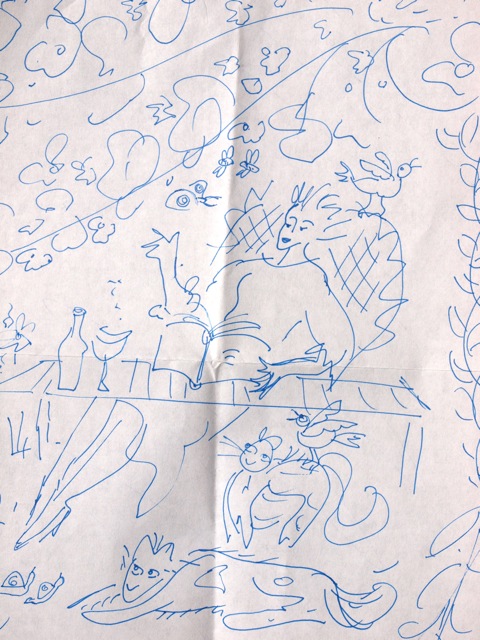
Sketch by Michele Roberts. Many of Michele's sketches 'of women having a nice time' are pinned up in Sarah's study. They enrich her life 'during good times, bad times and challenging times'.
Sketch by Michele Roberts. Many of Michele’s sketches ‘of women having a nice time’ are pinned up in Sarah’s study. They enrich her life ‘during good times, bad times and challenging times’.

Sarah: While I was struggling to write my first book, In the Chinks of the World Machine: Feminism and Science Fiction, Michèle gave me a whole afternoon a week of childcare – a blessed stretch of time – and later, on occasions when I was overwhelmed by domestic drudgery, she would think up ways and means of providing me with periods of release.

Michèle: I remember when Sarah got married vowing to myself that I would do my best not to be jealous or possessive, which would have been easy for me to do given how much I loved her. I got to know her husband and got to be fond of him. I was her witness at her wedding (as she was at mine) and she invited me to be godmother to her children. I love and feel close to them. So she helped me go on feeling close to her, feeling I still had a place with her, even though her life had changed so much, having three children and caring for them. She invited me to become involved.

Sarah: Male literary friendships have always been more visible. Men have always felt more entitled to inhabit public spaces – from the 18th century coffee shop to the Soho bars of the 1950s. The romantic idea of a literary friendship is that of two lonely (male) geniuses recognising each other as geniuses and then performing their friendship in front of a star-struck public. But male domination of public space has been, and is being challenged (by feminists then and now), so things are changing.

Michèle: The women’s movement helped to change that. Nowadays the male writers I know and am fond of acknowledge the power of women’s friendships. We know more than we used to about women’s friendships because for the last thirty or so years women have been writing about them, asserting their value and importance and exploring their meaning.

Those books got published because feminist women were working as editors and publishers, commissioning books, championing women writers. So my friendship with Sarah is connected to that history, those politics.

Feminists thought of each other as sisters, we valued each other, tried to listen to each other, tried hard not to obey the patriarchal rule which said that men always had to come first, we lived a public life of going out with each other, not confined to the home.

Sarah: At the same time, I’m going to make a claim for privacy, and the intimacy it allows. It’s more than forty years since Michèle and I met and talked on a balcony in Pimlico, when we cast ourselves off from the noisy goings-on behind us and floated high above the dusty summer streets of London. The intimacy of sailing with Michèle in that stone boat has remained for me an important and nurturing aspect of our long friendship.

Michèle: The Italian expression is: ti voglio bene. I feel Sarah and I wish each other well, at a profound level. Till death us do part.

Sarah LeFanu’s latest books are: Dreaming of Rose: A Biographer’s Journal, published by SilverWood and S is for Samora: A Lexical Biography of Samora Machel and the Mozambican Dream, published by Hurst & Co.

Michèle Robert’s latest novel, Ignorance, was published by Bloomsbury. You can read more about her friendships and her feminism in her memoir, Paper Houses, published by Virago.

Cruelty and Consolation – Katherine Mansfield and Virginia Woolf

Last week, Emily posted a video in which she spoke about the role of consolation (and neglect) in the friendship of George Eliot and Harriet Beecher Stowe.

In my video, I’ve chosen to reflect on the dynamic between kindness and cruelty in the relationship between Katherine Mansfield and Virginia Woolf.

These are topics we’ll be returning to in greater detail during our lunchtime lecture on December 3rd at New York University – London. We’ll provide more details nearer the time but we do hope that some of you can make it.

Frances Burney and Hester Thrale

When Emily met John Mullan at the Bloomsbury Institute, he suggested that we investigate the friendship between Frances Burney and Hester Thrale. We soon discovered a story full of intrigue and betrayal.

On a summer’s evening in 1778, Frances Burney’s father took her to Hester Thrale’s literary salon at Streatham Park. The grand occasion would have been intimidating indeed for the shy twenty-six-year-old writer, whose identity had only recently been revealed.

Burney had penned her novel, Evelina, at the dead of night and then audaciously published it anonymously without her parents’ consent. When her music-teacher father finally discovered its authorship, however, he astounded his daughter by not only giving his blessing but fizzing with such pride that he divulged the secret to his friend and employer, Hester Thrale.

A painting of Hester Thrale in 1771 by John Singleton Copley [Public domain], via Wikimedia Commons
London’s literati flocked to Thrale’s gatherings, attracted by the thirty-nine-year-old hostess’s wealth, ebullience, arrogance and wit. Thrale was delighted to introduce her friends to the mysterious author of the novel that was causing such a stir.

Thrale had literary ambitions of her own. She would go on to write a popular history book that failed to win over critics of the day but is now considered a radical pre-cursor to feminism, and she was a consummate memoirist, letter-writer and diarist. Perhaps envy soured Thrale’s pen that summer’s night in 1778 when she jotted in her journal that Burney’s ‘Conversation would be more pleasing if She thought less of herself’. Or perhaps fame really had gone to the young author’s head for a while. Either way, Thrale did admit that Burney’s ‘Merit cannot as a Writer be controverted’.

Despite Thrale’s mixed first impressions, she nonetheless welcomed Burney into her home, inviting her first for a weeklong visit and later for several months on end. Over the next six years, the pair forged an intense bond cemented by their shared wit and storytelling flair.

‘Irresistible Burney!’ Thrale wrote in one of her daily letters: ‘and who was ever like you for warm affection, cool Prudence, and steady Friendship!’ But this same ‘cool Prudence’, which Thrale once so admired, ended up causing a great rift between the two authors.

During her husband’s final illness, Thrale confessed to Burney her growing tenderness towards one of the musicians she employed: an impoverished Italian singer called Gabriel Mario Piozzi. Thrale felt determined that, after the death of her spouse, she would finally secure a love match.

Although Burney’s own father was a music teacher from a similar social milieu to Piozzi, she was horrified by the thought of her friend marrying a Catholic foreigner of lower social rank, and by what she saw as the emotional and financial abandonment of Thrale’s children. ‘Think a little’, Burney pleaded. ‘The mother of 5 children, 3 of them as Tall as herself, will never be forgiven for shewing so great an ascendance of passion over Reason’.

Thrale married Piozzi in 1784. From then on, Burney’s letters went unanswered and she was no longer welcome at the home of her former friend.

Frances Burney circa. 1784 painted by Edward Francisco Burney (1760-1848) [Public domain], via Wikimedia Commons
During the next thirty years and more, Burney ‘made every possible overture’ of friendship but Thrale, now Signora Piozzi, could no longer trust the woman she referred to as ‘l’aimable Traitesse’. But her name did continue to appear on the subscription list for Burney’s novels, as, indeed, did that of the young Jane Austen – an ardent fan.

Burney’s persistence may well have been motivated by an increased empathy with her former friend’s predicament. At the age of forty-one, Burney defied her father by marrying a penniless French Catholic and becoming known as Madame D’Arblay.

In 1817, Burney, now sixty-six, dared to call in on the seventy-five-year-old Thrale. ‘At the sound of my name’, Burney wrote immediately afterwards, ‘she came hastily from her Boudoir to receive me in the grand sallon’. But Thrale, suffering from asthma, was so embarrassed and agitated that she could not utter a single word.

Once she recovered, they sat together on a sofa and entered into a political debate. Though spirited, their conversation lacked the affection of old. And yet, they talked on as night fell, quite forgetting about dinner. When Burney finally realised the time and made to leave, Thrale affectionately thanked her for calling in. ‘Much surprised, & instantly touched,’ wrote Burney, ‘I turned back, & held out my hand. She gave me hers, & each hand again pressed the other’. And this late-life reconciliation endured.

Activity

Burney and Thrale often surprised each other. This month, we’ll take the opportunity to reflect on the unexpected things we have learnt while working together on Something Rhymed.

Elizabeth Bishop and Marianne Moore

Elizabeth Bishop was in dire need of maternal affection. At five years old, she’d witnessed her own mother committed to an asylum: the last glimpse Bishop ever got of her.

In the mid-1930s, as a shy, bushy-haired student at the all-women’s Vassar College in Poughkeepsie, New York, Bishop devoured many poems by the older modernist writer Marianne Moore. Later, she’d wonder whether she would ever have become a poet if it hadn’t been for reading the likes of ‘Marriage’ and ‘Peter’.

Elizabeth Bishop. Image used with kind permission from the Elizabeth Bishop Society.

Moore was perhaps ready to adopt a literary daughter. Her own mother rarely left her side, watching while she wrote or busying herself in the adjacent room, ready to cast her sharp editorial eye over each new poem. During the last three decades of Mrs Moore’s life, the pair even shared a bed.

Moore may have had a surfeit of maternal attention, but she could connect with Bishop’s parental loss. During Moore’s infancy, her father had cut off his right hand in a fit of delusion and had then been committed to an asylum. She could not recollect a single memory of him.

When Moore was approached by an old childhood friend, now the librarian at Vassar College, she reluctantly agreed to meeting the twenty-three-year-old Bishop. The young woman rushed from Grand Central Station, relieved to have just about made it on time to their meeting place beneath the imposing lion statues that flank the New York Public Library. Moore, who wore two wrist watches, was already waiting for her. She cut a quaint old-fashioned figure, her rust-pink hair braided around her head, her man’s polo shirt two sizes too large.

Marianne Moore in 1935. Creative Commons License.

Despite Bishop’s nerves and Moore’s reservations, the pair hit it off immediately. The older writer soon placed her protégée’s work in an anthology, writing an insightful preface to the new poems. But there was always a familial aspect to their friendship as well as a literary connection: they would take trips to the circus and the cinema and to children’s talks at the Natural History Museum. And, however early Bishop showed up, she would always find Moore there ready and waiting.

Soon, Bishop was invited to the narrow over-crowded apartment that Moore shared with her mother in Brooklyn – the unlikely but popular meeting place for Moore’s coterie of fellow high-modernist friends, among them H.D., T.S. Eliot, Ezra Pound, Wallace Stevens and William Carlos Williams.

Elizabeth Bishop is standing on the right and Marianne Moore is sitting beside her. Other writers include the likes of W. H. Auden, Tennessee Williams and Gore Vidal. Image used with kind permission of the New York Times.

Unlike Moore and her mother – who impersonated each other to the extent that it was difficult to tell where one ended and the other began – Bishop retained her separate identity. Six years into their friendship, she sent her mentor her latest poem ‘Roosters’. Moore and her mother objected to what they considered Bishop’s vulgarity – particularly her reference to a ‘water-closet’! Staying up until the early hours of the morning, the mother-daughter duo rewrote the younger woman’s poem, removing everything that had affronted them. Although Bishop incorporated some of the changes, she retained her lavatorial images. And the friendship survived undented.

Activity:

In her old age, Moore soared to an extraordinary level of superstardom: appearing on the Tonight Show, featured on the cover of Esquire, inundated by fans who showed up at her door. But in her memoir of her friend, Bishop lovingly recalls how the elderly Moore continued to attend creative writing classes as a student (sometimes to the tutor’s horror!) and even enrolled in a dance school, where she learnt to tango.

This month, we will follow in Moore’s footsteps by embracing lifelong learning.

Cocktails and Candour

London buzzed with a carnival energy on the night Emily and I met for cocktails at the Hotel Café Royal. It was the evening before the Easter weekend and Piccadilly Circus milled with people who had just arrived or were just about to depart, almost everyone wheeling cases or carrying backpacks or cradling cones of spring flowers.

Something Rhymed’s April ‘challenge’ to follow in the footsteps of Agatha Christie and Dorothy L. Sayers provided the perfect excuse to embrace the city’s festive atmosphere. Surrounded by holidaymakers and all decked out in my cocktail dress, I took in afresh the grandeur of Regent Street – its buildings tall and white against the clear blue sky.

Inside the revolving doors of the Hotel Café Royal, I entered a marble lobby filled with tall vases of orchids, and the bustle of the street gave way to a hushed sense of glamour. It was easy to imagine Christie and Sayers, the Queens of Crime, meeting here with fellow members of the Detection Club, for their lavish club dinners.

The Café Royal, London (William Orpen, 1912). Creative Commons License.

Unlike the ‘shop talk’ that took up much of their usual meetings, the club’s spring and summer dinners focused more on celebration.

Now that Emily and I teach at the same university, co-write literary features and run Something Rhymed together, we have to remind ourselves to make time for purely socialising. But we long ago pledged to mark every writing success, however small. During the past few years this commitment to celebration has become more important still.

In the Green Bar, we toasted Something Rhymed over a pink champagne cocktail and a luridly blue martini, and we agreed just to chat for a while, putting off the task we’d set ourselves to compose our own set of literary rules.

We got on with that part of April’s activity in the distinctly less rarified surroundings of a Soho noodle joint, writing in between slugs of Asashi beer, and miraculously managing to avoid staining our dresses with broth.

This ramen shop brought to mind the early days of our friendship, when we both taught English in rural Japan, secretly writing in between classes. Looking back on the ways our friendship has developed since then, we realised that another unspoken ‘rule’ had developed over the years and that we had this to thank for the development of our collaboration: as well as committing ourselves to celebration we’ve also committed ourselves to candour.

Rules
Rules for Our Collaborative Work

I’ve learnt so much from Emily about the importance of honesty, and the courage it sometimes takes to speak the truth as we see it. This is not to say that we talk about all aspects of our lives: there remain subjects we keep to ourselves or are more likely to discuss with others. But whether we’re seeking advice on personal matters, critiquing each other’s fiction, dividing workloads, or thrashing out a line of enquiry in our collaborative writing, we always endeavour to speak our minds.

This fundamental tenet led us to formulate a few more specific rules. In terms of maintaining trust between each other, we’ll always be clear about which projects we’d like to work on together and which we’d prefer to tackle alone, and we’ve also agreed that we must never co-publish anything that we can’t both stand by. And in terms of establishing trust with our readers, we’ve promised always to acknowledge speculation.

In this way, we hope that our collaboration will thrive and, more importantly, that our friendship will endure for a lifetime.

Conversations Spoken and Unspoken

Creative Commons License

I would like to say that our love of literature drew Emily and I together, or perhaps our mutual feminist ideals. But, if my memory serves me correctly, our very earliest conversations revolved around men.

Before boarding our flight to Tokyo to take up posts as English teachers, I’d spotted Emily and a bloke making their goodbyes. Since I was leaving my boyfriend behind in the UK, I suspected that Emily and I might share the experience of attempting to sustain long-distance relationships.

During many late-night conversations in the months that followed, I discovered that we had, in fact, made the opposite decisions: my boyfriend and I planned to keep going whereas Emily’s relationship had already come to an end.

In an attempt to move on, Emily was generally rather reticent about the man she’d left behind. Having seen him from afar at the airport, however, and sensing that her feelings still ran deep, I was curious and so tended to ask about him. As we gradually opened up about these men back home, our own friendship began to grow.

Many of these early conversations occurred towards the end of parties when most of our English teacher friends would embark on games like truth-or-dare and spin-the-bottle. When drunken nights began to get raucous, Emily and I often ended up drifting outside. I was loyal to my boyfriend back home and uninterested in hooking up with someone new. And, although Emily was officially single, I suspect that this was partially true of her too. Indeed, the goodbye I witnessed at Heathrow turned out only to mark a brief pause: after she completed her two years in Japan, they took up where they left off and have remained together ever since.

But the more I’ve got to know Emily, the more I’ve realised that there was also another reason why she preferred to absent herself when talk turned dirty: Emily is incredibly discreet. Over the years, this is one of the traits I have grown to admire most in my friend.

In truth-or-dare type scenarios, I have been known to reveal things about my life that should have remained private. The next day, I’ve invariably woken up regretting it. I can’t think of a single occasion when I’ve ever seen Emily make such a mistake.

I am grateful to Emily for the conversations we shared in the dark of our friends’ empty backyards: the confidences we traded about love and loss, and soon enough about literature and feminism too. But I am just as grateful for the conversations she saved me from indulging in: the private moments that remained private because of her.


Mary Lamb and Dorothy Wordsworth

In our round-up of Something Rhymed’s first year, we promised this month to reveal a friendship between two female authors that has been neglected in favour of these women’s relationships with famous men.  

Mary Lamb (Creative Commons License)

Mary Lamb and Dorothy Wordsworth, great writers themselves, are most often remembered because of their intense attachments to their brothers, essayist Charles Lamb and Romantic poet William Wordsworth. Their own fascinating friendship, preserved in their intimate correspondence, barely scrapes a mention in most literary histories.

And yet, like the men in their circle, Mary and Dorothy also hiked up the mountains around Grasmere, exchanging their thoughts on the natural world and trading ideas on each other’s poems.

When Dorothy visited London, Mary would welcome her into the small Inner Temple flat where she lived with her brother, and the two women would stay up talking late into the night.

The pair both shunned marriage in favour of devotion to their sisterly roles. The night before William’s wedding, Dorothy wore the ring that he had purchased for his betrothed and, when she gave it to him the following morning, he slipped it back onto her finger before taking it to the church. Dorothy did not attend the ceremony.

Stories of the relationship between the Lamb siblings suggest similar hints of the illicit. Mary, who suffered throughout her life from severe attacks of mental illness, had tragically stabbed their mother to death during her first breakdown. Charles promised to take care of his sister, thereby preventing her from being sent to Bedlam. They upheld their mutual pledge never to marry, instead committing themselves to each other ‘for better, for worse’ as Charles put it; writing in collaboration; and caring for their adopted child.

The women’s fraternal relationships, which had drawn them together, later threatened to split them apart. One of Mary’s breakdowns – so severe that she spent several weeks in an asylum – occurred after an overnight visit from Dorothy.

Charles, who felt that his sister’s mental health was reliant on a good night’s sleep, blamed the women’s late-night conversations for the onset of her illness. He therefore banned Dorothy from staying with them in future and declined her offer to bring Mary up to the Lakes.

But as soon as Mary recovered, she wrote a cheerful letter to Dorothy and the pair continued their friendship despite the restrictions imposed by Mary’s kindly but overbearing brother.

Dorothy Wordsworth (Creative Commons License)

Both of them eventually outlived their beloved siblings. In her dotage, Dorothy also suffered a loss of mental health – although different in nature from Mary’s lifelong illness.

As Dorothy’s grip on the present loosened she became immersed in memories of her youth. She took to reciting poems from the early Grasmere days: poems by the men we’ve come to think of as the great Romantics, but also her poems and those of her friend – the female Romantics whose lives and works have for too long been consigned to the shadows.

Activity

Inspired by Mary Lamb and Dorothy Wordsworth, this month we will write about some of our own late-night conversations.

A Year of Hidden Friendships

When we first launched Something Rhymed, a year ago now, concerned well-wishers expressed scepticism about whether we’d discover twelve pairs of historic female writer friends to profile each month over the course of 2014.

Thanks to our close-knit community of readers from around the globe, the reverse has in fact been true. You’ve helped us to unearth many more female collaborations than we could possibly have envisaged at the beginning of the year. With such a treasure trove of hidden friendships still to explore, we intend to keep sharing our findings here in 2015.

Old treasure chest
Creative Commons License

The collaborations we’ve explored so far were sometimes illicit, scandalous and volatile; sometimes supportive, radical or inspiring. And so, we’ve increasingly found ourselves asking why they have been consigned to the shadows.

To mark the end of Something Rhymed’s first year, here are our top ten ideas on why the friendships between some of our most famous female writers still have a cloak of secrecy about them:

  1. Women writing in the past had more opportunities to converse in the parlour than in the pages of literary magazines.
  • For reasons of propriety, for example, Harriet Beecher Stowe felt that she could not write an obituary in the Atlantic for her long-time friend and confidante, George Eliot.
  1. The marked harmony and lifelong endurance of many of these writing partnerships cost them copy.
  • Charlotte Brontë and Elizabeth Gaskell bonded over their shared experience of infamy since they had both become mired in scandal for daring to pen biting social criticism. However, this enduring friendship often gets written off as a mere acquaintanceship. Could marked harmony also account for why so few of us have heard about the unlikely friendship between Ruth Rendell and Jeanette Winterson?
  1. Friendships between women are often neglected in favour of a female author’s intense or turbulent relationships with men.
  • On January 1st we will reveal an intimate friendship that fits into this category…
  1. The literary status of some of our writer heroines has suffered because their genre, style or subject matter was particularly associated with women.
  1. Some of the pairs shared an alliance so radical that others refused to believe that it could possibly have thrived.
  1. Other collaborations challenged core mythologies about female authors: the well-bred lady; the solitary eccentric; and the suffering genius.
  1. Popular perceptions of female friendship still struggle to allow for the kind of rivalry embraced by some of our writer forebears.
  1. Rumours of lesbian affairs sometimes actually seem easier for commentators to accommodate than the possibility of an intellectual partnership between women.
  1. Close friendships between girls might be all well and good but, after marriage, women have traditionally been expected to devote themselves primarily to their husband and offspring.
  1. Historically, female collaboration was considered subversive and therefore taboo.
  • And yet, the subversive nature of these friendships between women makes them powerful sources of transformation: Maya Angelou’s Nobel party for Toni Morrison, for instance, both celebrated the achievements of a fellow African American author and challenged their government’s failure to do so itself.

Working together on Something Rhymed this year, we have experienced some of the most jubilant moments in our own friendship (as well as some of the most fraught!). But, from Eliot and Stowe – who taught us the importance of candour – to Mansfield and Woolf – who showed us that rivalry can be a positive force – we are learning how to keep our own collaboration on course. And, with your support, we will continue to celebrate the secret sisterhood between our trailblazing forebears, finally bringing it centre stage.

From Literary Protégée to Competition Rival: our interview with Madeline Miller

We were drawn to the friendship between Nora Lefurgey and L. M. Montgomery because it endured despite marked differences in their literary standings: while Anne of Green Gables propelled Montgomery to international fame, Lefurgey’s novel gathered dust in the proverbial drawer.

Of course, the prospect of rivalry does not end when both friends are published. Then there are questions of sales and reviews and awards. We’d been intrigued, therefore, when it was announced that both debut novelist, Madeline Miller, and multi award-winning author, Ann Patchett, had been shortlisted for the 2012 Orange Prize since Madeline had previously been one of a Ann’s protégées.


Ann Patchett. Creative Commons License.

We met Madeline to ask her about the transition from literary mentorship to competition rivals.

Madeline explains that she had always been a great fan of the established author’s work, and that she counts Truth and Beauty, Ann’s memoir about her friendship with fellow writer Lucy Grealy, as one of her favourite books of all time.

Early in her career, Madeline had been thrilled to receive a glowing blurb from Ann for the publisher’s proof copy of her debut novel, The Song of Achilles. At this stage, Madeline had never met Ann, this novelist who had unexpectedly done her such a good turn. Evidently still touched by the older author’s generosity, she tells us about how they finally came face-to-face.

Fortuitously, Ann had been due to give a reading at Madeline’s local book store, and so Miller bought tickets, intending to introduce herself after the event. When, on the night, an audience member asked for a reading recommendation, Madeline was delighted to hear the celebrated author single out the forthcoming Song of Achilles for praise. She was even more surprised when Ann suddenly looked up, right into Madeline’s eyes, and introduced her to the crowd.

Ann proceeded to share the limelight with the younger author, who couldn’t fathom how she had been recognised. She jokes that she had been ready to put it down to Ann’s magical powers until her fiancé later confessed that he was the one to have pointed her out. ‘But she does have magical powers,’ Madeline laughs, ‘I stand by that!’

Ann’s kindness didn’t stop there. The pair struck up an email correspondence, and Ann generously shared the benefits of her own longer experience as a published author. Madeline is particularly grateful for Ann’s advice to steer clear of reviews, which give an exaggerated sense of both the positive and the negative, encouraging the writer to focus on the outward expressions of literary “success” rather than drawing on internal inspiration. Ann also shared her secret to a fulfilled writing life: There are times for writing and times for living, Madeline remembers Ann once saying, and one feeds the other.

The next time the pair met in person, it was on Ann’s instigation: she invited Madeline to read at Parnassus Books – the independent store that she co-owns in Nashville, Tennessee. It was there the two novelists discovered that they’d both made it onto the short list for the 2012 Orange Prize (now the Baileys Women’s Prize) – an award that recognises the work of female novelists.

It could have been a situation fraught with stress: although a game-changer for the debut author, Madeline now found herself pitted against her mentor.

But, instead, Ann, who had already won the prize back in 2002, took great pleasure in the opportunity this time to share the limelight with her protégée. When the date of the prize ceremony was announced, Ann realised that she couldn’t make it over to Britain at that time. She was glad that Madeline would be able to attend, and she even loaned her competitor one of her own outfits that she felt might be particularly suitable for the Orange Prize do: a beautiful dress of tangerine silk.

Madeline Miller wearing the dress she loaned from Ann Patchett.

When the judges revealed that they were awarding the prize to Madeline Miller for The Song of Achilles, the young writer keenly acknowledged her indebtedness to her mentor in her acceptance speech. ‘I got to go and help represent her book as well,’ she says.

The competition seems to have actually strengthened their relationship. In fact, Madeline tells us that Ann was not the only one eager to congratulate her. The award, she says, ‘fostered a sense of collegiality’ amongst all its female nominees.

The friendship of Lefurgey and Montgomery taught us that creative rivalry can be endured, while the example of Miller and Patchett shows that it can even be enjoyed.

A shorter version of this interview was originally included in our feature in Mslexia Issue 57. 

Maggie Gee and Salena Godden: the Innocence Under the Armour

A shared sense of a female literary tradition fired the epistolary alliance between this month’s profiled writers: the reserved George Eliot and the ebullient Harriet Beecher Stowe. And so we asked authors Maggie Gee and Salena Godden to tell us about their similarities and differences, and the role in their friendship of the written word.

Creative Commons License
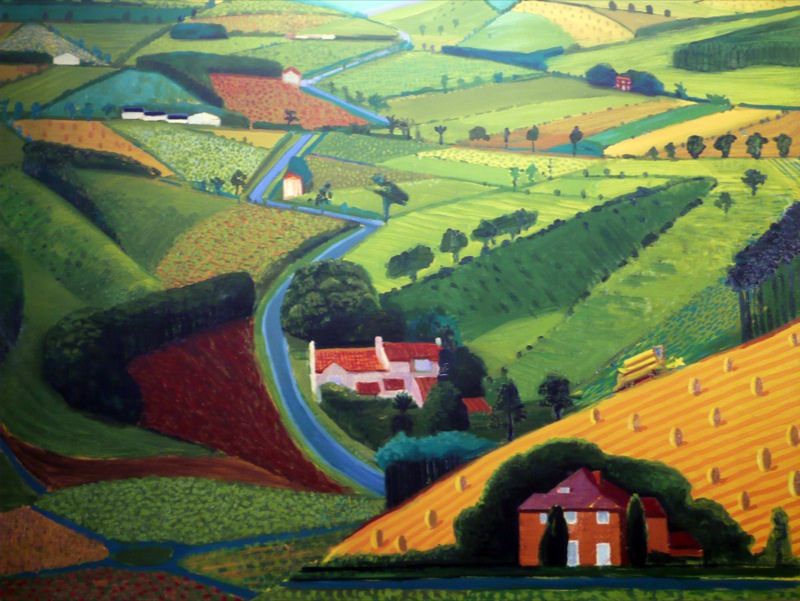
The Road Across the Wolds 1997, oil on canvas 48 x 60″ by David Hockney Creative Commons License

Maggie Gee

Maggie: When I first met Salena I found her lively and funny but also quite dauntingly and dazzlingly young – she’s a quarter of a century younger than me. When I heard her perform for the first time, reading a piece of short prose that was as much poetry as story, I really sat up. Wow – she could write – my memory of that piece is of a wide golden field: a sort of dizzy sweep of perspective; and realizing that she was unafraid to be lyrical about the world – a risk most writers won’t take in a culture where irony is king.

I think we share that innocent eye. I do satire but the presiding vision I have is love. I think that’s true of Salena too, in among the outrageous humour and belly laughs. And maybe we recognized that innocence in each other, though we each in our different ways have shells that prevent most people from seeing it. I knew Salena would like the radiant David Hockney Yorkshire landscape show at the Royal Academy in 2012: we went together (it was about the 9th time I had seen it actually!).

Salena Godden 3Salena: I’ll never forget that day we met and went to see that Hockney exhibition, in my memory it is a film. We had a sunny afternoon tea and shared ideas and gossip. Afterwards I remember walking all the way home, through Regents Park and up into Kentish Town, utterly inspired by the colours and the art, but mostly the company, the listening and the sharing and the fantastic conversations we had that afternoon.

I think we share a love of language, colour and light as much as we share a capacity to imagine the worst and the darkest of outcomes. I also think both of us have had to work (and still do work) bloody hard and have hardly ever taken no for an answer. I might be the naughty one or more hedonistic of the two of us, but there is nothing wilder than having an idea and digging your heels in, there is nothing braver than keeping on keeping on, especially when the chips are down or the odds are against you. I think we share an old fashioned sense of fair play, a willingness to fight your corner and a mischief – these are some of the things I’d say we share. If we had gone to the same school I would have probably nicked sweets and pens from Woolworths to give to Maggie to woo her to be my friend and tell me all about writing. 

Maggie Gee

Maggie: How are we different? Well, my father stuck around and gave me different problems to Salena, whose father left. I had more formal educational chances, and she has had more crazy fun. She sang, for heaven’s sake, and had two bands (at least), and ran cool things like The Book Club Boutique! What did I get: degrees. Oh, and she still writes, performs and publishes poetry, whereas my early drive to write poems compressed itself into prose. She’s a fine, bitter-sweet poet – I wish I had written her new collection, Fishing in the Aftermath: it’s intimate and wild and tender, but the words are worked and reworked like a Toledo blade.

Salena Godden 3Salena: My first impression of Maggie was of a sensation of being drawn into her fantastic inquisitive mind, what I mean is, she asks the most interesting questions of her surroundings and coerces people into revealing their mysteries. It is important to question and notice the tiny details in things, but these moments seem to spring golden when you are talking with Maggie.

When we first met back in 2002, I felt I was a rough boozy ruffian next to her, I was in awe. I could tell right away that Maggie was quick and smart, she uses language beautifully, there’s a magnetic pull and a magic in Maggie, she’s a bold heart and a true believer.

Maggie Gee

Maggie: I think we really like each other’s work. I read an early draft of Springfield Road, her brilliant memoir, which has just come out this summer. I was so pleased when she asked me to introduce her at the launch.

Salena Godden 3Salena: I took Springfield Road to Maggie feeling that I could trust her with it. My confidence was pretty shaken at the time, but I knew Maggie would ‘get it’ after I finished reading her beautiful and vivid memoir My Animal Life. Memoir is another kind of writing, you have no armour: you just have your truth and your ghosts.

Maggie Gee

Maggie: We both had problems with the same very big, mainstream publisher. Maybe my cynical view of how big publishers operate was helpful (my being lyrical about human life does not preclude being pretty cynical about most commercial publishing): and I could tell her, hand on heart, that I thought Springfield Road was a stunning piece of writing just as it was.

Salena Godden 3Salena: It was Maggie’s letters and words of encouragement that gave me the confidence I needed to persevere. Then I met John Mitchinson and Rachael Kerr who signed me on the Unbound label and together we all successfully crowd funded Springfield Road. My memoir would still be in a box under my bed if it weren’t for Maggie.

Maggie Gee

Maggie: Looking at the other side of the coin, Salena gave me a shot of new creative life by inviting me into a world of young writers and artists that I loved and felt happy in. Also, when I recently got a slightly demented Guardian review, Salena was the first to tweet in support.

Salena Godden 3Salena: As for that review, it missed the point, the romance, beauty and comedy in the book. I loved the concept of Virginia Woolf In Manhattan. I ate it all up, loving every imaginative word and page, it made me laugh and cry out loud. I mean imagine getting drunk with Virginia Woolf, what a wicked and wonderful dream that is…

Maggie Gee

Maggie: At significant moments in life, I have received wonderful long emails from Salena that are full of the texture of her days. They probably took a few seconds to write, read as naturally as breathing and are cousins of her confessional poems. Then I’ll write back in a kind of mirror writing. I notice my emails always reflect the style of the email that comes to me. Yes, Salena’s a very stylish lady, as well as a sweet one.

Salena Godden 3Salena: Maggie’s letters are a light beaming out of my inbox. She is a true comrade. It’s a funny old game writing, as you know, it is a lonely and competitive sport. Maggie has been so generous. I don’t know what I would have done without her this past decade or so. Some people bring out the best in you, they make you want to do good and aim high and dream bigger and Maggie Gee is that person to me.

Maggie Gee’s latest novel, Virginia Woolf In Manhattan, was published by Telegram Books.

Salena Godden’s latest book is a memoir, Springfield Road, published by Unbound. Her monthly event, The Book Club Boutique, will be launching its new residency at Vout-O-Reenee’s with a Burning Eye Books party on November 5th.