In the Hands of Chance?

Image by Angela Monika Arnold (Creative Commons licence)

A chance meeting in the ladies’ lavatory at a wedding marked the start of the friendship between last week’s guest interviewees, Polly Coles and Liz Jensen.

This got us thinking about some of the other unplanned first encounters of writers we’ve featured on Something Rhymed.

Susan Barker and Rima Haque, for instance – saw their paths collide back in 1999 at the Statue of Liberty, where they both had summer jobs. Rachel Connor and Antonia Honeywell formed an immediate connection when they happened to be paired as students in advance of their first MA Novel Writing workshop at Manchester University.

Of the monthly profiled writers, some like Charlotte Brontë and Elizabeth Gaskell and Harriet Beecher Stowe and George Eliot knew of each other by reputation before they met. Diana Athill formed a connection with Jean Rhys through her job as an editor at André Deutsch, and the friendship between Maya Angelou and Toni Morrison really blossomed when they both found themselves appearing at the Hay Festival in Wales.

But others, especially those who met early on in their literary careers, got to know each other under circumstances largely governed by happy twists of coincidence.

What would have happened if Vera Brittain and Winifred Holtby hadn’t each passed their university entrance exams and found themselves at the same Oxford college? Or if the teacher’s job in L.M. Montgomery’s hometown on Prince Edward Island had been given to someone other than Nora Lefurgey? Or Anne Sharp hadn’t gone to work as a governess with Jane Austen’s family?

Some might say that, with such similar political views and overlapping fields of work, Brittain and Holtby would likely have met eventually, but one can more easily imagine a life in which Austen had to manage without Sharp’s friendship, and Montgomery never found a kindred spirit in Lefurgey.

And since both Brittain and Holtby were always keen to credit the other for the role they had played in shaping their own success, this raises the question as to whether each woman’s life might have run a quite different course without the help of her valued friend.

Unlike the vast majority of our monthly guest bloggers and featured authors, who were already well on their way with their writing careers by the time they became acquainted, regular readers of Something Rhymed will know that when Emma Claire and I met neither of us had published a single article or story.

In fact, we had been scribbling in secret up until then, and hadn’t had the courage to share our ambitions to write with anyone else.

It’s nice to think that, having so many things in common, we would have found each other, perhaps on-line, eventually – an advantage female writers of today have over those in Montgomery or Austen’s times.

But it’s far nicer to be able to recall the fact that we’ve been there for each other through all the ups and downs of our writing journeys, and to think that, as Brittain once said about Holtby: ‘although we didn’t exactly grow up together, we grew mature together, and that is the next best thing’.

A Year of Hidden Friendships

When we first launched Something Rhymed, a year ago now, concerned well-wishers expressed scepticism about whether we’d discover twelve pairs of historic female writer friends to profile each month over the course of 2014.

Thanks to our close-knit community of readers from around the globe, the reverse has in fact been true. You’ve helped us to unearth many more female collaborations than we could possibly have envisaged at the beginning of the year. With such a treasure trove of hidden friendships still to explore, we intend to keep sharing our findings here in 2015.

Old treasure chest
Creative Commons License

The collaborations we’ve explored so far were sometimes illicit, scandalous and volatile; sometimes supportive, radical or inspiring. And so, we’ve increasingly found ourselves asking why they have been consigned to the shadows.

To mark the end of Something Rhymed’s first year, here are our top ten ideas on why the friendships between some of our most famous female writers still have a cloak of secrecy about them:

  1. Women writing in the past had more opportunities to converse in the parlour than in the pages of literary magazines.
  • For reasons of propriety, for example, Harriet Beecher Stowe felt that she could not write an obituary in the Atlantic for her long-time friend and confidante, George Eliot.
  1. The marked harmony and lifelong endurance of many of these writing partnerships cost them copy.
  • Charlotte Brontë and Elizabeth Gaskell bonded over their shared experience of infamy since they had both become mired in scandal for daring to pen biting social criticism. However, this enduring friendship often gets written off as a mere acquaintanceship. Could marked harmony also account for why so few of us have heard about the unlikely friendship between Ruth Rendell and Jeanette Winterson?
  1. Friendships between women are often neglected in favour of a female author’s intense or turbulent relationships with men.
  • On January 1st we will reveal an intimate friendship that fits into this category…
  1. The literary status of some of our writer heroines has suffered because their genre, style or subject matter was particularly associated with women.
  1. Some of the pairs shared an alliance so radical that others refused to believe that it could possibly have thrived.
  1. Other collaborations challenged core mythologies about female authors: the well-bred lady; the solitary eccentric; and the suffering genius.
  1. Popular perceptions of female friendship still struggle to allow for the kind of rivalry embraced by some of our writer forebears.
  1. Rumours of lesbian affairs sometimes actually seem easier for commentators to accommodate than the possibility of an intellectual partnership between women.
  1. Close friendships between girls might be all well and good but, after marriage, women have traditionally been expected to devote themselves primarily to their husband and offspring.
  1. Historically, female collaboration was considered subversive and therefore taboo.
  • And yet, the subversive nature of these friendships between women makes them powerful sources of transformation: Maya Angelou’s Nobel party for Toni Morrison, for instance, both celebrated the achievements of a fellow African American author and challenged their government’s failure to do so itself.

Working together on Something Rhymed this year, we have experienced some of the most jubilant moments in our own friendship (as well as some of the most fraught!). But, from Eliot and Stowe – who taught us the importance of candour – to Mansfield and Woolf – who showed us that rivalry can be a positive force – we are learning how to keep our own collaboration on course. And, with your support, we will continue to celebrate the secret sisterhood between our trailblazing forebears, finally bringing it centre stage.

In Praise of the Spinster

When we decided on this month’s challenge, I knew straight away which of our profiled authors I would like to raise from the dead.

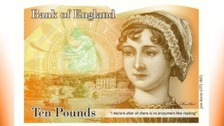
Even Jane Austen couldn’t sway me from beyond the grave, although it was a Wordsworth £1 classic edition of Emma that, as a young teenager, initiated me into the world of female authorship. I don’t need to conjure up Austen’s ghost to enjoy her dry humour, and her face – with which everyone in Britain will become intimately acquainted once the new £10 banknote is issued – was recorded for posterity by her sister Cassandra.

Creative Commons license.

Although Austen’s family destroyed much of her correspondence, the writer with whom I would love to make contact is far more of an enigma: all her literary works have been lost and her portrait was likely never painted.

Anne Sharp, the amateur playwright so valued by Austen, has been silenced for centuries. The intelligent, spirited voice of this governess in the employment of the Austen family has survived only in snippets. But when she does speak up across the ages, for example in Austen’s records of Sharp’s feedback, her astute critical faculties make us sit up and take note: here was someone who read with sensitivity and, despite the mighty class divide, felt at liberty to express her thoughts.

Perhaps it was this outspokenness that led Austen’s nephew to describe Sharp as ‘horridly affected but rather amusing’ – a phrase that brings to mind a neighbour’s portrayal of Austen as the ‘silliest, most affected husband-hunting butterfly’.

Like Austen, Sharp never did wed although marriage would have been the surest path to financial security. Unsurprisingly, little was recorded of Sharp’s romantic history. But we do know that her famous friend turned down a proposal from a wealthy man, and engaged in at least two other romantic liaisons. Yet the pernicious myth persists that Austen was too plain to attract suitors.

I once dragged a new squeeze to see the original portrait of Austen during a first date at the National Portrait Gallery. We failed to find anything unattractive in her appearance and I couldn’t help but feel that her alleged plainness would never have caught on had she not remained single. Cassandra actually described Austen as ‘triumphing over the married women of her acquaintance, and rejoicing in her own freedom’ – an image that complicates the prevailing notion of her romantic suffering.

Talking about Jane Austen and Anne Sharp at this year's Ilkley Literature Festival
We talked about Jane Austen and Anne Sharp at this year’s Ilkley Literature Festival

While Sharp’s single lifestyle would also have afforded her certain freedoms, it must have been a hard slog too – much more so than for Austen, whose only household responsibility was the preparation of tea and toast. After years of earning her crust as a governess for various wealthy families, she managed to set up her own boarding school in Everton. She spent the rest of her days in this area, living in York Terrace – a relatively prosperous street with views across the River Mersey to my hometown of Birkenhead.

I would love to learn from this working woman how she managed to do so well from such humble beginnings, and whether she ever considered giving up her independence and her toil for the perhaps easier option of marriage.

Perhaps my subconscious had been trying to tell me something when I dragged that poor date to view the painting of Austen: it was, in part, her independence that allowed her to pen those much-loved novels warning against ill-judged marriages. And it is her friend Anne Sharp – whose portrait I will never see – whose example reminds me that it was possible, even then, for a woman to make her way, ‘rejoicing in her own freedom’.


The Stuff of Legend

It was a question that prompted us to launch Something Rhymed, a question that eluded easy answers: why have so many female writer friends, unlike their male counterparts, failed to make legends of each other?

We wondered whether women had traditionally conducted their relationships privately while men had more opportunities to promote each other in public. Coleridge, for instance, had the freedom to up sticks to the Lakes where he could collaborate with Wordsworth on the Lyrical Ballads. At around the same time, Jane Austen’s abode was entirely at the whim of her family and she still felt she had to publish anonymously.

However, closer investigation showed us that women too have long been attempting to make legends of each other. After all, Charlotte Brontë travelled cross country to stay with Elizabeth Gaskell (a pair we’re sure to profile since so many of you have suggested them), and after Brontë’s early death Gaskell published the first biography of her friend.

This month’s pair, Vera Brittain and Winifred Holtby, emerged very much from this trailblazing tradition, embracing mutual publicity from the start: debating at the Oxford Union, campaigning for their shared social and political causes, publishing prolific amounts of journalism. Indeed, the pair became so entangled in people’s minds that Winifred Holtby was once introduced at a meeting as ‘Miss Vera Holtby’! It is fitting, therefore, that after Holtby’s early death, Brittain edited and promoted her friend’s final novel and then memorialised their relationship in Testament of Friendship.

Question Mark

We took rather longer to expose our friendship to public scrutiny. For the first decade since our initial meeting, we critiqued each other’s work in the privacy of our own homes, and we published entirely separately. But ever since The Times commissioned us to write about female writing friendship, we’ve become far less publicity shy, looking to Brittain and Holtby as our role models.

Our attempts to follow in their footsteps has brought us many unexpected and joyful connections, from drinking Prosecco in Kiliney Castle with writer pals Anne Enright and Lia Mills to gaining our first hits on this site from Korea and Kyrgyzstan. The generous coverage Something Rhymed has received from Slightly Bookist and Women Writers, Women, Books has resulted in particularly strong contingents of blog followers from Canada and the USA, and tweets from the likes of the New York Public Library. Just recently, we received some especially interesting suggestions from our new North American friends, who alerted us to the epistolary relationship between George Eliot and Harriet Beecher Stowe, as well as the friendship that A.S. Byatt managed to forge with her literary heroine, Iris Murdoch.

Murdoch also came up on the back of a connection we’ve forged closer to home. When the Yorkshire Post picked up on Holtby’s (and Emily’s) Yorkshire connections, one of their reader’s got in touch to tell us about Murdoch and the philosopher Philippa Foot, whose extraordinary friendship eventually survived a sexual interlude and even a massive bust-up.

Mercifully, our friendship has not only survived but thrived since we made the decision to follow the example of Brittain and Holtby. But our investigation into female writers and publicity has not yet produced an answer to our initial question. Instead, the question itself has changed. So now we’ve begun to ask ourselves this: why do women’s attempts to make legends of each other tend to get written out of literary lore?

Celebrating Each Other’s Successes

NotebooksUnlike Maya Angelou and Toni Morrison, or Katherine Mansfield and Virginia Woolf, there was a huge disparity in the worldly successes of this month’s featured writers.

Although Anne Sharp wrote plays for her students to perform, and was able to use her sharp critiquing skills to give Jane Austen advice on her work, she has gone down in history as little more than a footnote in the life story of her illustrious friend.

We cannot know whether Sharp ever felt envious of Austen’s achievements, and the fact that her work had the chance to reach an audience far wider than her immediate social circle. Neither would we go as far as speculating that she could have been another Austen-in-the-making if life had dealt her a different hand of cards.

It is interesting to wonder, though, whether the governess might have attempted to pursue any similar ambitions if her family and financial circumstances had been different.

What we do know is that, despite their contrasting levels of commercial success, each woman rated the other. Sharp celebrated the publication of Austen’s novels along with her, but was also ready to tell her friend when she felt there was a flaw in the work – advice that Austen appears to have highly valued.

It’s nice to imagine that her decision to rename her novel First Impressions as Pride and Prejudice was her way of acknowledging in print the crucial support she’d received from Sharp.

It’s a notion that might mean something to last week’s guest bloggers. Antonia Honeywell and Rachel Connor discussed the pride they take, not just in each other’s creative output, but their long-running writing friendship too.

Antonia’s comment on the publication of Rachel’s first novel (ahead of her own book deal with Weidenfeld and Nicholson) was one that really struck home with us. ‘It felt like a great triumph not only for Rachel,’ she recalled, ‘but for the dedication with which we both carved out the time for our regular exchanges of work.’

As we’ve mentioned before on Something Rhymed, our own career trajectories have gone along roughly in tandem so far, but there is bound to be a point when – if only temporarily – one of us will accelerate past the other.

When that happens, we hope we can learn from the example of Antonia and Rachel, and Austen and Sharp too – that we will be able to enjoy this joint success for our writing friendship, rather than focusing on any perceived gulf that divides us as individuals.

Other news

We’re currently enjoying the BBC Radio 4 series Five Hundred Years of Friendship – episodes available to listen to on-line.

We’ll be moving on to the next profiled writers on Tuesday. We were advised to look into the friendship of Vera Brittain and Winifred Holtby by many of our readers, so we particularly look forward to sharing what we’ve discovered about them.

We’re still actively researching female writer pals, so do keep letting us know, by leaving a reply or Tweeting one of us, if there is any particular friendship you’d like to see profiled.

Jane Austen and Anne Sharp

emma-anne-sharp1
The presentation copies of Emma that Jane Austen sent to Anne Sharp (image used with kind permission from Bonhams)

When we realised that we knew all about the great male literary friendships but little of their female counterparts, we both immediately wondered whether Jane Austen had a writer friend. But since so little is known of her life, we weren’t confident of discovering much.

However, after a bit of sleuthing, we found out that Austen did have ‘an excellent kind friend’. What’s more, this support came from an unexpected source: her niece’s governess, Anne Sharp.

This name will be familiar to those of you who’ve been following Radio 4’s 15 Minute Drama, The Mysterious Death of Jane Austen. You might not be aware, however, that Sharp was herself a writer.

Austen was attracted to Sharp’s keen intelligence and wit, combined with independence of spirit – sensibilities that transcended class lines. But Sharp lived an even more financially precarious existence than Austen – something Austen worried about on her friend’s behalf. Rehearsing the match-making role of her heroine, Emma, she dreamt that Sharp might marry a wealthy employer.

Like Austen, though, Sharp never did wed. The demands of fulltime teaching prevented her from pursuing writing professionally. However, she did get to flex her literary muscles by writing plays for her pupils to perform. Austen herself likely acted in one such play (interestingly, cast in the role of governess), and Sharp was known to pen male roles for herself.

Fascinatingly, one of her theatricals was entitled Pride Punished or Innocence Rewarded. Several years later, Austen decided to change the title of one of her novels from First Impressions to Pride and Prejudice, and it’s hard to imagine that she hadn’t been influenced by the work of her friend.

She certainly valued Sharp’s critical faculties, electing her as the only friend to whom she sent one of her precious presentation copies of Emma. The candour with which Sharp answered her request for a critique shows the level of trust between these two writer friends. Sharp pointed out a flaw in one of the sub-plots, ultimately rating this latest novel somewhere between Pride and Prejudice and Mansfield Park.

After Austen’s early death, her sister sent Sharp a lock of Austen’s hair, a pair of clasps, and a small bodkin as mementoes – mementoes of a radical friendship that refused to be bound by the constraints of class, or to be defined by divisions between the professional and the amateur; mementoes of an influential literary alliance, yet one that has been all but forgotten.

Activity

This month, we’re going to send each other a trinket accompanied by a note that explains why it should stand as a memento of our friendship. Like the gifts that Anne Sharp cherished, something as small as a hairclip or needle might be all it takes to bring back memories.

As usual, please also share with us any more female writing friendships that you’ve discovered.