Thinking Back Through Our Mothers

By coincidence, this month Emily and I both recommended authors who were deeply influenced by Charlotte Brontë.
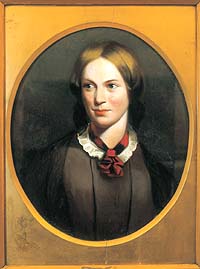
Portrait of Charlotte Brontë by J. H. Thompson  (Creative Commons License)
Portrait of Charlotte Brontë by J. H. Thompson
(Creative Commons License)

I will now treasure the copy of Jean Rhys’s After Leaving Mr MacKenzie, which Emily gave to me. Of course, Rhys’s most famous novel, Wide Sargasso Sea, which was inspired by Jane Eyre, imagines the first Mrs Rochester before she became consumed with madness and locked in the attic.

Rhys’s work, in turn, inspired Emily. She dedicated After Leaving Mr MacKenzie to me with the words: ‘When I first read this book, it changed the way I thought about writing forever’.

Just as Rhys’s descriptions of dingy hotel rooms and low-lit streets have lingered long in Emily’s imagination, I feel as if I have sat at the cocktail bar in A Tiny Speck of Black and then Nothing, Emily’s novel, chatting with the blind barman. There’s a scene in which the heroine searches for her missing friend in the labyrinthine alleyways of Osaka that has become so lodged in my own mind that I could almost mistake it for a memory. Moreover, the melodic quality of Emily’s novel sets up in duet with Rhys’s melancholic song.
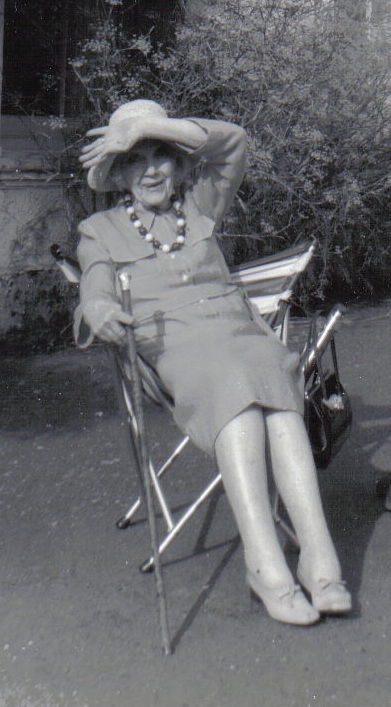
 

Jean Rhys in the 1970s (Creative Commons License)
Jean Rhys in the 1970s
(Creative Commons License)

I also chose for Emily a writer whose work I engage with in my own writing. Virginia Woolf, although she famously overturned taboos of madness and sexuality, claimed that ‘one could hardly describe’ the life of her half-sister who was diagnosed with ‘imbecility’.

When I began my novel, The Waifs and Strays of Sea View Lodge, I set out to prove Woolf wrong by writing from the perspective of twin sisters, one of whom has profound learning disabilities. However, I ended up turning back to Woolf’s novels for inspiration on how to write about our flawed yet valiant attempts to read each other’s minds.

Woolf had an ambivalent relationship with Charlotte Brontë, whose genius she felt was hindered by her attempts to ape a male type of writing rather than creating a voice of her own. However, like Rhys’s Wide Sargasso Sea, it seems to me that Woolf’s Mrs Dalloway also owes a debt of gratitude to Charlotte Brontë’s Jane Eyre.  
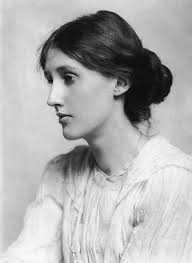
Virginia Woolf (Creative Commons License)
Virginia Woolf
(Creative Commons License)

I first read Mrs Dalloway when I was in my late teens, and I still remember the passage that seduced me: ‘Like a nun withdrawing, or a child exploring a tower, she went upstairs, paused at the window, came to the bathroom. There was the green linoleum and a tap dripping. There was an emptiness about the heart of life; an attic room’.

How odd that this depiction of sexual grief so captured my adolescent imagination. I now wonder whether I subconsciously related it back to Bertha, Charlotte Brontë’s ‘mad woman in the attic’, whose story I found even more fascinating than that of Jane Eyre.

‘We think back through our mothers if we are women,’ Woolf claimed in A Room of One’s Own. In Mrs Dalloway and Wide Sargasso Sea we catch a glimpse of two authors doing just that: befriending and confronting their predecessor on the page. This, in turn, has been the founding philosophy of our quest on Something Rhymed. Together, Emily and I are gleaning tips about how to sustain our valuable friendship by thinking back through the successes and mistakes of our literary mothers – a lineage that runs from Brontë to Woolf and Rhys.
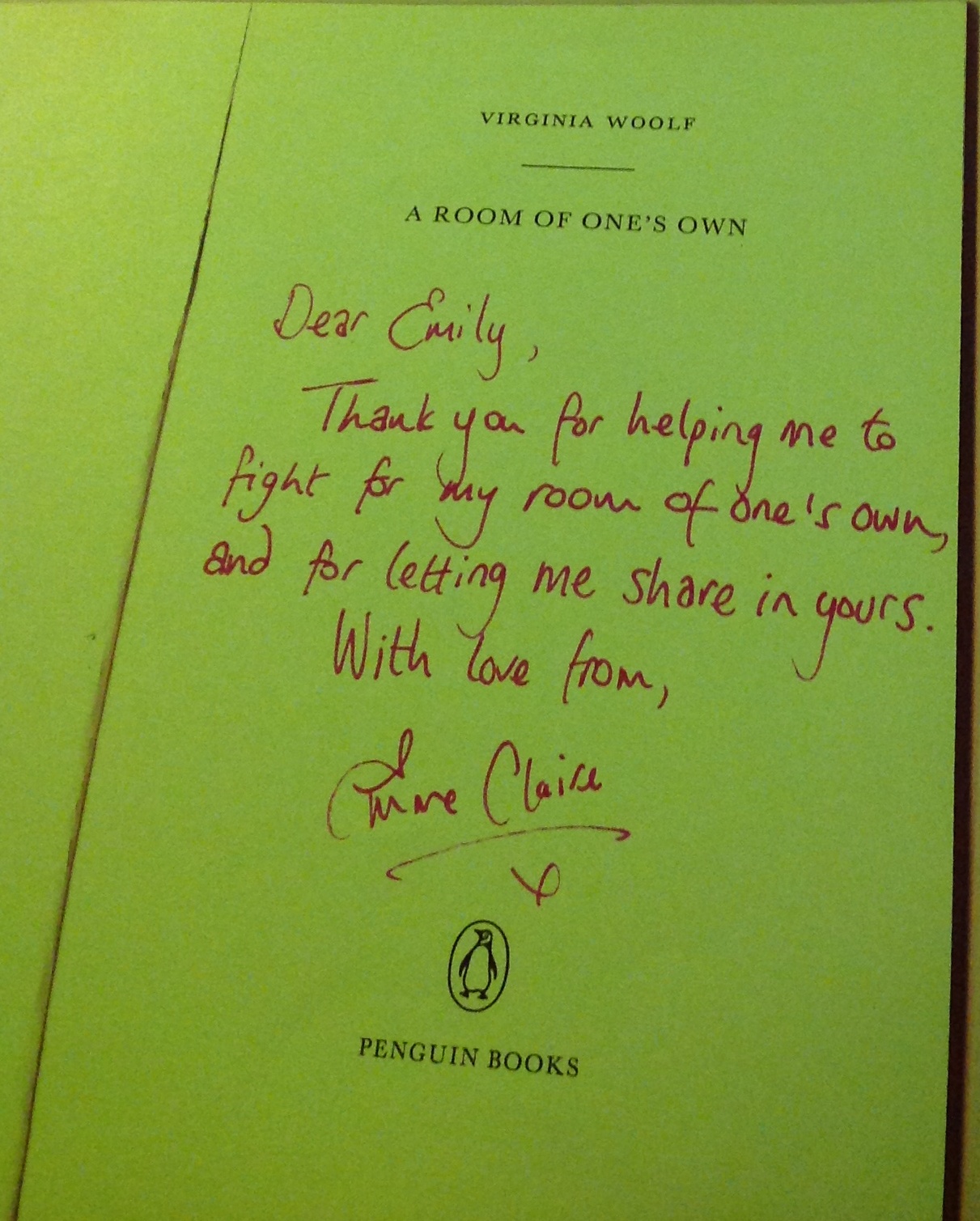
A Room of One’s Own to Share

A Room of One's Own by Virginia Woolf
A Room of One’s Own by Virginia Woolf

My gift for you, Emily, is A Room of One’s Own by Virginia Woolf – a book to which I have returned so many times during my quest to find a literal and psychological writing space.

When I first read this extended essay on women and creativity in my college bedroom, we hadn’t yet met. The very fact that I was studying in Cambridge was evidence, perhaps, that the world had begun to listen to Woolf’s argument that women should receive the same access to education as men. Her words particularly resonated, since I read them from the other side of doors that had kept her locked out.

I don’t think I’d admitted to anyone that I wanted to become a writer myself but when the opportunity arose to run the college literary society, I jumped at the chance.

The first female writer I ever met was Bernice Rubens, and I got to take her to dinner in college. The drinking society members were downing glasses of wine and playing a game called ‘no hands pudding’, which involved them thrusting their faces into their food. ‘You don’t fit in here,’ Rubens told me. ‘You’ll look back and feel proud that you don’t.’

Cambridge introduced me to some brilliant and kind academics, to some very dear friends, and to many varied and wonderful books. But it was a world still relatively unused to northern state school educated women, so Ruben’s observation had been astute. I am profoundly grateful for the room I found during my time at Cambridge, but it wasn’t quite yet a room of one’s own.

I re-read the essay a few years after graduation, when I was by then trying to forge my way as a writer. In order to work on my first novel, I slept on a friend’s floor, shared a bunk bed with a flatmate, and lived as a warden in a raucous halls of residence. Woolf’s argument that ‘A woman must have money and a room of her own if she is to write fiction’ had taken on, for me, a pressing significance.

Although I was still struggling to find a literal room of one’s own, I had by then found a figurative one in my friendship with you. In you, I discovered someone else who was also trying to carve out enough time and money and space to write, someone else who shared the conviction that it was worth the fight.

Most recently, I re-read A Room of One’s Own in the study in my backyard – my very own creative refuge. You have your own study now too. We have sat side-by-side at both of our desks, writing together about friendships between literary women. In this way, you have given me a gift that perhaps exceeds even Woolf’s hopes for the female writers who would follow her. With your help, I have been lucky enough to find not only a room of one’s own, but also a room to share.

Emily Dickinson and Helen Hunt Jackson

tumblr_mevs2yhzId1rnvzfwo1_1280
Emily Dickinson (far left) and Helen Hunt Jackson (in purple dress) pictured on the Amherst Community History Mural. The picture is used with the kind permission of Jim Wald

The abiding image of Emily Dickinson is that of a reclusive poet, dressed only in white, and known among her neighbours as The Myth. So we were surprised and delighted to discover that she had been friends with one of the most famous writers of her generation, someone whom Ralph Waldo Emerson described as the best of America’s poets.

Dickinson’s celebrated friend was Helen Hunt Jackson – a name that, to our shame, we found unfamiliar. Although her reputation as a poet has failed to stand the test of time, she is still well remembered in the USA as a campaigner for the rights of Native Americans, and her novel Ramona has never been out of print.

Like Mansfield and Woolf, theirs was an unlikely friendship. Jackson was a social animal, whose successful career stood in stark opposition to that of Dickinson – an intensely private poet.

Indeed, during Dickinson’s lifetime, she saw only a handful of her poems go to press. Jackson actually shepherded one of them to publication, cajoling her into this by saying that: ‘It is a cruel wrong to your “day and generation” that you will not give them light’.

Dickinson also held Jackson’s work in high esteem, once claiming that – with the exception of George Eliot – she considered Jackson’s poems stronger than those of any woman since Elizabeth Barrett Browning.

Thomas Wentworth Higginson, who acted as a literary mentor to both writers, introduced Dickinson and Jackson to each other’s work. However, the two women had actually known each other since childhood. They both came from the small town of Amherst, Massachusetts but, whereas Jackson had roamed far and wide, Dickinson had stayed firmly put. Once they’d reconnected, Jackson visited Dickinson on her return trips to Amherst. So – unlike many of Dickinson’s friendships – the two writers conversed in person as well as through letters.

Their friendship even influenced some of their work. Jackson acted on occasion as muse, commissioner, and recipient of poems by Dickinson. And, for her part, Dickinson is widely thought to have inspired the central character in Jackson’s first novel: a woman who wears only white, and who writes strange and dazzling poems.

Activity

Helen Hunt Jackson once commissioned Emily Dickinson to write her a poem about an oriole – an orange-breasted blackbird common in the north east of America. Dickinson responded with ‘The Hummingbird’.

This month, we will be commissioning each other to write about a particular topic – although, like Dickinson, we reserve the right to go on a bit of a tangent!

As always, we’d be grateful for suggestions of other female writer friends you’d like us to research.

Celebrating Each Other’s Successes

NotebooksUnlike Maya Angelou and Toni Morrison, or Katherine Mansfield and Virginia Woolf, there was a huge disparity in the worldly successes of this month’s featured writers.

Although Anne Sharp wrote plays for her students to perform, and was able to use her sharp critiquing skills to give Jane Austen advice on her work, she has gone down in history as little more than a footnote in the life story of her illustrious friend.

We cannot know whether Sharp ever felt envious of Austen’s achievements, and the fact that her work had the chance to reach an audience far wider than her immediate social circle. Neither would we go as far as speculating that she could have been another Austen-in-the-making if life had dealt her a different hand of cards.

It is interesting to wonder, though, whether the governess might have attempted to pursue any similar ambitions if her family and financial circumstances had been different.

What we do know is that, despite their contrasting levels of commercial success, each woman rated the other. Sharp celebrated the publication of Austen’s novels along with her, but was also ready to tell her friend when she felt there was a flaw in the work – advice that Austen appears to have highly valued.

It’s nice to imagine that her decision to rename her novel First Impressions as Pride and Prejudice was her way of acknowledging in print the crucial support she’d received from Sharp.

It’s a notion that might mean something to last week’s guest bloggers. Antonia Honeywell and Rachel Connor discussed the pride they take, not just in each other’s creative output, but their long-running writing friendship too.

Antonia’s comment on the publication of Rachel’s first novel (ahead of her own book deal with Weidenfeld and Nicholson) was one that really struck home with us. ‘It felt like a great triumph not only for Rachel,’ she recalled, ‘but for the dedication with which we both carved out the time for our regular exchanges of work.’

As we’ve mentioned before on Something Rhymed, our own career trajectories have gone along roughly in tandem so far, but there is bound to be a point when – if only temporarily – one of us will accelerate past the other.

When that happens, we hope we can learn from the example of Antonia and Rachel, and Austen and Sharp too – that we will be able to enjoy this joint success for our writing friendship, rather than focusing on any perceived gulf that divides us as individuals.

Other news

We’re currently enjoying the BBC Radio 4 series Five Hundred Years of Friendship – episodes available to listen to on-line.

We’ll be moving on to the next profiled writers on Tuesday. We were advised to look into the friendship of Vera Brittain and Winifred Holtby by many of our readers, so we particularly look forward to sharing what we’ve discovered about them.

We’re still actively researching female writer pals, so do keep letting us know, by leaving a reply or Tweeting one of us, if there is any particular friendship you’d like to see profiled.

Jill Dawson and Kathryn Heyman: competition and correspondence

When Kathryn Heyman read our profile of the rivalrous friendship between Kathryn Mansfield and Virginia Woolf, she told us about the role of envy in her long-distance friendship with fellow novelist, Jill Dawson. So we decided this week to feature a guest blog from them.

Jill Dawson and Kathryn Heyman

You either want to kill your competitors or become their friends. We chose friendship. But perhaps it’s slightly disingenuous to present it that way: when we feel that competitive spirit, it’s partly because we are attracted to the very qualities which we have – or aspire to have – ourselves.

Like Woolf, who wanted to be a better writer because she believed Mansfield had set a high standard, when one of us is successful it spurs the other on. We have allowed ourselves to be truthful about the role envy plays in our friendship because envy, after all, is a way of discovering what it is that we want.

Because we are in the same field, there are inevitably times of difficulty, of one achieving something the other wants. Award shortlists, film deals, new book deals, invitations to international events: we are, in some ways, competitors, at least if we chose to believe that there is not enough to go around. Both of us would say that we would prefer to be the one winning the Booker Prize in a given year, for instance – but if the other won it the same year, that would be a pretty neat next best thing.

We live on opposite sides of the world now, which causes us some pain. But we talk to each other every week. Our conversations are about writing, gossip, lipstick, what to wear to events, children, husbands, our works-in-progress. We’ve been alongside each other for each of our novels – thirteen between us – and know the stages of writing. ‘I thought it was going so well,’ one of us will say, ‘but now it all seems so flat. I can’t hold it together, it’s going to collapse.’ ‘Yes,’ the other will say. ‘You always say that at precisely this stage, just before you discover something wonderful; remember the last book? And the one before that?’

We write to each other regularly too. Like Woolf and Mansfield, we discuss our novels-in-progress, money matters, the books we are reading, our mutual friends. At one point, the notion of the ideal reader cropped up in our correspondence, the person who we really write for, the one who is capable of understanding the depth and intelligence of our work. And we realised then that we’ve found in each other our ideal reader – the one writer in the world for whom we would value ourselves as a reader as much as a writer. We are extraordinarily blessed that the competitor we most fervently admire is also the friend who we adore.

Kathryn Heyman’s fifth novel, Floodline, was published by Allen and Unwin in 2013.

Jill Dawson’s eighth novel, The Tell-tale Heart, will be published by Sceptre in 2014.

This post is adapted from a longer article by Kathryn Heyman, originally published in Vogue in 2008.

Remember: 

We’d love to hear about the letters you’ve exchanged, or perhaps you would like to share some reflections on the role of envy in your friendship.

We’re still on the look out for famous female writer pals, so do keep them coming too.

Katherine Mansfield and Virginia Woolf

Katherine Mansfield and Virginia Woolf

Virginia Woolf’s scathing first impression of Katherine Mansfield as ‘a civet cat that had taken to street-walking’ had always led us to put them down as enemies, but when our novelist friend Jill Dawson suggested them for our Times article on female writing friendships we began to question this preconception.

It turned out that Mansfield and Woolf considered themselves dear friends: they sought each other’s opinions on the books they traded; they exchanged gifts of Belgian cigarettes, loaves of bread, coffee beans, and columbine plants; they sent each other umpteen letters; and discussed their work over tea.

The two women were unlikely pals: Mansfield hailed from the far-flung colonies, whereas Woolf’s family was firmly entrenched in the English intelligentsia; Mansfield embraced her youthful desires with bohemian exuberance, whereas Woolf approached intimacy with timidity.

Both women experienced chronic illness, had complex relationships with editor husbands, and felt ambivalent about their childlessness. But it was really their shared literary endeavours that fired their friendship. Indeed, after spending a weekend with Woolf, Mansfield remarked that it was ‘very curious & thrilling that we should both, quite apart from each other, be after so very nearly the same thing’.

Although their friendship was relatively brief – from 1917 until Mansfield’s death in 1923 – its effect on their work was profound. During this time, Mansfield produced most of her celebrated stories (one of which Woolf published), and Woolf forged her trademark style. Although we more readily associate Woolf with the stream of consciousness technique, it was actually Mansfield who tried it out first.

In fact, Woolf seems to have been the more dependent of the pair: she was hurt (but likely also stimulated) by Mansfield’s damning review of her second novel; she worried when her letters failed to elicit a swift response; and references to Mansfield haunt her journal, showing her friend’s continued influence from beyond the grave.

Both friends recognised each other’s literary prowess: Woolf claimed that Mansfield’s was the only prose to have made her jealous, and Mansfield said that reading Woolf made her proud.

We too feel proud of our literary ancestresses – these women whose relationship could accommodate support and rivalry, criticism and praise; who were open to each other’s influence; and whose important friendship we’d been all too ready to write off.

Activity

Katherine Mansfield and Virginia Woolf enjoyed corresponding with each other. In this letter, Woolf describes jotting in her diary ideas she wanted to share with Mansfield. This way, she wouldn’t forget to mention them the next time she wrote to her friend.

This month, we will follow their example. Like Woolf, we will use our notebooks to keep track of the things we’d like to discuss. Then we will write about these ideas in letters that we will post to each other.

We’d appreciate any suggestions of other friendships between famous female writers (living or dead) that you’d like us to feature in future posts.