Two Lives, Lived in Different Ways: Polly Coles and Liz Jensen

Like Mary Lamb and Dorothy Wordsworth before them, writers Polly Coles and Liz Jensen have enjoyed many years of friendship. In our first guest interview of 2015, they give us some insights into what makes their relationship work.

SR: How did you become friends?

Liz: Where else but in the Ladies? It was at the wedding of two mutual friends twenty years ago. Polly had already made an impression on me at the ceremony, where she wore a lovely chocolate-brown outfit with a lace collar, and read a poem aloud. Beautifully.

She seemed so serene and poised, which is the exact opposite of how I felt in those days. In the Ladies I overheard her talking to someone – very eloquently and cool-headedly – about the fact that she was writing, and finding it hard. I was writing at the time too, and also finding it hard. So I accosted her.
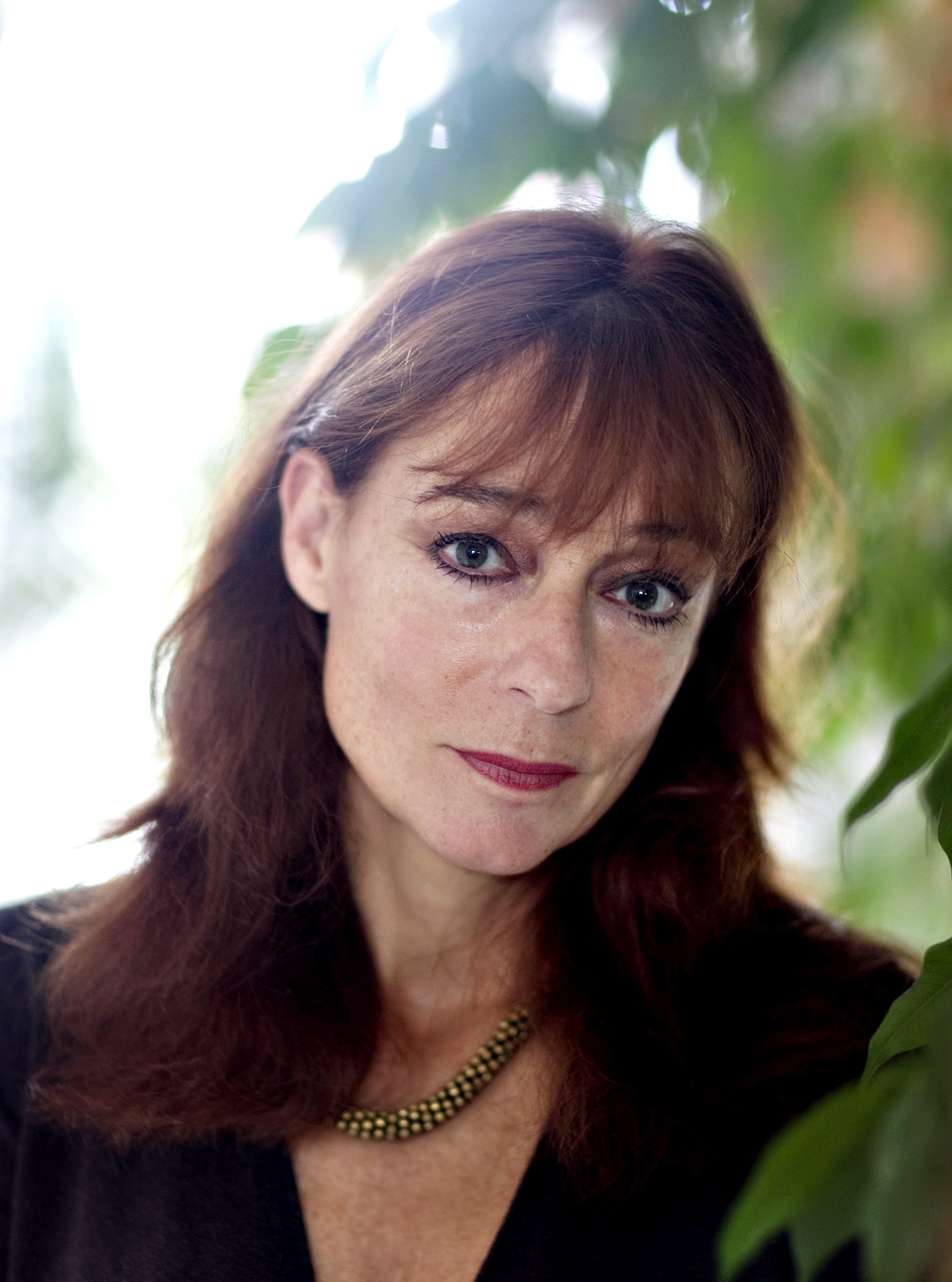
Liz Jensen, photograph by Jacob Ehrbahn.

SR: Can you tell us about some of the ways in which you have you supported each other over the years?

Polly: Soon after we first met we began meeting every few weeks and exchanging chapters of the novels we were then writing. Liz’s work became her first novel, Egg Dancing. Mine was called Utopia Station. I sent it to a couple of agents and then, although I felt it was an honourable first try, I decided that I’d see it as a kind of apprentice piece and go on to a second one. I went through the same process with the next novel and in 2013 I had a non-fiction work published.

After I stopped writing with the same focus as Liz (some time around when my twins were born and I had three kids under three), I went on editing her novels. I hugely enjoy editing and in fact my work as an abridger for Radio 4 is the mother of all edits – massive cuts are needed, whilst one must also retain the continuity of prose style and narrative.

So – it always came easily and pleasurably to me, the more so because Liz is always very generous and appreciative of any help. I think this matters. It’s not that you expect to be acknowledged, but it’d be disingenuous to say it isn’t nice to be appreciated.

Polly Coles, photograph by Laurie Lewis.

SR: Would you say that writing lies at the heart of your friendship?

Liz: As I remember it began as quite a formal writing/editing partnership but it quickly developed, not just because we complement one another so well (she is the wise one, I am the hysteric) but because after a few months of exchanging chapters and editing one another’s first novels, we both fell pregnant. It was a very happy surprise.

Our boys were born just a couple of weeks apart. Quite independently of one another we hit on archangel names: Gabriel and Raphael. Raphael was my second child, and I stopped at two. But Polly went on to have three more babies in quick succession.

So inevitably, our writing careers diverged. Because it happened in such an organic way, it didn’t feel like a problem. That said, with Polly’s writing mostly on hold, and my novels now being published at two-year intervals, there was an imbalance: she was helping me as much as ever, but I wasn’t reciprocating.

I knew one day she’d write something astonishing, and that it would be published: it was something I never, ever doubted. And sure enough, she has: her astute, philosophical, sharp-eyed memoir, The Politics of Washing: Real Life in Venice.

SR: Have you ever experienced any feelings of literary rivalry or envy?

Polly: None whatsoever, which might sound strange, given that she was a rising and active literary star and I, despite my literary aspirations, had taken a very different path. I did do some freelance work over the years, but I was mostly at home with my children and although I never stopped writing, I just never quite got round to pushing myself forward in any significant way.

I suppose success or the absence of it can spawn envy, but as I said, I chose to be a full time mother and I always believed that my time could come, so even there, it just was never an issue. I’m afraid this all sounds rather goody two-shoes. It’s not. It’s just two lives, lived in different ways. And a friendship.

The Politics of Washing: Real Life in Venice by Polly Coles is published by Robert Hale. The Essay – Venice Unravelled, her five programmes on life in modern Venice, was recently broadcast on BBC Radio 3.

Liz Jensen’s latest novel is The Uninvited. She is also the author of The Ninth Life of Louis Drax, which will be released as a film this year. Both books are published by Bloomsbury.

So Many Unexpected Connections

As we mentioned in our first post of the month, it was one of our blog readers, Sarah Emsley, who told us about the friendship of L.M. Montgomery and Nora Lefurgey.

We’d got to know Sarah through her website and her support of Something Rhymed. Forming this kind of unexpected connection, often across the seas, has been one of the real pleasures we’ve encountered as a direct result of setting up our project.

Since beginning Something Rhymed at the start of this year, we’ve profiled the friendships of eleven pairs of female authors. But, of course, these women’s relationships with other writers didn’t stop with a single friend. Through our research we’ve learned about other important connections between different authors we’ve featured on this site.

Winifred Holtby, lovingly memorialised by Vera Brittain in Testament of Friendship, had earlier written a biography of her own: a book about Virginia Woolf. George Eliot, often believed to have been scornful of Jane Austen’s work, in fact studied the novels of her forebear in preparation for beginning to write her own fiction.

One of this month’s authors, L.M. Montgomery, felt a sense of affinity with Eliot. Mathilde Blind’s early biography of Eliot had such an impact on the then young and aspiring Montgomery that several of its words and phrases found their way into her own journals.

Elizabeth Gaskell was friends, not just with Charlotte Brontë, but also with Harriet Beecher Stowe. Stowe, as we wrote in October, was such an admirer of Charlotte Brontë that she once asked a medium to help her try to make contact with the late author’s ghost.

A planchette - the kind of device once used by Harriet Beecher Stowe, to try and make contact with the ghost of Charlotte Bronte. (Creative Commons licence)
A planchette – the kind of device once used by Harriet Beecher Stowe, to try and make contact with the ghost of Charlotte Bronte. (Creative Commons licence)

One half of next month’s pair of writers was also greatly influenced by Brontë, but she adopted a less other-worldly approach. Jean Rhys’s most famous book Wide Sargasso Sea resurrects the story of Antoinette Cosway, her reimagined version of the character of Bertha Mason, the ‘madwoman’ who’d previously languished in the attic of Brontë’s novel Jane Eyre.

We look forward to sharing more of Rhys’s own story with you in our first post of December, next week, and also continuing to discover many more important links between the great female authors – connections that often transcended their historical eras.

From an Author and Editor Relationship to Something Bigger: Sheila Hancock and Kate Mosse

Today’s guest blog features our interviews with one of Britain’s most-loved actresses Sheila Hancock, also a bestselling author, and her friend, the bestselling author Kate Mosse. The two met in the 1980s, when Kate, then working in publishing, was given the task of editing Sheila’s first book – an experience both women recall with fondness.

‘I was a young editor’, Kate tells us, ‘sent to work with the great and legendary Sheila Hancock and I couldn’t really believe my luck. I was only twenty-five or something, out of university… I felt like I’d been thrust into the world of the stars’.

Kate Mosse Copyright: Mark Rusher. Picture used with the kind permission of Orion.
Kate Mosse
Copyright: Mark Rusher. Picture used with the kind permission of Orion.

Soon she was travelling to Sheila’s house every week to work with her on her memoir Ramblings of an Actress. Kate’s first impressions were that, in addition to being very witty and funny, Sheila was ‘an incredibly clever woman’ and ‘a person of great principle’, with a clear vision for her book – something that made working with her ‘a completely joyous job’.

As for Sheila, she says that Kate ‘was young and probably a bit nervy, but she certainly didn’t show it’. In fact, she remembers her as ‘a real little bossy knickers’, someone who gave her enormous encouragement ‘to keep at it and not lose my confidence and give up’.

Talking of Kate’s regular visits to her home, she tells us about an occasion when the then-editor sat down and informed her ‘I’m not leaving until you’ve finished that chapter’. Sheila says that she predicted even then that Kate ‘would eventually do something amazing’, although she wasn’t sure what. ‘I just knew that this girl was very, very special’.

Kate recalls a memory from around that time when the pair went to one of the famous women’s peace protests at the Greenham Common nuclear base. She describes ‘one terrible picture’ taken of the two of them there ‘although we could be anywhere!’ The day was an ‘extraordinary’ occasion and one that took them away ‘from the author and editor relationship to something bigger’ that was ‘more part of the women we were rather than the workers we were’.

Sheila Hancock We sought permission from Bloomsbury to use this image.
Sheila Hancock
We sought permission from Bloomsbury to use this image.

In the years that have passed since those early experiences, the two have continued to actively support each other. Kate recounts how her friend rang her up for some advice when, after the death of Sheila’s husband the actor John Thaw, she was preparing to write the memoir that would become The Two of Us. And when Kate’s novel Labyrinth  won a prize at the British Book Awards 2006, it was Sheila who presented the award to her.

More recently, Sheila, who has watched Kate’s career develop with ‘awe and pleasure’, attended the launch of Kate’s latest book The Taxidermist’s Daughter. On the 23rd of this month, Kate will be interviewing Sheila on stage at an event at London’s Bloomsbury Institute to mark the publication of Sheila’s novel Miss Carter’s War.

Though both women acknowledge the importance of solitude to the life of a writer, they also talk about the need for friendship. As Sheila says, ‘It’s nice to meet up with a friend to find out what they’re doing and what the life outside is like’. These relationships prevent her from getting into the world of her book ‘to the exclusion of all else’.

Kate tells us that she values friendships with other writers. Amongst her peers, she sees people ‘who have the same creative emotions that I do. We have the same mixture of success and failure… the same mixture of ambition and wanting to be invisible, and that’s how we sustain one another’.

Kate Mosse’s most recent novel The Taxidermist’s Daughter is published by Orion.

Sheila Hancock’s novel Miss Carter’s War will be published by Bloomsbury on 9 October.

Celebrating Female Friendship

When this month’s guest bloggers, Harriet Levin and Elizabeth L. Silver, let us take a look at one of their on-line chats, we felt privileged to be witnesses to a conversation that so clearly conveyed their mutual appreciation of each other’s support.

This has, of course, been a common theme in all of the guest posts this year. Like them, Rachel Connor and Antonia Honeywell, and Sarah Butler and Tessa Nicholson, have gone from living close to their writer friend to being separated by geographical distance. But they all wrote of how they’re still able to rely on their pal’s advice, even though they are physically far apart.

IMG_1146Jill Dawson and Kathryn Heyman, too, who live on opposite sides of the world, told us how their frequent phone conversations, about ‘writing, gossip, lipstick’ amongst other things, keep the relationship going.

Kadija ‘George’ Sesay and Dorothea Smartt spoke of the pleasures of working with each other professionally. Rima Haque shared a story about hearing valuable literary advice from Susan Barker on a crowded London night-bus.

Julie Sarkissian and Haley Tanner, and Emily Bullock and Ann Morgan, were keen to emphasise how much they valued having someone with whom they’ve been able to share the struggles and eventual triumphs of their books-in-progress.

We are grateful to all of this year’s guest bloggers for posting these inspiring words about the crucial role that the friendship of another woman has played in their writing lives.

Since launching Something Rhymed at the beginning of the year, we’ve often found ourselves wondering why the literary friendships of our most famous female writers are generally less well-known than those of their male counterparts.

Recently, we’ve been mulling over a number of theories, but one conclusion we’ve come to is that the all-too-common depiction of ambitious women as inevitable jealous rivals could have played a major part in this. Katherine Mansfield and Virginia Woolf are two writers, in particular, whose reputations have suffered in this way. This month’s pair, Maxine Kumin and Anne Sexton, are another, historically later, example.

At Something Rhymed, we’re keen to try and promote some more positive representations of women’s friendship, so with this in mind we’ve just launched our #SomethingRhymed hashtag on Twitter with this tweet: Women’s relationships are too often seen as bitchy & backstabbing. Tell us about a time when a female friend supported you. #SomethingRhymed

We’ll be sharing our own stories (in 140 characters or less!) of helping each other out personally or professionally. Whether you’re a writer or not, we’d love to hear about your positive experiences of female friendship too. If you’re not on Twitter, but would still like to add your voice to the conversation, why not leave a message in the Comments section below?

Remember

You can keep up-to-date with Something Rhymed by following our blog via email. Just type your email address into the box beneath the banner on the right hand side of the screen, and then click on the ‘Follow’ button beneath. On mobile devices, you need to scroll down to the bottom of the page to find the box and ‘Follow’ button.

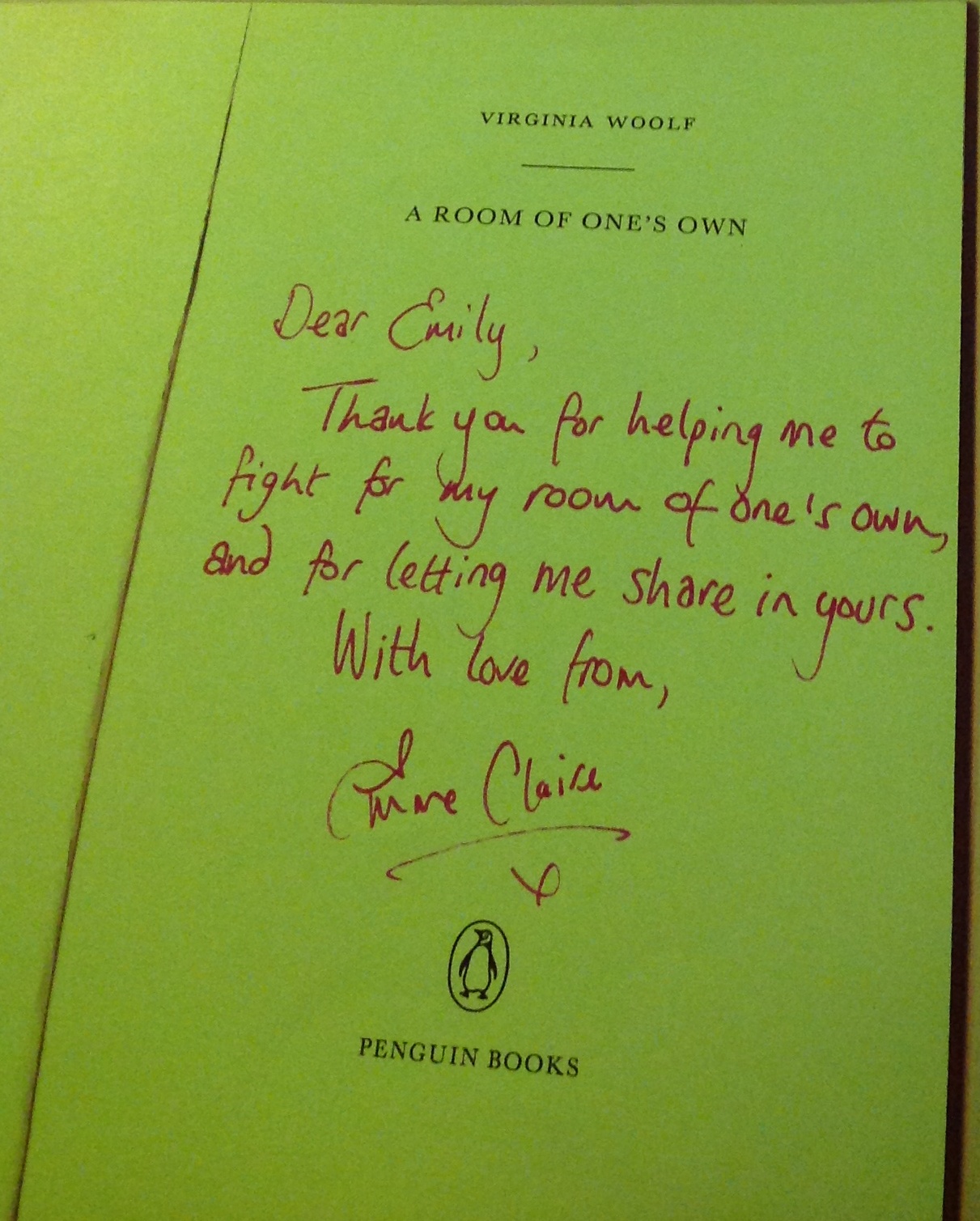
A Room of One’s Own to Share

A Room of One's Own by Virginia Woolf
A Room of One’s Own by Virginia Woolf

My gift for you, Emily, is A Room of One’s Own by Virginia Woolf – a book to which I have returned so many times during my quest to find a literal and psychological writing space.

When I first read this extended essay on women and creativity in my college bedroom, we hadn’t yet met. The very fact that I was studying in Cambridge was evidence, perhaps, that the world had begun to listen to Woolf’s argument that women should receive the same access to education as men. Her words particularly resonated, since I read them from the other side of doors that had kept her locked out.

I don’t think I’d admitted to anyone that I wanted to become a writer myself but when the opportunity arose to run the college literary society, I jumped at the chance.

The first female writer I ever met was Bernice Rubens, and I got to take her to dinner in college. The drinking society members were downing glasses of wine and playing a game called ‘no hands pudding’, which involved them thrusting their faces into their food. ‘You don’t fit in here,’ Rubens told me. ‘You’ll look back and feel proud that you don’t.’

Cambridge introduced me to some brilliant and kind academics, to some very dear friends, and to many varied and wonderful books. But it was a world still relatively unused to northern state school educated women, so Ruben’s observation had been astute. I am profoundly grateful for the room I found during my time at Cambridge, but it wasn’t quite yet a room of one’s own.

I re-read the essay a few years after graduation, when I was by then trying to forge my way as a writer. In order to work on my first novel, I slept on a friend’s floor, shared a bunk bed with a flatmate, and lived as a warden in a raucous halls of residence. Woolf’s argument that ‘A woman must have money and a room of her own if she is to write fiction’ had taken on, for me, a pressing significance.

Although I was still struggling to find a literal room of one’s own, I had by then found a figurative one in my friendship with you. In you, I discovered someone else who was also trying to carve out enough time and money and space to write, someone else who shared the conviction that it was worth the fight.

Most recently, I re-read A Room of One’s Own in the study in my backyard – my very own creative refuge. You have your own study now too. We have sat side-by-side at both of our desks, writing together about friendships between literary women. In this way, you have given me a gift that perhaps exceeds even Woolf’s hopes for the female writers who would follow her. With your help, I have been lucky enough to find not only a room of one’s own, but also a room to share.

Rachel Connor and Antonia Honeywell: ‘a collaboration to be treasured’

In this month’s guest blog, long-time writer friends Rachel Connor and Antonia Honeywell take up the March challenge to send each other mementoes of their friendship…

Rachel

Antonia and I were connected even before we met: we were paired, in advance of the MA in Novel Writing at Manchester University, to submit work in the same workshop.

From the beginning, friendship and work have been intertwined.  For nearly a decade we’ve spent happy hours talking of books and our children; of our ambitions, hopes and passions.  There’s a geographical distance (I live in the north; Antonia in the south of England) but we snatch time together in person where we can.

When the MA ended, Antonia and I took turns to submit work by email, which was printed off by the other and returned with comments.  This loop of regular submission and feedback has sustained us ever since.

The pressures of work or childcare have sometimes interrupted the pattern but the firm foundation of a working relationship will always be there.  We are, for each other, cheerleader, editor and critical friend.

Antonia's gift for Rachel
Antonia’s gift for Rachel

When I received the beautiful locket Antonia sent me I was immensely touched.  It symbolises space – the space we have afforded each other and the space for development of our creative work.

When I opened it, I was surprised to see that it contains a tiny rose, to represent growth.  I’m not sure whether she thought of it, but the rose is a crucial image in a novel I’m working on right now (which is based on Charles Rennie Mackintosh).  Consciously or subconsciously, she must have picked up on that.

I do miss Antonia’s actual presence but I know that we’ve carved out an emotional and creative space in which we can both grow.  It’s a friendship and a collaboration to be treasured – just like the locket, in fact, which now takes pride of place on the bookshelves next to my writing desk.

Antonia

It’s possible that the early hours of the morning aren’t the best time to write, but on top of four small children, we have chronic illness in the house, a head teacher being an arse, and a cellar pump that keeps failing. Yet here I am, writing.

From the first days of our friendship, Rachel’s faith in my work has given me permission to write even, and especially, when life has conspired to make it impossible. Others know us as mothers, teachers, wives and workers, but to each other, we are writers first.

Rachel's gift to Antonia
Rachel’s gift to Antonia

The little book Rachel sent me symbolises what brought us together, what sustains our friendship and what is produced by it. No Anne Sharp could have been prouder of Jane Austen than I was of Rachel when Sisterwives was published: it felt like a great triumph not only for Rachel, but for the dedication with which we both carved out the time for our regular exchanges of work.

Those exchanges have ebbed and flowed with the vicissitudes of our other lives, but our writing relationship has always been one in which the words ‘I told you so’ hold no negative connotations.

We don’t meet in person very often, but every meeting is an oasis. The next will be on Rachel’s birthday this summer. The last time I was able to celebrate Rachel’s birthday with her in person, too long ago, I confided the seed of the idea that would become The Ship. This time, The Ship will be on the verge of publication.

It began with two women who wanted to write. The rose in the locket is a symbol of the wonders that can happen, when dreams are given a little space.

Rachel Connor’s novel Sisterwives was published by Crocus Books in 2011. Her radio play The Cloistered Soul will be broadcast on Radio 4 on 29th May this year.

Antonia Honeywell’s novel The Ship will be published by Weidenfeld & Nicolson in January 2015.

 Remember

We’re still searching for more famous female writer pals to feature in the upcoming months, so do let us know if there’s a pair you’d like to see profiled.

You can do this by leaving a reply to any of the posts on the site, or Tweeting us at @EmilyMidorikawa or @emmacsweeney.

You can keep up with Something Rhymed by following us via email, by clicking the button on the right of the screen.

My Box of Memories

Pears soap, Emma Claire’s recent trinket gift has a special place in my family history too. It was the choice of my father’s own Grandma and, because of the childhood memories he associated with it, a favourite of his too.

Consequently, at least in the early years, it was the only soap we used at home. On receiving this broken sliver of amber, I found myself immediately transported by its familiar stickiness and herb-like scent to long-ago bath times at Eastfield Crescent, sitting in the tub with my little sister, our singing voices competing with the noise of the electric fan.

Emma Claire, this trinket that stands both for Bam-Bam and the ghost of your novel in its earlier forms, has now been safely shut away in my own memory box. It’s been a discovery, though perhaps not an entirely surprising one, to learn that this tendency to memorialise our pasts is just another thing we share in common.

But, in keeping with the last of our February posts, I’m keener now to acknowledge the differences between us too. I’ve stored away a petalled pink and green ballet headdress, a tiny scented satin bag from Japan that (even after eighteen years) still somehow keeps its perfume, and – having grown up in a non-religious household – there are no equivalents to your christening bracelets.

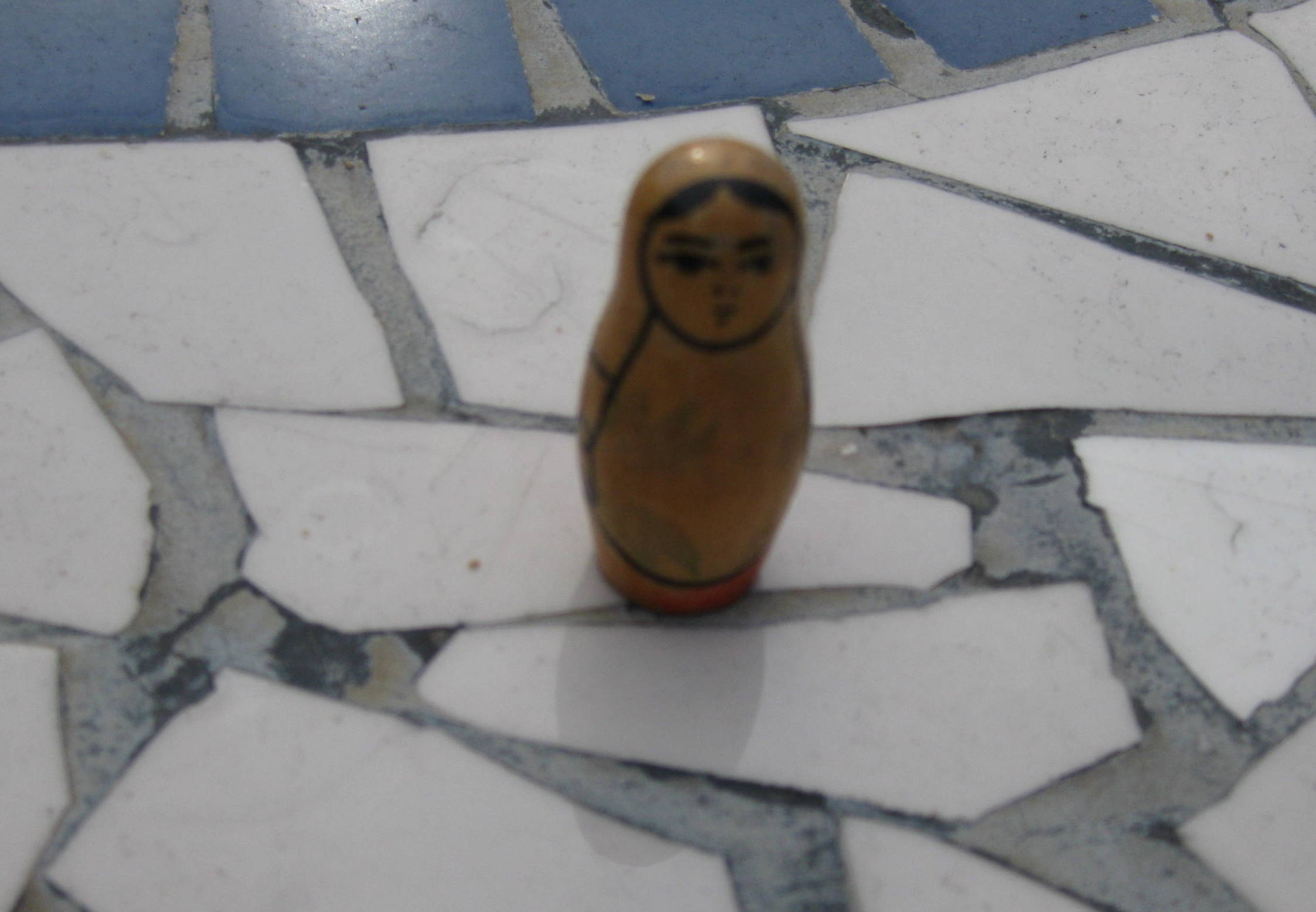
The trinket I have removed to make way for your soap, Em, is the inner-most part of a Russian Doll.

Gift for EmmaI have fractured memories of playing with its outer casings as a child, painted wooden shells that split apart to reveal the series of dolls inside them. I don’t know what happened to those exterior pieces. Did they get cracked, or lost over time? Did my mother pass the doll to a friend without realising its heart was missing?

At some stage, anyway, I must have found this solitary little doll, the only part that couldn’t be broken into two, and decided I wanted to save it.

Some of its varnish has come away and the red and green of the painted clothing has faded to nothing in places. But I feel certain that someone who can see the brighter amber in a broken bar of Pears soap will overlook the many scuff marks, and be able to enjoy this small memento of her friend from a time many years before she knew her.

Broken Things

Emma’s gift for Emily The trinkets contained in this jewellery box show that I was a child intent on self-memorialising: christening bracelets; gymnastics medals; my annual bus passes; the label from my first bra.

But the object that I’ve removed from the jewellery box to pass on to you, Emily, is a memento of Bam-bam – my grandma. After she died, when I was just nine, I took this bar of Pears soap as a keepsake and its scent of thyme still reminds me of her.

Bam-bam wore fur coats and visited the hairdresser every week; she fed me milk loaf and strawberry splits; people gathered around the piano when she played; the local librarians all knew her by name. After she died, we found exercise books stacked in her bedside cabinet all of them filled with her own handwritten poems.

For me, the search for literary ancestresses stems back to the discovery that my own grandma was a closet writer. My dad kept her exercise books and I have treasured her bar of Pears soap.

So now, Em, you have a little more insight into the importance of Pears soap in The Waifs and Strays of Sea View Lodge. Or, I should say, the significance it used to have. The soap is now only mentioned here and there, no longer carrying the symbolic weight it had in earlier drafts – drafts that you read and critiqued. Only you, who have accompanied me on every step of this long writing journey, would detect in the final version the lingering scent of Pears soap.

In a way, then, may this memento stand for everything that’s written out, for our shared dedication to voicing stories that have previously been silenced. After all, with its focus on female friendship – a neglected aspect of literary lore – this is what Something Rhymed is all about.

Sadly, this trinket must also stand for broken things. Although I’d kept the bar of soap intact for decades, packing and unpacking it every time I moved house, I dropped it when I reached into a high cupboard to fetch it for you.

After my initial dismay, I realised that there’s perhaps something appropriate about this. I’ve always been drawn to broken things: derelict funfairs; threadbare cardigans; people whose surface resilience hides their distress.

My grandma was broken by the death of her eldest son and the disintegration of her marriage. In writing this message to you, Em, it strikes me that in my novel I offer an elderly woman a last chance to be healed – a chance my grandma never seized.

But there’s beauty in the broken, isn’t there, Em? I know that you too will appreciate the brighter amber that was revealed when the bar of Pears soap splintered, its headier scent of thyme.