Ruth Rendell and Jeanette Winterson at the Theakstons Old Peculier Crime Writing Festival 2013 (Copyright Fenris Oswin)
At first glance, the friendship between two of Britain’s best-loved writers, Ruth Rendell and Jeanette Winterson, might seem a tad unlikely. For starters, their fiction is radically different. And then there’s the obvious difference in age.
Now in her eighties, Rendell is almost thirty years Winterson’s senior and, certainly in the friendship’s earliest days, she took on the role of nurturer. Winterson, whose relationship with the woman who adopted her as a baby was famously troubled, writes of Rendell with great affection in her memoir, describing her as ‘the Good Mother – never judging, quietly supporting’.
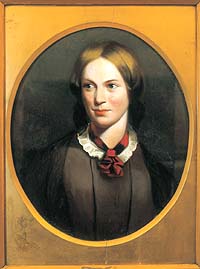
This side of their friendship, reminded us of the maternal element to the relationship between Charlotte Brontë and Elizabeth Gaskell, despite there only being a six-year age difference in their case.
Rendell took Winterson under her wing from the beginning. Hearing that the younger writer was looking for a place to stay, she invited her to move into her own home while she was abroad. She had no qualms about handing over the keys to someone she’d only just met, claiming to have known ‘at once that she was absolutely trustworthy and honest and honourable’.
Rendell’s nurturing was professional as well as personal, leading Winterson to describe the older author – to whom she has sometimes even turned for writerly advice – as her ‘role model’. When Hammer commissioned Winterson to write a horror novel, she sought out Rendell’s guidance on how to maintain a page-turning plot.
Winterson is keen to reciprocate the generosity in different ways, often for instance, buying Rendell gifts of earrings. But other attempts to treat her friend haven’t always quite gone to plan, thanks to Rendell’s more private nature. Winterson recalls how on the occasion of her pal’s birthday one year she’d thought of taking her out for dinner and champagne. But she says Rendell responded with ‘oh, do I have to?’ and so she ‘went round to her house and cooked scrambled eggs instead’.
This incident, narrated with good humour by Winterson, seems to encapsulate both the differences and the closeness between these two women. It’s a simple memory, but, to us at least, it speaks volumes about an outwardly unusual literary pairing that transcends differences in creative output, age and personality.
Activity
When Ruth Rendell offered Jeanette Winterson a place to stay, it made all the difference to the young author, who was then struggling to find somewhere to write.
This month, we’ll be letting each other know about a time of our own when the help of our friend made all the difference.
Do keep those recommendations for other pairs of writing friends coming in.
I will now treasure the copy of Jean Rhys’s After Leaving Mr MacKenzie, which Emily gave to me. Of course, Rhys’s most famous novel, Wide Sargasso Sea, which was inspired by Jane Eyre, imagines the first Mrs Rochester before she became consumed with madness and locked in the attic.
Just as Rhys’s descriptions of dingy hotel rooms and low-lit streets have lingered long in Emily’s imagination, I feel as if I have sat at the cocktail bar in A Tiny Speck of Black and then Nothing, Emily’s novel, chatting with the blind barman. There’s a scene in which the heroine searches for her missing friend in the labyrinthine alleyways of Osaka that has become so lodged in my own mind that I could almost mistake it for a memory. Moreover, the melodic quality of Emily’s novel sets up in duet with Rhys’s melancholic song.
I also chose for Emily a writer whose work I engage with in my own writing. Virginia Woolf, although she famously overturned taboos of madness and sexuality, claimed that ‘one could hardly describe’ the life of her half-sister who was diagnosed with ‘imbecility’.
When I began my novel, The Waifs and Strays of Sea View Lodge, I set out to prove Woolf wrong by writing from the perspective of twin sisters, one of whom has profound learning disabilities. However, I ended up turning back to Woolf’s novels for inspiration on how to write about our flawed yet valiant attempts to read each other’s minds.
Woolf had an ambivalent relationship with Charlotte Brontë, whose genius she felt was hindered by her attempts to ape a male type of writing rather than creating a voice of her own. However, like Rhys’s Wide Sargasso Sea, it seems to me that Woolf’s Mrs Dalloway also owes a debt of gratitude to Charlotte Brontë’s Jane Eyre.
I first read Mrs Dalloway when I was in my late teens, and I still remember the passage that seduced me: ‘Like a nun withdrawing, or a child exploring a tower, she went upstairs, paused at the window, came to the bathroom. There was the green linoleum and a tap dripping. There was an emptiness about the heart of life; an attic room’.
How odd that this depiction of sexual grief so captured my adolescent imagination. I now wonder whether I subconsciously related it back to Bertha, Charlotte Brontë’s ‘mad woman in the attic’, whose story I found even more fascinating than that of Jane Eyre.
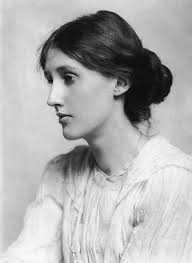
‘We think back through our mothers if we are women,’ Woolf claimed in A Room of One’s Own. In Mrs Dalloway and Wide Sargasso Sea we catch a glimpse of two authors doing just that: befriending and confronting their predecessor on the page. This, in turn, has been the founding philosophy of our quest on Something Rhymed. Together, Emily and I are gleaning tips about how to sustain our valuable friendship by thinking back through the successes and mistakes of our literary mothers – a lineage that runs from Brontë to Woolf and Rhys.
In this month’s guest blog, long-time writer friends Emily Bullock and Ann Morgan take up the June challenge to send each other a book with a dedication inside.
Emily Bullock
Ann and I first met on the interview day for UEA’s Creative Writing MA… So she tells me, and over the years I’ve come to think of her memory as my own. We were then lucky enough to be in the same writing workshop. Was I first drawn to the person or the pen? I no longer recall that either. But I do know that I liked both a great deal. Ann spent some nights on my airbed, which sealed the new friendship, and all these years later we are still friends.
The book I have chosen for Ann was inspired by her Year of Reading the World. Through this project, she came across a writer who didn’t get to read a novel until she was a teenager. The anecdote stayed in my mind because Ann is such a good storyteller. The first novel this writer got to read also seems the right selection for Ann because of her adventures in reading a book from every country, and the writing journey we have both been on, which will finally result in our debut books coming out next year.
‘What had he brought back from this long and weary journey?’
The airbed has deflated but we go on: friends and writers. I feel fortunate to have you as a travelling companion.
Ann Morgan
Emily’s right: we did meet at the interview day for our master’s. I can even remember the book she was reading – Salt: A World History by Mark Kulansky.
If it seems a bit freaky that I can recall so much, it’s no doubt testament to how well we got on. Almost from the word go, we were chatting easily and seemed to understand each other’s take on books and writing. The friendship was particularly important for me as I was commuting from London to study on the course in Norwich – hence the airbed (in case you were wondering).
Ten years on, we remain great friends. We’ve seen each other change, grow, struggle and succeed, and it’s lovely that our debut books, The Longest Fight and Reading the World: Postcards from my Bookshelf, will be coming out at roughly the same time in 2015.
In recognition of this, I’ve chosen a novel that links together our projects: Seconds Out by Martín Kohan.
It’s the book I read from Argentina during my Year of Reading the World and centres on boxing, which is the subject of Emily’s novel. The story also seems appropriate because I think both of us would agree that the journey to publication has been a bit like a battle on occasions. As a result, my dedication reads:
‘It has felt like the longest fight at times, but it’s been great to share the knocks and knockouts with you. Here’s to the next bout.’
Emily Bullock’s novel The Longest Fight will be published by Myriad Editions in spring 2015.
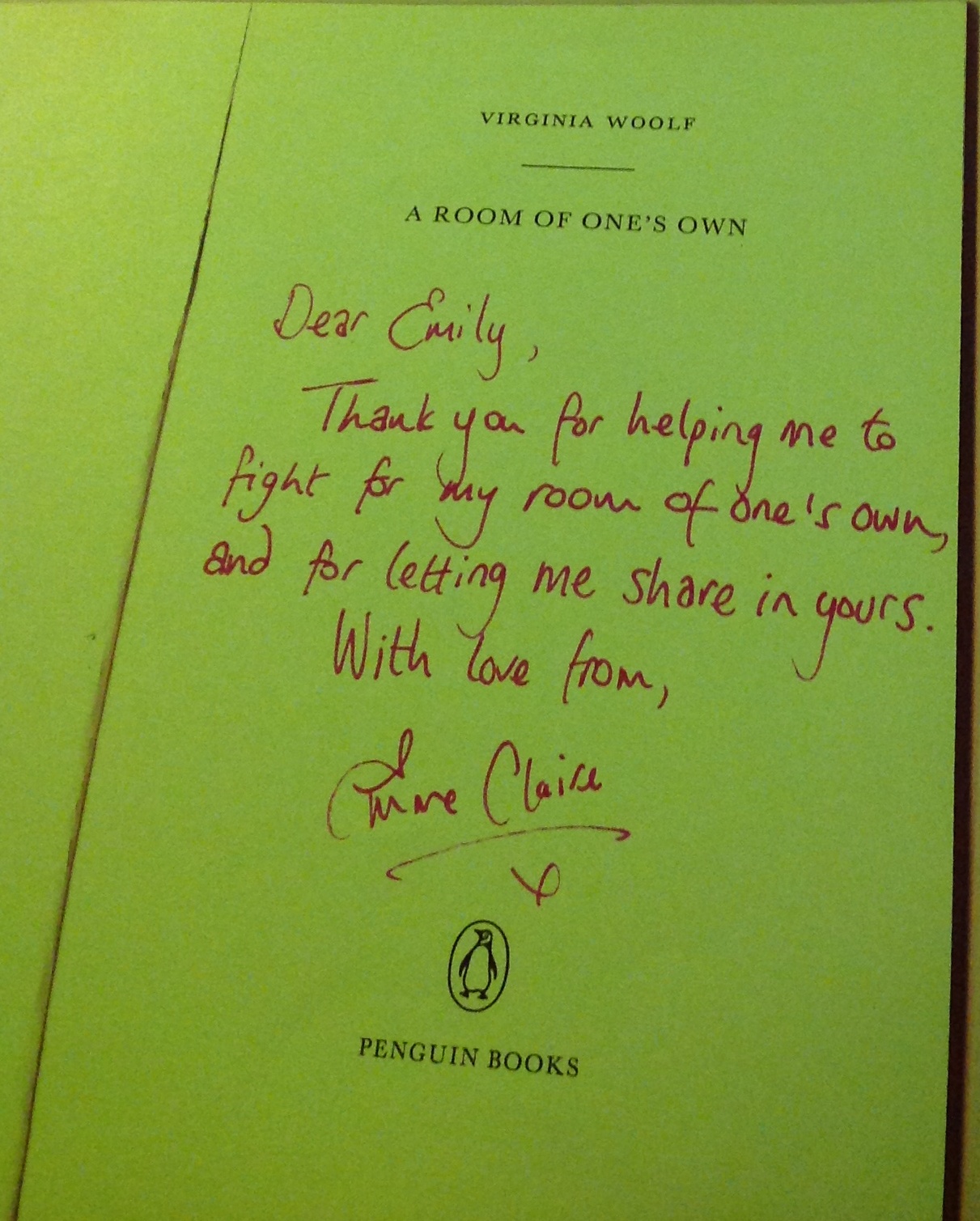
My gift for you, Emily, is A Room of One’s Own by Virginia Woolf – a book to which I have returned so many times during my quest to find a literal and psychological writing space.
When I first read this extended essay on women and creativity in my college bedroom, we hadn’t yet met. The very fact that I was studying in Cambridge was evidence, perhaps, that the world had begun to listen to Woolf’s argument that women should receive the same access to education as men. Her words particularly resonated, since I read them from the other side of doors that had kept her locked out.
I don’t think I’d admitted to anyone that I wanted to become a writer myself but when the opportunity arose to run the college literary society, I jumped at the chance.
The first female writer I ever met was Bernice Rubens, and I got to take her to dinner in college. The drinking society members were downing glasses of wine and playing a game called ‘no hands pudding’, which involved them thrusting their faces into their food. ‘You don’t fit in here,’ Rubens told me. ‘You’ll look back and feel proud that you don’t.’
Cambridge introduced me to some brilliant and kind academics, to some very dear friends, and to many varied and wonderful books. But it was a world still relatively unused to northern state school educated women, so Ruben’s observation had been astute. I am profoundly grateful for the room I found during my time at Cambridge, but it wasn’t quite yet a room of one’s own.
I re-read the essay a few years after graduation, when I was by then trying to forge my way as a writer. In order to work on my first novel, I slept on a friend’s floor, shared a bunk bed with a flatmate, and lived as a warden in a raucous halls of residence. Woolf’s argument that ‘A woman must have money and a room of her own if she is to write fiction’ had taken on, for me, a pressing significance.
Although I was still struggling to find a literal room of one’s own, I had by then found a figurative one in my friendship with you. In you, I discovered someone else who was also trying to carve out enough time and money and space to write, someone else who shared the conviction that it was worth the fight.
Most recently, I re-read A Room of One’s Own in the study in my backyard – my very own creative refuge. You have your own study now too. We have sat side-by-side at both of our desks, writing together about friendships between literary women. In this way, you have given me a gift that perhaps exceeds even Woolf’s hopes for the female writers who would follow her. With your help, I have been lucky enough to find not only a room of one’s own, but also a room to share.
Since I first picked up a copy of Jean Rhys’s novel in my late teens, I have pressed it on a number of people. I say pressed, because I’m not sure it’s always been a welcome recommendation, the response often being that it’s depressing.
This is a valid comment, and each time I’ve returned to the book over the years I’ve found it sadder than I did on the previous reading. But there are flashes of dark humour there too, in Rhys’s wry observations, and her sharp-drawn depiction of the titular Mr Mackenzie’s pomposity.
What really attracts me to After Leaving Mr Mackenzie, though, is the unaffected beauty of the writing. Rhys’s second published novel came out in 1931 and the story is firmly of its era, but the unfussy, hypnotic prose retains a freshness that’s stood the test of time.
I have thought about buying this book for you before, Emma Claire, but have always held back – perhaps because a favourite book can come to seem like a part of your own history. Unreasonable as it is, it’s hard not to take it as a personal slight if your friend then goes and tells you they didn’t like it.
But I think – I hope – you will like it, because you have such a musical ear. You’re always picking out riffs and melodies within written stories, or even spoken conversations, which other people might not care about, or miss.
Set in grey London and Paris, After Leaving Mr Mackenzie – the story of a woman who has, in reality, been left by yet another man – lacks the lush imagery of Rhys’s much-lauded later novel Wide Sargasso Sea. Neither is it as formally inventive as Goodnight Midnight (although I like it the better for that).
But there is an integrity about this novel that I love. To read it is to be transported to dingy hotel rooms and low-lit streets, and shabby bars that reek of quiet desperation, all rendered by the author with a unique kind of beauty.
But my main reason for choosing After Leaving Mr Mackenzie as this month’s gift is this:
When I discovered this book, it changed the way I thought about writing forever.
It showed me that a good novel could be about much more than a gripping plot and characters that linger long in the mind, or even a beguiling setting or atmosphere.
From Rhys I learned that good writing could sing a song to its reader. In this case, it’s a melancholic song about half-broken things, but – knowing of your literary tastes, Em – I wonder if you might like it all the more for that?
When we first became interested in female writing friendship, we wrote off Elizabeth Gaskell and Charlotte Brontë as mere acquaintances.
In between their first meeting in the Lake District in 1850, and Brontë’s untimely death just five years later, they met only a handful of times, and, undoubtedly, each of them was closer to other women.
Brontë had been a pal since childhood with the loyal Ellen Nussey. She was deeply influenced by the feminist Mary Taylor, and inextricably bonded with her famous sisters Emily and Ann. In the more sociable Gaskell’s case, she moved in exulted social circles and counted Florence Nightingale and Harriet Beecher Stowe amongst her friends.
But something about the relationship between Brontë and Gaskell kept nagging away at us. We found it intriguing that Patrick Brontë – a man fiercely protective of his late daughter’s memory – had chosen the author of Cranford as her biographer. Brontë’s sojourns to 84 Plymouth Grove, the home of the Gaskell family, also piqued our interest, as did the frequency of the correspondence between the two women.
Wondering whether we had been too hasty in overlooking this pair, we turned to their letters to investigate further. Here, we discovered a relationship based on mutual support, and shared artistic and professional concerns.
We found that Gaskell and Brontë regularly exchanged candid views on literature and publishing, sometimes accompanying their letters with recommended books. On a personal level, Gaskell took the ailing Brontë under her wing. When it came to their writing, though, it was Brontë who provided the greater share of support by acting as a sounding board for her friend’s literary ideas and giving her generous advice on how she could improve her novels.
Brontë even persuaded her publisher to delay the release of Villette, because it would have clashed with the publication of Gaskell’s novel Ruth.
Gaskell would, of course, one day seek to return this generosity by styling her Life of Charlotte Brontë as a tribute to her friend, someone of whom she’d once said, ‘I never heard or read of anyone who was for an instant, or in any respect, to be compared to her’.
Activity
Charlotte Brontë included a copy of Wordsworth’s Prelude with her first letter to her literary pal.
This month, we’ll be sending each other a book and writing a dedication on the inside cover.
If you know of any more writer friends that you think we ought to profile on this site, please do tell us about them.
‘A rainbow in somebody’s cloud’ – Maya Angelou (Image taken at Hay Festival, 28 May 2014)
We are saddened by the death of Maya Angelou, a writer whose life and work has been an inspiration to people the world over, and a woman from whose great capacity for friendship we’ve learned so much this year.
Regular readers of Something Rhymed will know that we profiled Angelou’s relationship with Toni Morrison back in February. Influenced by their championing of each other’s achievements, we set ourselves the task, on a much smaller scale, to follow their example.
We made lists of the things we admired about each other and developed them into pieces of creative work. Although we’d always considered our friendship to be a very open one, we were surprised by how many of the points we noted down we had never spoken of before.
It made us wonder how long we might have gone on silently appreciating, but never expressing, that we valued these qualities if we hadn’t paid attention to Angelou and Morrison.
When we discovered that Morrison would be appearing at Wales’s Hay Festival this year, we quickly bought tickets to hear her talk. We knew that she and Angelou had bonded years ago at Hay, when both women found themselves far away from home at a time when their mothers were ill. And so it felt particularly poignant that it was during yesterday’s festival session that many audience members (ourselves included) first heard that Angelou had died.
Morrison eloquently gave voice to the gasps that rippled through the vast tent when she spoke of her personal loss. ‘I thought she was eternal,’ she said. ‘I thought she always, always would be there.’
As writer friends ourselves, it is difficult to listen to language like this without wondering how one of us would cope in a similar situation, how we would feel if the person we’d come to rely on to such an extent was suddenly gone from our life.
Morrison, who called Angelou ‘a real original’, was understandably reluctant to say too much about her death. ‘It hurts so much that I have no treasurable, powerful, elegant words to say about that,’ she told the crowd. ‘I need time to talk about Maya. She was important in so many ways.’
But what struck us as we listened was the extent to which each of these women had already made significant efforts to commemorate the life of her friend.
Morrison’s speech in praise of Angelou at the USA’s most recent National Book Awards was a case in point, as was the party Angelou threw for her friend in 1993 – a response to what she saw as a lack of official national acknowledgement when Morrison won the Nobel Prize for Literature.
We are thankful for what we have learned from this literary pair: that it is important to celebrate the lives of our close ones, not just in fine tributes once they are gone, but also when they are still here.
When Laura MacDougall of Hodder & Stoughton contacted us about the friendship between one of her authors, Julie Sarkissian, and fellow US novelist, Haley Tanner, we were keen to learn more. So, we interviewed them for this month’s guest post.
Julie (left) with Haley (right)
Something Rhymed: What were your first impressions of each other and how did you become friends?
Haley: The first time I saw Julie I wanted to become her friend instantly. It was the first week of the MFA program we did together and during these awful get-to-know you exercises where everyone tried as hard as possible to impress everyone else with their apathy and pretension – in the middle of all that she was a shining beacon of honesty and ease and genuine enthusiasm. Then we had our first workshop together and the story she brought to the table was just beautiful and strange and so impressive – I still remember lines from that first story – and I thought she’d never be my friend – she just seemed so brilliant – and way too cool for me. I think she must have done the first inviting-out-to-drinks – I don’t remember – but I’m pretty shy about those things so I bet it was her. The first time we went out together I could not believe that this gorgeous intense-genius person was so down-to-earth, so real and wonderful and so human.
Julie: A few of us students were standing around after some kind of orientation and I remember thinking Haley was very hip, was totally beautiful and very charming and engaging. We later found ourselves in class together but we didn’t talk outside class until the day her writing was workshopped for the first time. I was blown away by her talent. I went up to her after class and said, your writing is amazing, I have this feeling we speak the same language, let’s go get a drink. So we went to a bar that us MFA kids would go to after class and we stayed up talking long into the night. After that, we took all our classes together and, after we graduated, we saw each other almost as much as we had in school.
Something Rhymed: What qualities or interests do you share and in what ways do you differ?
Julie: Haley’s an adventurer and I’m a creature of habit. I’ve worked in the same restaurant for ten years, had the same therapist for seven years, had the same boyfriend/now husband for nine years. In that amount of time Haley has travelled the world many times over. We are both pretty extroverted, we both love a good in-depth, no holds barred heart-to-heart. Needless to say we both love to read and love to talk about books.
Haley: Oh my goodness! There isn’t anything I wouldn’t like to do with Julie by my side. We both procrastinate by baking or cooking or cleaning when we should be writing. Julie was the first writer I met who would admit that there were many times that we’d rather do anything – anything AT ALL, than write. What ways do we differ? Julie is far more social than I am. She’s a real girl’s girl – she has this incredible ability to create an amazing space where women can be supportive of each other and let go and have real fun. I remember Julie throwing an all-girls holiday party, cranking Mariah Carey’s ‘All I Want For Christmas’ and getting everyone to dance around the room. I think Julie should be held up as an example that being an incredible literary genius does not mean that you cannot throw a great dinner party, kick off your heels, and dance around the room.
Julie is an amazing friend, and she’s an amazing friend to a long list of very lucky people. I’m sort of a homebody – Julie has always drawn me out of my shell, and taught me, by example, how to be a better friend.
Julie (left) & Haley (right)
Something Rhymed: Can you tell us about the role of writing in your friendship?
Haley: Julie is the only person on the planet with whom I can share some of my darkest writing troubles – she’s so unguarded, I can tell her anything. Julie helped me write my first query letter to an agent – and she forced me to send it. I wouldn’t have a career without her encouragement. I still have all of Julie’s handwritten edits on the early versions of the manuscript for my first novel – those pages are the only edited rough-draft relics I’ve saved – if only for her handwriting and genius.
Recently we’ve been talking about motherhood – it’s an entirely new world we’re both entering. It’s essential to survival to have someone by your side who knows who you were before you were a mom. For me, writing has taken on an entirely new importance – it’s a way to spend time in my mind – to reclaim some of the territory lost to the baby and the breastfeeding and the sleep struggles. I think that having a friend who is also exploring this alien land can keep you from losing your mind.
Julie: Haley is one of the only people whom I am very, very close with that I feel can empathize with the struggles of writing, publishing, the disappointments, the jealousies, the confusion. I rely on her to validate many of my ambivalent, painful feelings about writing and being a writer that are hard to express to other friends. Our friendship is so much more than just about writing, but we first connected over writing and confiding in each other about writing was the basis of a deep intimacy.
Something Rhymed: Have the two of you ever experienced any feelings of literary rivalry and, if so, how did you find a way to manage them?
Julie: When Haley sold her novel and I was still editing mine with my agent I was definitely jealous. I wanted so badly to have what she had. But I think the word rivalry implies one person desiring to be superior and that I have not necessarily experienced. Haley was the first person to read my novel and vice versa, so we were invested in each other’s novels from the very beginning.
Haley: I have never, never, felt any sort of rivalry with Julie – and no envy. I truly love her, and I’ve only felt true happiness at her success. I think there’s a very pervasive and damaging idea floating out in the universe that writing – or any art – is a zero-sum game – that someone else’s success is your loss. That’s ridiculous and harmful – and it sabotages real, supportive, loving relationships. Throughout all of the early struggles I always believed that one day Julie and I would be lucky enough to do interviews like this – to talk about our books and our lives together.
Julie Sarkissian’s novel, Dear Lucy, is published by Hodder & Stoughton
For May’s Something Rhymed activity, Emma Claire commissioned me to write about ‘the provinces’.
For the benefit of our international readers, some of whom may more commonly use this term in a different way, it’s worth mentioning that by ‘the provinces’ she meant those areas of the country away from the capital and other major cities.
I am, you might say, a city girl, which goes some way to explaining one of Emma Claire’s early impressions of me. Being mixed-race – I’m half-English and half-Japanese – I’ve generally felt more at home in the metropolis than the less ethnically-diverse smaller towns where, through accidents of birth and circumstance, I have actually spent the greater part of my life.
There are many things that I could say about this subject, some of which I touched on in a longer memoir, written for the Tangled Roots project last year. But since this is a relatively short blog post, and not an essay, I have taken a leaf out of Emily Dickinson’s book and interpreted Emma Claire’s assignment loosely.
Here, I have set down some thoughts about my first home, on the outskirts of York, in a part of the UK that could be regarded as firmly within the provinces.
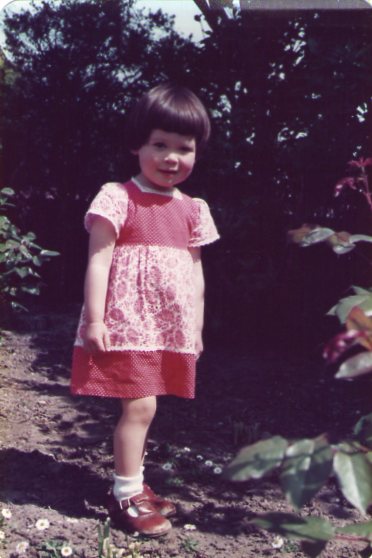
Emily in the garden, aged two-and-a-half
It was an ordinary semi-detached house on the Badger Hill estate.
I had never seen a badger anywhere in its vicinity. The name was merely a ghost of the wooded landscape that must have preceded the tarmac, brown brickwork, and fenced-off areas of lawn.
Our neighbours were an elderly couple, the Ks, who my little sister and I really liked. Although, as a rule, they had no time for ‘foreigners’, like most people with these sorts of prejudices, they were apt to make exceptions.
Our mother had managed to win them over early, due in part to what they believed was her miraculous ability to predict the weather. It didn’t matter that she’d told them she was simply a keen watcher of the BBC forecast, they were adamant it was all down to some mystical Asian charm.
The Ks would keep an eye out for those mornings when our mother emerged from our back door with a bagful of washing, and this would usually be followed an hour or so later by Mrs K stepping outside with a fresh load of her own. This meant, effectively, that if there was a full clothes line in our garden, there would almost always be laundry hanging outside our neighbours’ house too.
Externally, our house may have been indistinguishable from that of our neighbours, but inside there were noticeable differences between where we lived and the houses of our school friends.
In later years, after the deaths of both my parents, people who knew us back then would often recall the ‘exotic’ scents of Mum’s cooking drifting out of our kitchen, the Japanese scrolls and prints hanging on the walls, the miniature stringed koto on the windowsill with its melancholic plinking sound.
There were other differences too, like the many books in my parents’ study and the fact there was a study at all – where my parents worked at desks side-by-side – but it was the Japanese elements, so at odds with the Englishness of that building, that seem to make the biggest impression, probably because they were the least expected.
These seeming contradictions were, of course, entirely normal to me. I had grown up with them. But I’m sure I was influenced by these reactions, which included open-mouthed surprise at times.
In fact, it could have been the first spark of a fascination in me with objects or people that appear in unexpected places and the ways others react to them – a major theme, I’ve realised recently, in a lot of the writing I’ve done in the years since then.
We all get lumbered with mythologies about our character long after we’ve outgrown them. In my family, for instance, I’m thought to be fiercely competitive, keen only to do those things at which I excel.
This version of me came about with good reason: at about ten years old, I asked my mum whether I stood a chance of getting into Oxford or Cambridge; in my teens, I could hardly enjoy exam success if a classmate got 98% when I got only 96; I was so appalled at my ineptitude at driving that once, during a lesson with my dad, I stormed out of the car at traffic lights, leaving him to take the wheel. My parents were amused and bemused by the precocity and ferocity of my ambitions, wondering how I’d acquired such traits.
Friends I first met in my twenties, such as Emily, rarely recognise my family’s characterisation of me. In my own narrative, my competitive streak disappeared during my university years. At Cambridge, I tell myself, I learnt to study simply for the joy of it; I became privileged enough to consider reading and writing and thinking as ends in themselves.
But when Emily commissioned me to write about gymnastics, the memories I mulled over complicated my own version of this change in me.
After years of pestering my parents, they let me join a gym club when I turned seven. Even at that young age, I was acutely aware of the need to catch up with those who’d been training since they were three: I’d get really worked up about competitions, not allowing my parents to watch, and eventually feeling devastated when an excruciating 3.0 on the asymmetric bars led to my demotion from the squad.
But I carried on training throughout my teens, attending as many as five sessions per week, long after I’d accepted that I’d never get back into the first team, let alone really make it as a gymnast.
The experience of practising something that didn’t come naturally gave me a tiny glimpse into my sister’s life. Lou’s cerebral palsy and autism make everyday tasks at least ten times harder for her than they are for me. After years of hearing me talk nineteen to the dozen, she kept on sounding out words in front of the mirror until she eventually said them clearly enough for us to comprehend; after years of watching me cartwheel around the garden, she managed her first steps at six.
Emma Claire and Lou
More remarkable still, Lou undertakes her daily graft with such aplomb that it rarely comes across as onerous. She’ll introduce herself to strangers, trying out her favourite phrases, and she’s invariably the first one on the dance floor and the last one off. Lou’s zest for life is never based on achievement or competition, her sense of self-worth never reliant on beating someone else.
When I made the choice to continue with gymnastics, I came to value the journey without getting fixated on the destination – a lesson that’s served me well when it comes to writing. It strikes me now that I was unwittingly following Lou’s example by doing something simply for the love of it: a quality that comes naturally to her but that was at least ten times harder for me.










 Something Rhymed