
It’s been a week since the last of our first series of Something Rhymed salons, which looked at ways to increase gender parity in the literary world. So now marks a good time to reflect on the ideas we’ve generated during our panel discussions.
The author and books blogger, Kendra Olson, who attended all three salons, has kindly offered us her summary of the series. Over the coming days, we’ll follow on from this by posting up some of the panellists’ talks and some other responses by audience members. And, finally, we’ll collate all the ideas we’ve come up with for accelerating change.
If you came along, now’s your chance to voice any suggestions that you didn’t get to make on the nights. And, if you weren’t able to make it, do get involved in the conversation by using the comment box below.
A Summary of the Something Rhymed Salon Series by Kendra Olson
Over the last month I’ve been attending a series of literary salons in Central London that examine the problem of gender inequality in the literary world and attempt to come up with practical, positive solutions. The salons were run by the talented and generous Emma Claire Sweeney and Emily Midorikawa of Something Rhymed, a blog celebrating female literary friendship.
Emma and Emily brought together an impressive array of panellists for the salons, including women writers and academics, literary editors, critics, performance poets, reviewers, presenters, and the founder of a literary events company committed to diversity in the arts. Regarding the lack of male panellists (Michael Caines of the Times Literary Supplement was the only man on any of the panels), Emma said that they had tried very hard to get male panellists—they initially sought to have equal gender representation–but did not receive much interest from men. This is not to say that men did not attend the salons, because they did—indeed, it seemed to me that each salon brought more men who were intrigued and motivated by the discussion; one of them was the talented Leslie Tate, who has written up his observations on the first two salons on his blog.
The starting point for the discussions was the VIDA count, which has consistently shown a striking imbalance amongst the rates of publication and reviews of male and female writers at the major literary publications. For those who don’t know, VIDA is an organisation representing women in the literary arts, which seeks to examine, publicise and address gender (and other) imbalances in the literary world.
Salon One: VIDA Count
 Michael Caines spoke about unequal representation of female reviewers. Caines speculated that one of the reasons why women are poorly represented is due to editors already having a ready pool of tried and tested male journalists at their disposal. He said that we don’t just need more female fiction reviewers but more female reviewers across all categories–women tend to be given the “lighter” stuff whereas men are given more serious subjects, such as politics.
 BBC presenter and writer, Harriett Gilbert spoke of her experience, saying that literary editors at magazines are far more likely to be women—hers are nearly all female. However, they still tend to choose books by male writers. Her theory is that while women are happy to read books by men and immerse themselves in the male experience, the reverse is not true (this is something that several panellists commented upon over the course of the salons). She believes the problem has far deeper roots than the publishing industry, going all the way back to childhood. After all, it’s easier for a girl to be a tomboy than for a boy to be the reverse. She thinks this is why JK Rowling disguised her sex when writing the Harry Potter books, so that boys could safely walk around with her books. Because of this situation, editors need to ferret out the female reviewers, and female writers should be proactive in seeking reviewing roles. However, alternatives to traditional media should also be considered as publishers are now seeking a variety of publicity models for fear that print media is on its way out.
 Maggie Gee (prolific writer and Vice-President of the Royal Society of Literature) advised young writers to do what they’re interested in and go where they wish—all writers are earning less these days. She recalled Virginia Woolf’s envy of Katherine Mansfield, which Gee put down to there being so few opportunities available for women at the time thus making them direct competitors. Gee encouraged women writers to be supportive of one another. During the discussion she spoke to the value of smaller, independent publishing houses who could take risks with more interesting work.
 The ever inspiring performance poet and author, Salena Godden, a friend of Maggie Gee, said she is wary of labels and that a writer must only concern themselves with bettering the work they wrote yesterday. She read from a poignant essay she wrote for the forbookssake website to promote the Women in Print campaign by Unbound. She also encouraged women writers to put themselves out there and enter competitions and submit their work without the constant expectation of being rejected.
“I believe that if we do not start publishing more women, we only pass on half of our inheritance, half of our heritage, half of the story. If we only hear from the great white shark, we miss all the other diverse voices and fish in the sea.” –Salena Godden, ForBooksSake
During the discussion, the Books Editor for Mslexia, Danuta Kean, stated that we live in a society where 40% of the population is comprised of ethnic minorities, however this is not represented in literature and publishing. She said that it was up to publishing representatives to change the situation.
Salon Two: So-called Women’s Issues
The second salon analysed why books about women and so-called women’s issues are so often devalued by the literary establishment. Why is it that the experiences and perspectives of women are seen as less than that of men? Is this because women have, traditionally, written about the home and family whereas men, as per their historical life roles, have explored, experienced and thus written about the wider world? Why is one experience seen as valid and not the other? Is this the reason for devaluing women’s literature, or are there other issues at play?

The journalist and literary critic, Arifa Akbar (formerly of The Independent) said that while the idea of women’s fiction is a helpful category, it is also a trap. It means you can be pushed to the side-lines more easily. Margaret Atwood suddenly becomes women’s fiction. When women read men’s writing we universalise it, but the reverse doesn’t happen. Conversely, the domestic novel is only domestic when a woman writes it, not when it’s by Philip Roth or Karl Ove Knausgård. She said that newspaper and magazine editors need to be aware of this and give equal space to women writers—she was unsure if these editors were indeed conscious of not doing so—and that women writers have a duty to make them mindful of this.
 Bestselling historical fiction author, Karen Maitland, attended an all-girls school yet the only female novelist they read was Jane Austen, and she wrote about husband-hunting! Karen said that she became interested in historical fiction because of the beguinages (the medieval cities of women). She said that at historical fiction conferences, male authors are often given more credit than female authors when it comes to what are seen as male fields (weaponry etc). She was unsure if it worked the other way around. She also related an experience she’d had in a bookstore recently where the (male) bookstore owner had actually separated all the books by the gender of the writer (even those writers who used gender neutral pseudonyms) in order to ensure (one would presume) that his male customers did not “accidentally” buy a book written by a woman! Karen wondered if the advent of ebooks might actually change men’s buying habits as the book cover isn’t visible.
 Booker Prize shortlisted novelist, Michèle Roberts, reminded us that women invented the novel. But most of our institutions – education, the law, the media etc. – have been dominated by men. She thought that the younger generation of men was changing, but that these changes need to be carried out in a wider cultural arena for there to be changes in the literary world. She said that having a women’s writing group is one of the things which has kept her going as it offers close critical reading and support.
 Sarah LeFanu, former senior editor at The Women’s Press and one of the three members of Michèle’s writing group, said the issue of gender disparity in publishing has been depoliticised. Nowadays if you complain about it you’re seen as whinging. But the issue remains as political as it ever was. As an example of this she cited last year’s Penguin anthology of short stories, which featured 18 women writers and 30 men! She was concerned that women don’t take up all the space that should be available to them—particularly in this day and age when publishers are so risk averse. She said good writing does not have a gender bias. She also encouraged participants to write about these issues and to talk about why the books they enjoy aren’t being read and reviewed more widely.
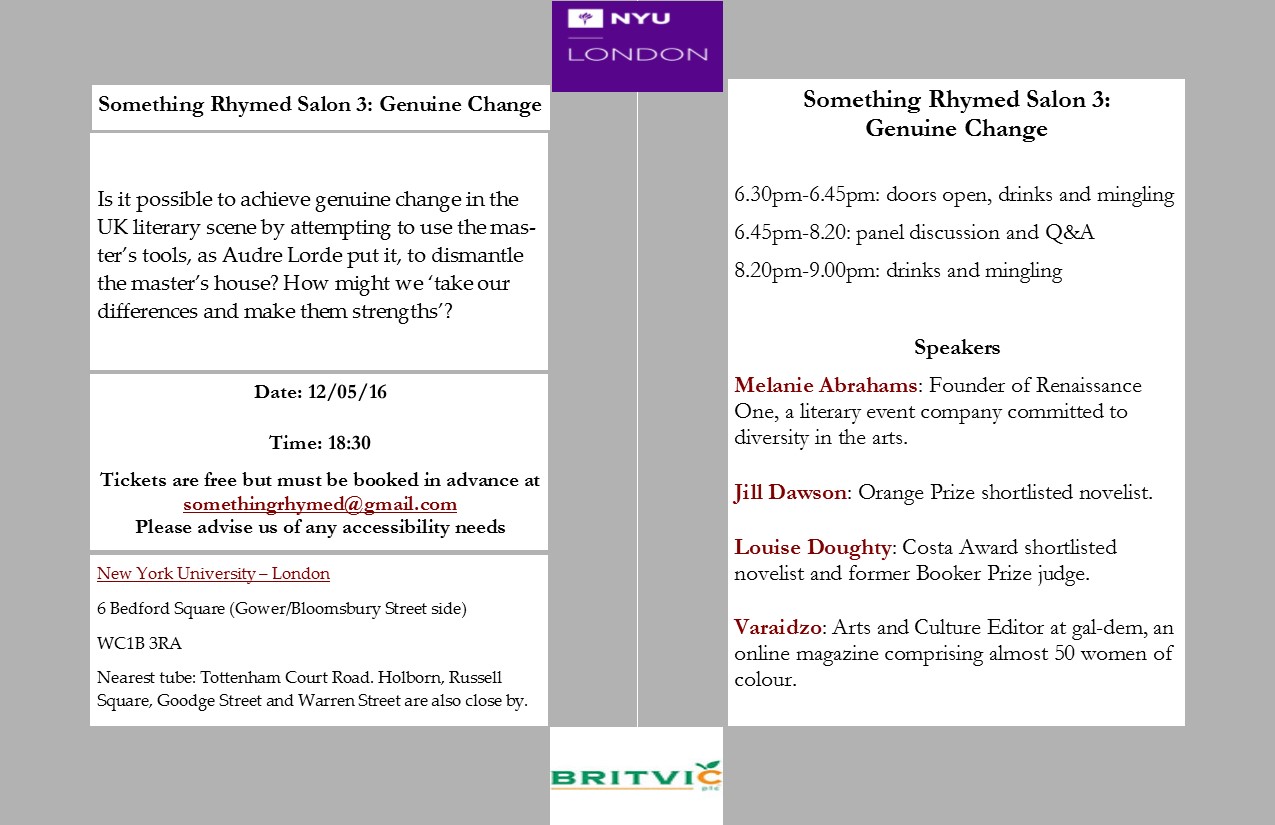
Salon Three: Genuine Change
The final salon aimed to come up with solutions, not only in regards to gender disparity but also in regards to ethnicity, class, ability and sexuality. As one speaker put it, our literature should represent our society as a whole, and all the diversity within it.
 Varaidzo, arts and culture editor at gal-dem (an online magazine produced by women of colour), said she’s been quite critical about the lack of scope in the British publishing industry. But, in some ways, her own journey has been relatively easy. She attributed this to growing up during the time of the internet and being able to navigate that space and talk to the people she wanted to fairly easily. Regarding the topic of education and children’s books, she noted that very few children’s authors manage to transcend gender—the boys go out and do things while the girls are introspective.
 Orange Prize shortlisted novelist, Jill Dawson, who has guest blogged on SomethingRhymed, said the issue is as much about sexuality, class etc. as it is about gender. She said that working class women need more literary role models (currently the women represented in mainstream publishing are mostly from the Oxbridge educated class). As a young woman, she read a lot of African-American women as their writing spoke to her in a way that, for example, Martin Amis’s writing did not. What interested her was that they had a unique vernacular and voice. They too were struggling (Maya Angelou for example), and their words continued to influence Jill when she became a young, single mother. She encouraged people to think about who and what they’re reading, as changing our reading habits and reading more widely is one way of changing the literary landscape.
 Former Booker Prize judge and Costa Award shortlisted novelist, Louise Doughty, who has also guest blogged on Something Rhymed, spoke to the benefits of the internet age. Since publications can be crowdfunded and there is online publishing, websites etc. For example, VIDA came out of the work of one person. The opportunities for writers now are small but multiple, and while not all ventures will be successful, some will be. While publishers claim to be desperate for new voices, at the same time their (conservative minded) sales and marketing teams are at their backs. These people can only go on what is already selling and are therefore always chasing last year’s successes and unwilling to take risks on new voices.
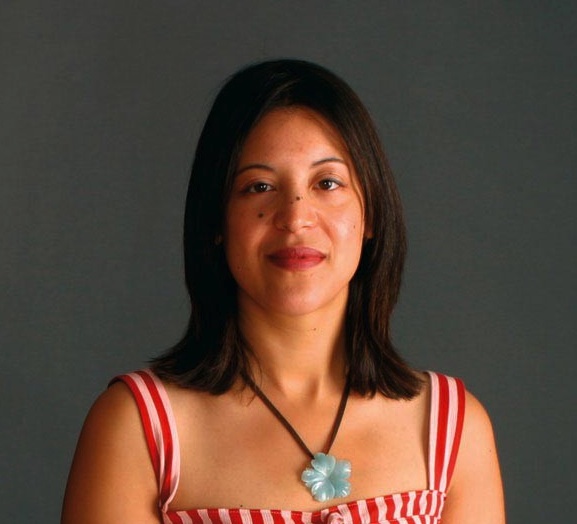 Melanie Abrahams, the founder of Renaissance One, a literary events company committed to diversity in the arts, said that while there may be a lot of noise made about a title online, that doesn’t necessarily equate to a lot of sales. Traditional publishing has changed very little over the years and the internet doesn’t always affect that. She claimed to know a lot of writers who are successful and don’t use social media at all.
During the discussion, an audience member who is a professor at both Goldsmiths and New York University spoke about the fact that she was able to choose her own readings for her students at NYU, but at Goldsmiths she had to teach a pre-devised syllabus. The Art of the Novel course, for instance, included only one or two female authors.
The issue of prizes came up a few times during the salons. In the first salon, Michael Caines wondered if the judging committees of literary awards should be assessed for gender parity. This was an issue which Maggie Gee and Michèle Roberts spoke of as well, recounting how they’d had to argue to get female novelists shortlisted when judging major literary awards.
While I’m still relatively new to the literary scene, I found the salons enlightening, thoughtful and very accessible–a delightful surprise as they could easily have turned out to be somewhat cliquish and depressing. In fact, the organisers did such a wonderful job of creating a welcoming, friendly and supportive atmosphere that I stayed until the end—and am very glad I did as I had lots of lovely conversations afterwards.
Reflecting on my own experience, I have to admit that I’ve perhaps read more men than women in the past, but in the last few years this has changed dramatically. These days nearly all of the books I read are by women—not because I’ve made a conscious decision to read more women writers, but simply because I’m lucky enough to benefit from many female literary friendships and I’m interested in getting to know the work of these authors and the work of the writers they enjoy. This is not to say that I’ve stopped enjoying the work of male writers—not at all—but perhaps the circles I move in as an author with a small, independent publisher means that I’m more likely to discover the work of female authors.
What do you think? Are you a woman writer, or do you work in publishing? If so, what has your experience been? Regardless, do you have an idea for accelerating change? Please do leave a comment below.




 Something Rhymed