At the first Something Rhymed Salon, Salena Godden read from an essay that was originally published on For Books’ Sake – a site that champions writing by women. She has kindly given us permission to re-blog it here.
She originally wrote the piece in 2014 to tie in with the Women in Print campaign by the innovative publisher, Unbound, which tried to tackle the wider gender imbalance in the publishing industry.
It wasn’t intentional to publish both books in the same year but that’s the way the cards fell and I followed the bread crumbs up the path to find myself here today.
I began work on Springfield Road in 2006 – but before that I wrote poetry, short stories and songs in my band SaltPeter. Back in the early 1990’s I was idealistic and fearless. I’d been working on a novel and I thought I finally had something worth reading. I boldly booked a meeting with a well-known publisher.
I remember bowling into the glass offices alone, with no manager or agent, just me and my manuscript. I also gave him a beautiful mock-up of the book, complete with images, artwork and layout, which a designer friend had been working on with me. After he’d read it, the publisher was kind about it. Looking back, he was very generous, but then he said something I’ll never forget… he told me it was ‘too brave’ for a first novel.
The publisher closed that meeting by suggesting I read Bridget Jones and try writing chick-lit and then come back to him. That was the summer Bridget Jones’s Diary was buzzing like an incessant vibrating lipstick. I have never attempted to write a chick-lit, but that first rejection and those words ‘too brave’ stayed with me.
Springfield Road was initially sold to a major publishing house. After four years we went our separate ways, and now it seems that bravery was what was required. It was frustrating to watch my story chopped to bits in order to try and make it fit into another commercial genre, the misery memoir.
The bravest thing I could do was to take my book back, re-write and publish it my way and to never, ever give up. I think of 2006-2010 and being signed to a major publisher as my writer’s training ground; I learned how to fake that I had a thick skin, I learned some patience. Most importantly I learned to read my own compass and to be sure to stay true and tell my story my way.
Working with Unbound I have the sense of being in a team whilst also still being independent. Writing is hard work, the crowd funding process was hard work and now spreading the word about both books is hard work too.
But I have my Unbound family and editor Rachael Kerr behind me, I adore our working relationship and friendship. Burning Eye’s Clive Birnie has great passion for publishing, Burning Eye Books is boldly setting out to show us that ‘spoken word’ does work on the page.
They also publish an above average number of women. My golden rule has always been to go where the love is, there is a real love for books here.
When I was a little girl I spent much of my time upside down or spinning in circles. I have always had an awareness that there is more, ok to put it bluntly, I have always had an interest in getting out of my head to get into my head. As a teenager I was drawn to literature of a hedonistic nature.
I devoured books like Tom Wolfe’s The Electric Kool Aid Acid Test and Fear and Loathing in Las Vegas by Hunter S Thompson, the work of William Burroughs, Timothy Leary, the Beats and Jack Kerouac.
I searched high and low for women’s stories, I read Carolyn Cassady’s Off The Road a miserable account of the reality of rent and babies, depression and poverty, whilst her husband Neal Cassady is On The Road with Kerouac enjoying orgies of pot and LSD.
Next I discovered Joyce Johnson’s book Minor Charactersabout 1950’s New York, she writes about her time with the beats, Allen Ginsberg and William and Joan Burroughs.
Again this is a portrayal of being an observer, of not being of any importance to the party, the movement or the revolution. As for William Burroughs, his wife Joan was shot, it was an accident, a trick that went wrong, but she is now listed as not much more than a footnote in the weird and wonderful Burroughs experiments.
These curious and curiouser worlds of experimentation and hedonism it seems have always been narrated by men and from the male perspective. I want to read about female ejaculation. Ha! Seriously, I want to read books by women about women on the front line and in the trenches.
I want to read books by women about the passion and the sacrifices we make living this writing life, writing this living life. I want to see more places set for women at that great table that is the feast of books.
I believe that if we do not start publishing more women, we only pass on half of our inheritance, half of our heritage, half of the story. If we only hear from the great white shark, we miss all the other diverse voices and fish in the sea.
It is no accident that I mostly read men when I was a teenager, back then it seemed to me that was where the party was. It took me years to stumble upon the great Jean Rhys and her vivid 1930’s boozy Paris.
One of my all-time favourite novels Good Morning, Midnight was hidden from me, overshadowed by the likes of Henry Miller and Louis Ferdinand Celine.
Writing Springfield Road I realise now I was trying to narrate a time and place in childhood, to capture it and hold it up in a jam jar for us to see the wings, as you might a butterfly, and then to set it free and watch it fly. I couldn’t find the book I wanted to read in the library, so I wrote it, to paraphrase Toni Morrison.
I wanted to write a story from how the world looked to me as the half caste kid, the alien with the green eyes in a brown face. Both Fishing In The Aftermath and Springfield Road burn with the frustration of longing to belong, of being invisible, yet pull on strength found in the freedom of being an outsider. I am wary of labels and boxes and lists, I feel they only serve to distract and divide writers.
A writer must only concern herself that what she writes today is better than yesterday, she must compete with the better work of her own making tomorrow. Every morning, man or woman, we surely all begin with the same fight: Writer V’s Empty Page.
Today there are millions of mixed race, cloud bothering, daydreamers, little girls spinning in circles getting dizzy in playgrounds all over Britain – And as I write this I say hail to each and every one of them, may they all be too brave.
If any of you have stories about your struggles to be accepted by the literary establishment, please do share them using the comment facility below.
It’s been a week since the last of our first series of Something Rhymed salons, which looked at ways to increase gender parity in the literary world. So now marks a good time to reflect on the ideas we’ve generated during our panel discussions.
The author and books blogger, Kendra Olson, who attended all three salons, has kindly offered us her summary of the series. Over the coming days, we’ll follow on from this by posting up some of the panellists’ talks and some other responses by audience members. And, finally, we’ll collate all the ideas we’ve come up with for accelerating change.
If you came along, now’s your chance to voice any suggestions that you didn’t get to make on the nights. And, if you weren’t able to make it, do get involved in the conversation by using the comment box below.
A Summary of the Something Rhymed Salon Series by Kendra Olson
Over the last month I’ve been attending a series of literary salons in Central London that examine the problem of gender inequality in the literary world and attempt to come up with practical, positive solutions. The salons were run by the talented and generous Emma Claire Sweeney and Emily Midorikawa of Something Rhymed, a blog celebrating female literary friendship.
Emma and Emily brought together an impressive array of panellists for the salons, including women writers and academics, literary editors, critics, performance poets, reviewers, presenters, and the founder of a literary events company committed to diversity in the arts. Regarding the lack of male panellists (Michael Caines of the Times Literary Supplement was the only man on any of the panels), Emma said that they had tried very hard to get male panellists—they initially sought to have equal gender representation–but did not receive much interest from men. This is not to say that men did not attend the salons, because they did—indeed, it seemed to me that each salon brought more men who were intrigued and motivated by the discussion; one of them was the talented Leslie Tate, who has written up his observations on the first two salons on his blog.
The starting point for the discussions was the VIDA count, which has consistently shown a striking imbalance amongst the rates of publication and reviews of male and female writers at the major literary publications. For those who don’t know, VIDA is an organisation representing women in the literary arts, which seeks to examine, publicise and address gender (and other) imbalances in the literary world.
Salon One: VIDA Count
Michael Caines spoke about unequal representation of female reviewers. Caines speculated that one of the reasons why women are poorly represented is due to editors already having a ready pool of tried and tested male journalists at their disposal. He said that we don’t just need more female fiction reviewers but more female reviewers across all categories–women tend to be given the “lighter” stuff whereas men are given more serious subjects, such as politics.
BBC presenter and writer, Harriett Gilbert spoke of her experience, saying that literary editors at magazines are far more likely to be women—hers are nearly all female. However, they still tend to choose books by male writers. Her theory is that while women are happy to read books by men and immerse themselves in the male experience, the reverse is not true (this is something that several panellists commented upon over the course of the salons). She believes the problem has far deeper roots than the publishing industry, going all the way back to childhood. After all, it’s easier for a girl to be a tomboy than for a boy to be the reverse. She thinks this is why JK Rowling disguised her sex when writing the Harry Potter books, so that boys could safely walk around with her books. Because of this situation, editors need to ferret out the female reviewers, and female writers should be proactive in seeking reviewing roles. However, alternatives to traditional media should also be considered as publishers are now seeking a variety of publicity models for fear that print media is on its way out.
Maggie Gee (prolific writer and Vice-President of the Royal Society of Literature) advised young writers to do what they’re interested in and go where they wish—all writers are earning less these days. She recalled Virginia Woolf’s envy of Katherine Mansfield, which Gee put down to there being so few opportunities available for women at the time thus making them direct competitors. Gee encouraged women writers to be supportive of one another. During the discussion she spoke to the value of smaller, independent publishing houses who could take risks with more interesting work.
The ever inspiring performance poet and author, Salena Godden, a friend of Maggie Gee, said she is wary of labels and that a writer must only concern themselves with bettering the work they wrote yesterday. She read from a poignant essay she wrote for the forbookssake website to promote the Women in Print campaign by Unbound. She also encouraged women writers to put themselves out there and enter competitions and submit their work without the constant expectation of being rejected.
“I believe that if we do not start publishing more women, we only pass on half of our inheritance, half of our heritage, half of the story. If we only hear from the great white shark, we miss all the other diverse voices and fish in the sea.” –Salena Godden, ForBooksSake
During the discussion, the Books Editor for Mslexia, Danuta Kean, stated that we live in a society where 40% of the population is comprised of ethnic minorities, however this is not represented in literature and publishing. She said that it was up to publishing representatives to change the situation.
Salon Two: So-called Women’s Issues
The second salon analysed why books about women and so-called women’s issues are so often devalued by the literary establishment. Why is it that the experiences and perspectives of women are seen as less than that of men? Is this because women have, traditionally, written about the home and family whereas men, as per their historical life roles, have explored, experienced and thus written about the wider world? Why is one experience seen as valid and not the other? Is this the reason for devaluing women’s literature, or are there other issues at play?
The journalist and literary critic, Arifa Akbar (formerly of The Independent) said that while the idea of women’s fiction is a helpful category, it is also a trap. It means you can be pushed to the side-lines more easily. Margaret Atwood suddenly becomes women’s fiction. When women read men’s writing we universalise it, but the reverse doesn’t happen. Conversely, the domestic novel is only domestic when a woman writes it, not when it’s by Philip Roth or Karl Ove Knausgård. She said that newspaper and magazine editors need to be aware of this and give equal space to women writers—she was unsure if these editors were indeed conscious of not doing so—and that women writers have a duty to make them mindful of this.
Bestselling historical fiction author, Karen Maitland, attended an all-girls school yet the only female novelist they read was Jane Austen, and she wrote about husband-hunting! Karen said that she became interested in historical fiction because of the beguinages (the medieval cities of women). She said that at historical fiction conferences, male authors are often given more credit than female authors when it comes to what are seen as male fields (weaponry etc). She was unsure if it worked the other way around. She also related an experience she’d had in a bookstore recently where the (male) bookstore owner had actually separated all the books by the gender of the writer (even those writers who used gender neutral pseudonyms) in order to ensure (one would presume) that his male customers did not “accidentally” buy a book written by a woman! Karen wondered if the advent of ebooks might actually change men’s buying habits as the book cover isn’t visible.
Booker Prize shortlisted novelist, Michèle Roberts, reminded us that women invented the novel. But most of our institutions – education, the law, the media etc. – have been dominated by men. She thought that the younger generation of men was changing, but that these changes need to be carried out in a wider cultural arena for there to be changes in the literary world. She said that having a women’s writing group is one of the things which has kept her going as it offers close critical reading and support.
Sarah LeFanu, former senior editor at The Women’s Press and one of the three members of Michèle’s writing group, said the issue of gender disparity in publishing has been depoliticised. Nowadays if you complain about it you’re seen as whinging. But the issue remains as political as it ever was. As an example of this she cited last year’s Penguin anthology of short stories, which featured 18 women writers and 30 men! She was concerned that women don’t take up all the space that should be available to them—particularly in this day and age when publishers are so risk averse. She said good writing does not have a gender bias. She also encouraged participants to write about these issues and to talk about why the books they enjoy aren’t being read and reviewed more widely.
Salon Three: Genuine Change
The final salon aimed to come up with solutions, not only in regards to gender disparity but also in regards to ethnicity, class, ability and sexuality. As one speaker put it, our literature should represent our society as a whole, and all the diversity within it.
Varaidzo, arts and culture editor at gal-dem (an online magazine produced by women of colour), said she’s been quite critical about the lack of scope in the British publishing industry. But, in some ways, her own journey has been relatively easy. She attributed this to growing up during the time of the internet and being able to navigate that space and talk to the people she wanted to fairly easily. Regarding the topic of education and children’s books, she noted that very few children’s authors manage to transcend gender—the boys go out and do things while the girls are introspective.
Orange Prize shortlisted novelist, Jill Dawson, who has guest blogged on SomethingRhymed, said the issue is as much about sexuality, class etc. as it is about gender. She said that working class women need more literary role models (currently the women represented in mainstream publishing are mostly from the Oxbridge educated class). As a young woman, she read a lot of African-American women as their writing spoke to her in a way that, for example, Martin Amis’s writing did not. What interested her was that they had a unique vernacular and voice. They too were struggling (Maya Angelou for example), and their words continued to influence Jill when she became a young, single mother. She encouraged people to think about who and what they’re reading, as changing our reading habits and reading more widely is one way of changing the literary landscape.
Former Booker Prize judge and Costa Award shortlisted novelist, Louise Doughty, who has also guest blogged on Something Rhymed, spoke to the benefits of the internet age. Since publications can be crowdfunded and there is online publishing, websites etc. For example, VIDA came out of the work of one person. The opportunities for writers now are small but multiple, and while not all ventures will be successful, some will be. While publishers claim to be desperate for new voices, at the same time their (conservative minded) sales and marketing teams are at their backs. These people can only go on what is already selling and are therefore always chasing last year’s successes and unwilling to take risks on new voices.
Melanie Abrahams, the founder of Renaissance One, a literary events company committed to diversity in the arts, said that while there may be a lot of noise made about a title online, that doesn’t necessarily equate to a lot of sales. Traditional publishing has changed very little over the years and the internet doesn’t always affect that. She claimed to know a lot of writers who are successful and don’t use social media at all.
Kendra Olson
During the discussion, an audience member who is a professor at both Goldsmiths and New York University spoke about the fact that she was able to choose her own readings for her students at NYU, but at Goldsmiths she had to teach a pre-devised syllabus. The Art of the Novel course, for instance, included only one or two female authors.
The issue of prizes came up a few times during the salons. In the first salon, Michael Caines wondered if the judging committees of literary awards should be assessed for gender parity. This was an issue which Maggie Gee and Michèle Roberts spoke of as well, recounting how they’d had to argue to get female novelists shortlisted when judging major literary awards.
While I’m still relatively new to the literary scene, I found the salons enlightening, thoughtful and very accessible–a delightful surprise as they could easily have turned out to be somewhat cliquish and depressing. In fact, the organisers did such a wonderful job of creating a welcoming, friendly and supportive atmosphere that I stayed until the end—and am very glad I did as I had lots of lovely conversations afterwards.
Reflecting on my own experience, I have to admit that I’ve perhaps read more men than women in the past, but in the last few years this has changed dramatically. These days nearly all of the books I read are by women—not because I’ve made a conscious decision to read more women writers, but simply because I’m lucky enough to benefit from many female literary friendships and I’m interested in getting to know the work of these authors and the work of the writers they enjoy. This is not to say that I’ve stopped enjoying the work of male writers—not at all—but perhaps the circles I move in as an author with a small, independent publisher means that I’m more likely to discover the work of female authors.
What do you think? Are you a woman writer, or do you work in publishing? If so, what has your experience been? Regardless, do you have an idea for accelerating change? Please do leave a comment below.
Our friends at Naked Wines, who kindly provided the wines for our salon series, are offering a special discount even for those of you who couldn’t come along in person.
Please meet Varaidzo, the final speaker in this Thursday’s line-up. We’re really looking forward to her thoughts on how best to accelerate gender equality in the literary world.
We still have a few spots left, so please do join in the conversation by emailing us on SomethingRhymed@gmail.com to make one of them yours.
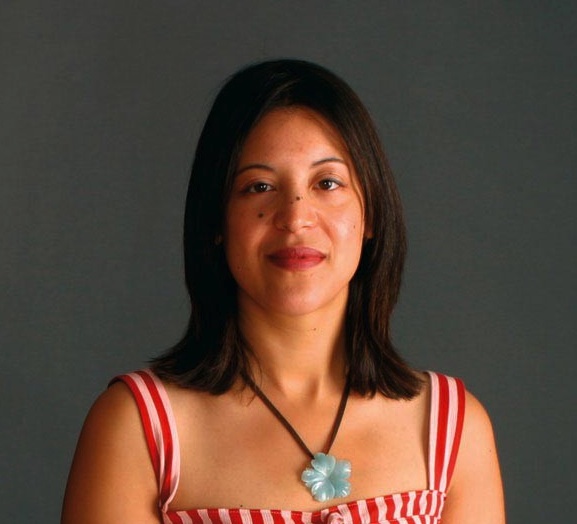
Varaidzo is a writer, editor and film programmer with a focus on storytelling through fiction, journalism and film. She is an editor at gal-dem.com, an online media platform produced by women of colour, and curates the gal-dem Winter Film Festival which showcases work solely by women of colour filmmakers. As a speaker, she regularly advises film and publishing organisations on how to engage young people and ethnic minorities with media industries. Her writing has appeared in Media Diversified and New Statesman, and her forthcoming essay on navigating black childhood in white spaces will be published in The Good Immigrant(September, 2016)
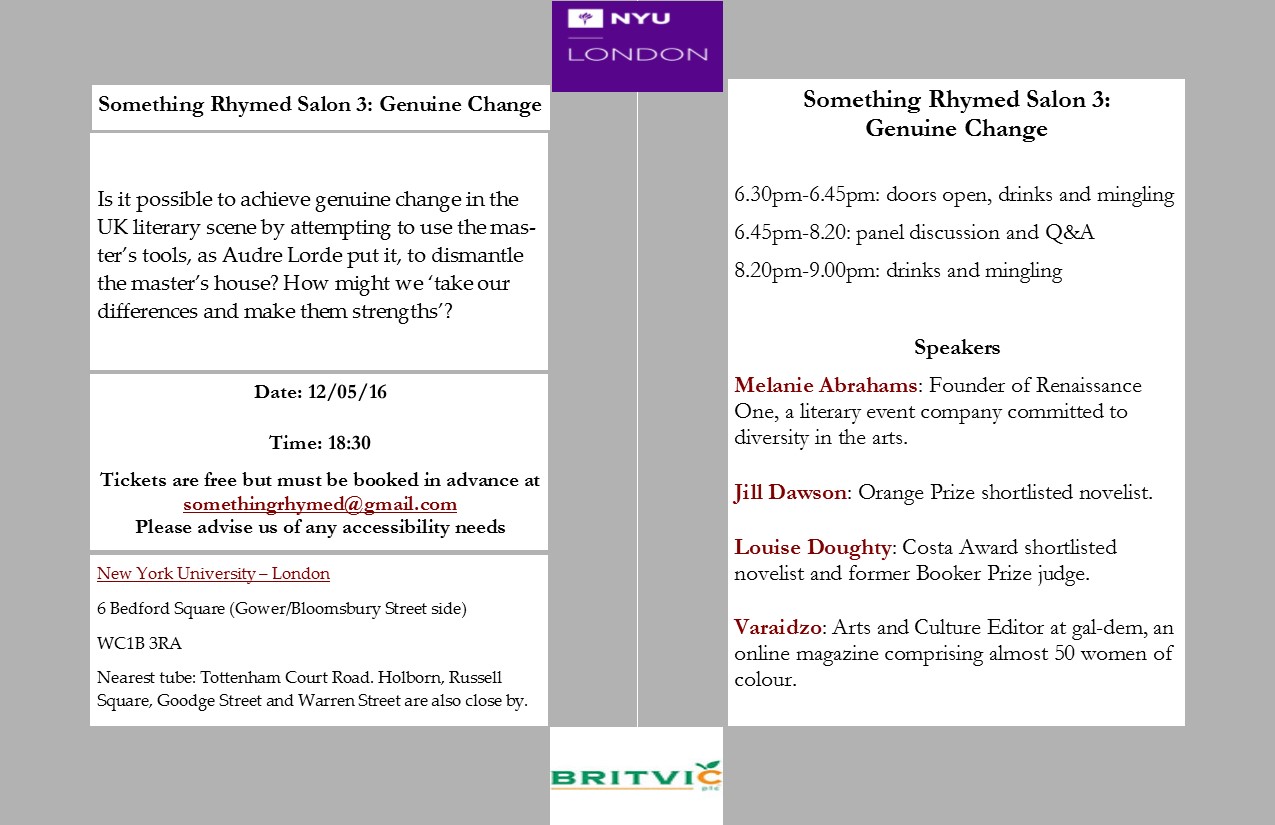
Melanie Abrahams, founder of an events company dedicated to diversity in the arts, will be joining us this Thursday at the third and final Something Rhymed salon. Here we will ask whether it is possible to achieve genuine change in the UK literary scene by attempting to use the master’s tools, as Audre Lorde put it, to dismantle the master’s house.
If you’d like to hear Melanie’s ideas for accelerating positive change and also share your own, please email us at somethingrhymed@gmail.com to book one of the last spots.
Melanie Abrahams is a curator, producer and speaker, who has channeled a love of books and words into projects and escapades. She has curated events and festivals both independently, and through her companies Renaissance One and Tilt, for the Bluecoat, Chris Ofili, Miami Book Fair International and Southbank Centre. As a literature producer, she has shaped poetry videos for BBC’s The Space with Chris Redmond, and has toured with writers including Ali Smith, Amiri Baraka, Patience Agbabi and Caryl Phillips. This year she partners with the British Library to present London Is The Place For Me, a Caribbean festival of literature and liming, as part of a wider project exploring the theme of independence, and contributes fifty one-to-ones, and supporting public events, to writers and practitioners around England.
Here at Something Rhymed, we take any opportunity to celebrate female literary friendship. It is therefore with great pleasure that we welcome Louise Doughty, a dear novelist friend of Jill Dawson, to our third and final salon.
Longstanding readers will already know about Jill’s bond with the Australian writer, Kathryn Heyman, because this pair kicked off our guest blog series back in 2014. Similarly, Louise blogged for us with one of her old friends, Jacqui Lofthouse.
We’ll look forward to seeing Jill and Louise together this coming Thursday, May 12th, and to hearing their ideas for achieving greater diversity in the literary world.
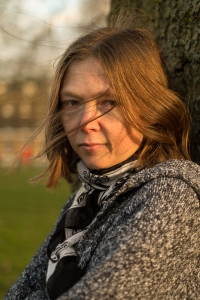
Louise Doughty’s eighth novel, Black Water, will be published on 2nd June. Her most recent book was the top ten bestseller Apple Tree Yard, published in 2013 by Faber & Faber UK and Farrar Straus & Giroux New York. It was longlisted for the Guardian Not the Booker Prize, shortlisted for the CWA Steel Dagger Award and the National Book Award Thriller of the Year and is published or being translated into twenty-seven languages worldwide. A four-part BBC1 adaptation is currently in production with Emily Watson in the lead role. Doughty’s sixth novel, Whatever You Love, was shortlisted for the Costa Novel Award and longlisted for the Orange Prize for Fiction. She has also won awards for radio drama and short stories, along with publishing one work of non-fiction, A Novel in a Year, based on her popular newspaper column. She is a critic and cultural commentator for UK and international newspapers and broadcasts regularly for the BBC.
We are delighted to welcome award-winning novelist, Jill Dawson, to our third and final salon in this series. Jill will be helping us to come up with strategies for improving diversity in the literary world.
Jill Dawson is the author of nine novels and winner of an Eric Gregory Award for poetry. Fred and Edie, her third novel, published in 2001, was shortlisted for the Orange and Whitbread prizes and voted ‘one of fifty essential novels by a living author’. The Great Lover, about the poet Rupert Brooke, was a best-seller and Richard and Judy book-club choice. Her seventh novel, Lucky Bunny, won a Fiction Uncovered award. The Tell-Tale Heart was nominated for the Folio Prize. Her latest, about the writer Patricia Highsmith, is The Crime Writer, to be published 2016. In addition Jill is a tutor of creative writing, credited with bringing many new writers to publication through the one to one mentoring scheme she set up, Gold Dust (www.gold-dust.org.uk).
Please join Jill and us this coming Thursday for drinks, snacks and fruitful conversation.
We had another full house last night at our second Something Rhymed Salon, when we talked about the devaluing of so-called women’s issues. Our speakers fed us a gloriously varied platter of food for the mind, and the conversation continued over madeleines, sparkling water and plenty of wine.
Emily and I were pleased to welcome both men and women to our shindig, and we were particularly happy to hear people comment on the friendly atmosphere created by our fantastic panellists: Arifa Akbar, Sarah LeFanu, Karen Maitland and Michèle Roberts.
Do join us for our third and final salon, next Thursday May 12th at 6.30pm, when we’ll have an equally stellar line-up:
Melanie Abrahams: Founder of Renaissance One – a literary events company committed to diversity in the arts.
At tonight’s Something Rhymed salon, journalist and literary critic, Arifa Akbar, will be sharing a behind-the-scenes glimpse of her experiences as a literary editor and reviewer.
If you would like to join in the conversation, please nab one of the last spots by emailing SomethingRhymed@gmail.com.
The Independent Arts Correspondant Arifa Akbar.
Arifa Akbar is a journalist and literary critic. She is the former literary editor of The Independent, where she worked from October 2001 until April 2016, as a reporter and arts correspondent before joining the books desk in 2009.
She was a judge for the Orwell Prize in 2013, the Fiction Uncovered Prize in 2014, and the British Book Industry Award in 2016.
Arifa has chaired author interviews at the London Literature Festival, Foyles, Asia House and the Bath Literature Festival.
She is a regular newspaper reviewer on Sky News, and reviews books in print and on radio. She studied English Literature at university and then completed a Masters in Gender Studies, specialising in French Feminism and ‘writing the body’.
We are honoured that Michèle Roberts has agreed to speak about the devaluing of so-called ‘women’s issues’ at tomorrow’s Something Rhymed salon.
Female friendship is at the heart of her writing and feminism – something she reflected on with her own literary friend, Sarah LeFanu, in September’s guest post.
Michèle Roberts (left) and Sarah LeFanu (right) at Sissinghurst in 1981.
Michèle Roberts has published over twenty books: novels, poetry, essays, memoir, artist’s books. She is Professor Emeritus at the University of East Anglia, a Chavalier dans l’Ordre des Arts et des Lettres, and a Fellow of the Royal Society of Literature. Her latest publication, with Jenny Newman and Sarah LeFanu, is The Lille Diaries. She currently teaches a Guardian Masterclass (mistressclass?) on novel-writing.
We are delighted that Sarah LeFanu has agreed to share her wealth of experience with us at the Arts Council sponsored Something Rhymed salon on May 4th. It will be a particular delight to meet Sarah since we were so captivated by the thoughts on female literary friendship that she explored in her guest post last year.
Sarah LeFanu
Sarah LeFanu was an editor at The Women’s Press for ten years, and was responsible for their ground-breaking feminist science fiction list. She has edited seven anthologies of original stories (including three all-women anthologies), and her books include Rose Macaulay: A Biography and its companion volume, Dreaming of Rose: A Biographer’s Journal. For six years (2003 – 2009) she was Artistic Director of the Bath Literature Festival, where she consistently promoted women writers.
If you would like to join Sarah LeFanu, Karen Maitland, Arifa Akbar and Michele Roberts to discuss the problem of gender inequality in the literary world, do email us at SomethingRhgymed@gmail.com.

 I feel a little nervous writing about this campaign as I’m only just now in print after over two decades of rejections and near misses. The poetry collection Fishing In The Aftermath poems 1994-2014 came out in July with Burning Eye Books and the childhood memoir Springfield Road was published in October with Unbound.
 They also publish an above average number of women. My golden rule has always been to go where the love is, there is a real love for books here.
 Michael Caines
  BBC presenter and writer,
 The ever inspiring performance poet and author,






 Something Rhymed