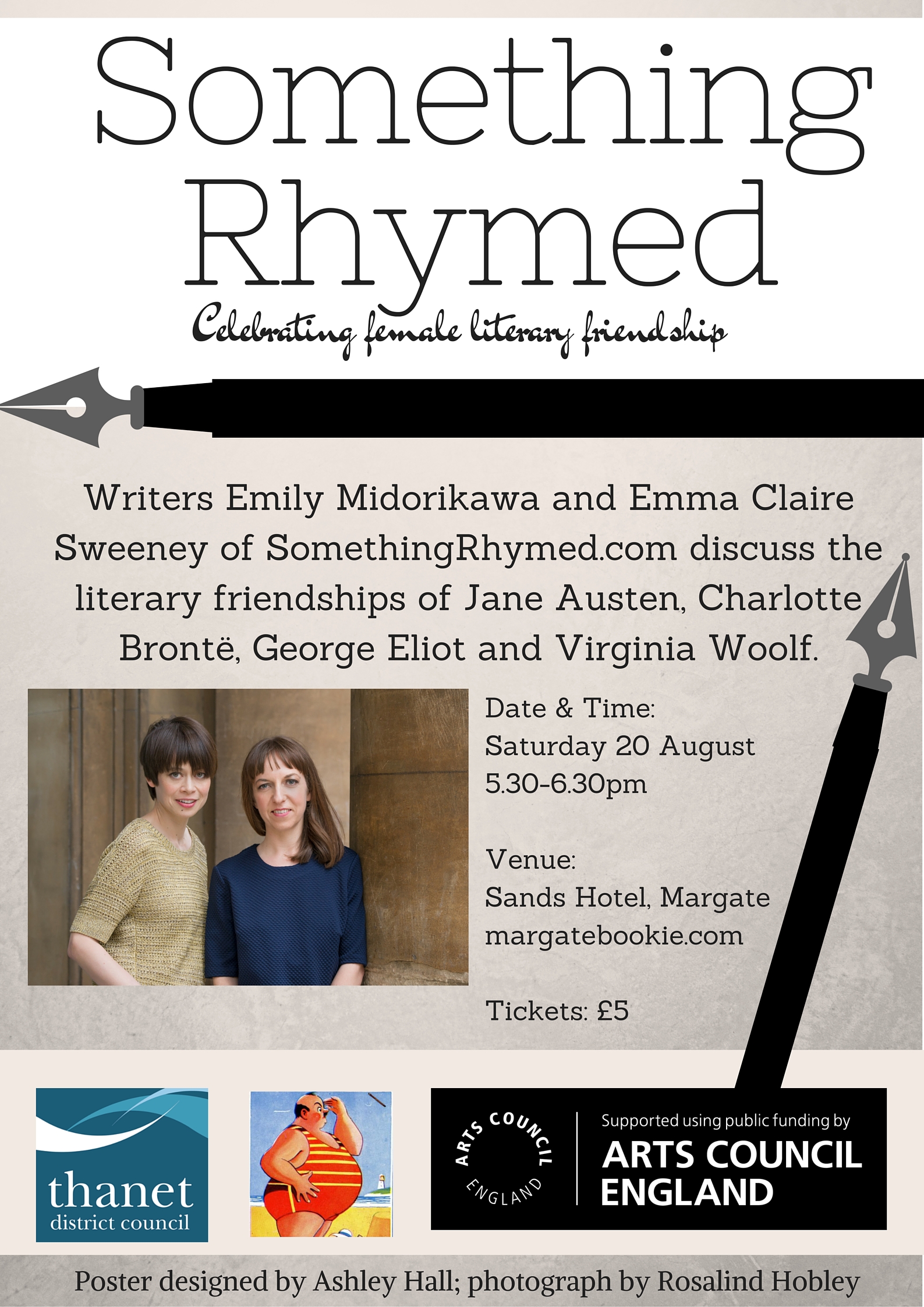
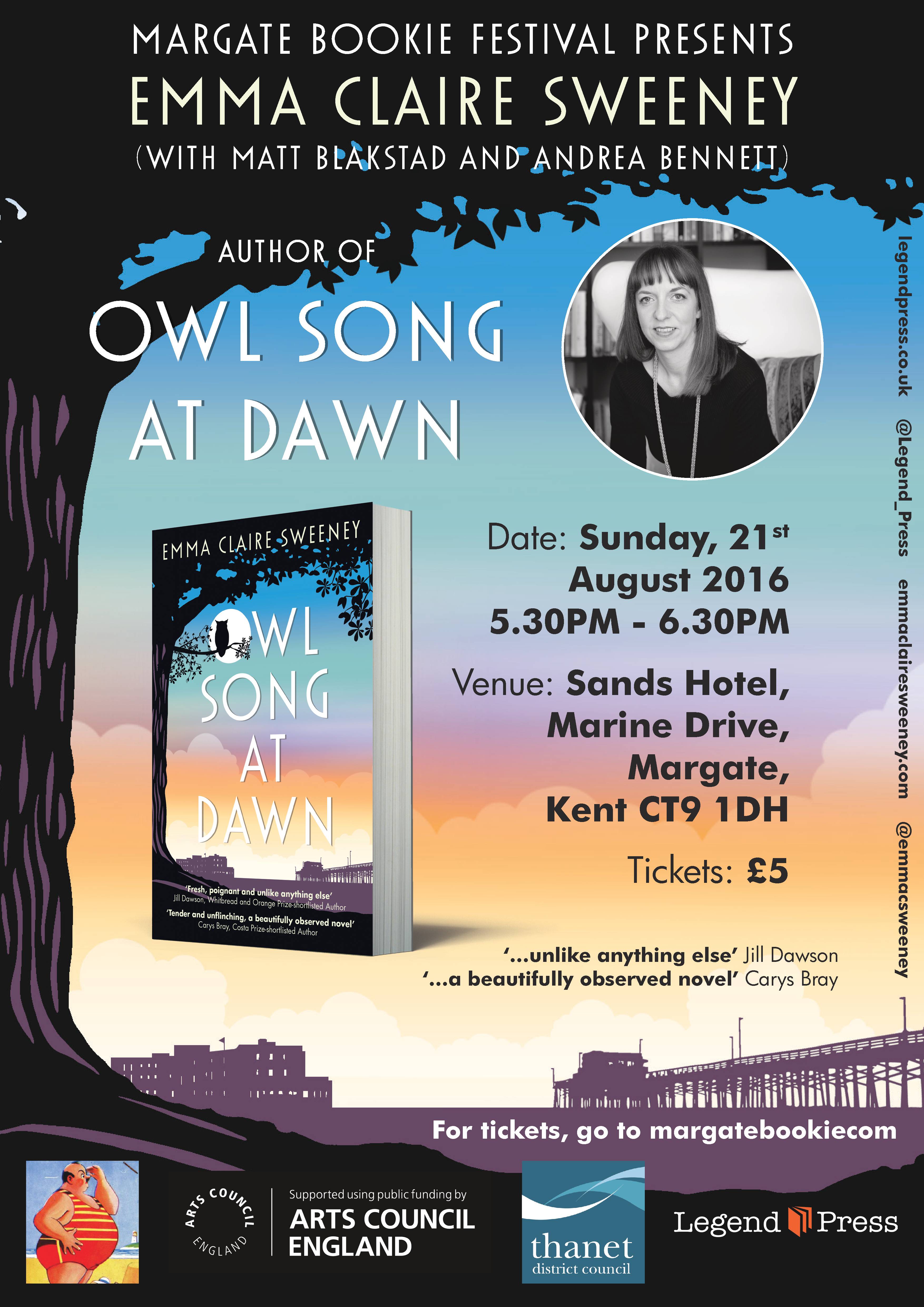
Do join us for our talk on literary friendship at Margate’s literary festival on August 20th. Or why not make a weekend of it and stick around for Emma’s appearance at the literary lounge on August 21st, where she will be talking about her debut novel, Owl Song at Dawn?
Date & Time: Saturday 20 August, 5.30-6.30pm Venue: Sands Hotel, Margate Ticket: £5, book here. Click on the poster to view it in greater detail.
We are really looking forward to two days of literary fun and friendship down by the sea. The line-up includes friends of Something Rhymed, Maggie Gee and Salena Godden, who wrote a joint guest post for us back in 2014 and appeared at our first Something Rhymed Salon.
Tickets: £5.00 or all three Literary Lounge events for £15 Date & Time: Sunday August 21, 5.30-6.30pm Venue: Sands Hotel, Margate. Click on the poster to view it in greater detail.
In the midst of turbulent times here in Britain, it is good to have things to look forward to.
As many of our readers will know, throughout the two-and-a-half years that we have been running Something Rhymed, and more recently writing a non-fiction book together, Emma has also been working on a novel.
I have written before about the joys of being able to follow the progress of Owl Song at Dawn – a project that has been a real labour of love for Emma.
As a reader, I quickly fell in love with its story too, even in its earliest, least polished drafts. For what feels like a very long time now, I have been waiting for the day when readers beyond Emma’s family and friends will be able to share in her wonderful book.
Owl Song at Dawn is a warm and deeply evocative novel. Its indomitable protagonist, Maeve Maloney – the octogenarian proprietor of the Seaview Lodge boarding house – has spent a lifetime in the seaside town of Morecambe, trying to unlock the secrets of Edie, her exuberant yet inexplicable twin. These are characters who will move you, and stay with you long after you’ve finished reading.
When Emma called me up to tell me that the publishing house Legend Press had acquired the rights to Owl Song at Dawn, it was a wonderful moment for both of us. While we’ve been hard at work on our joint book since then– and with Emma’s publication date creeping ever closer – it’s been fun to remain somewhat involved with her novel too.
We’ve talked a lot about early drafts of book covers, for instance, and the literary events Emma has planned for this summer. Recently, I was privileged to be able to get a special preview of a short story of hers, which will be coming out at around the same time as the book.
Now, finally, on the first of July 2016, the launch day of Owl Song at Dawn has arrived. And, not as Emma’s friend, but simply as someone who loves good writing, I urge you to buy a copy.
The novel is available to order here. It has, in fact, been available for pre-order for several months but I confess that I haven’t ordered it myself.
You see, ever since I first read a page of Owl Song at Dawn, I have looked forward to the day when I will be able to pick up a printed and bound copy from a bookseller’s display, glance at Emma’s name on the cover and then hand over my money with the lovely, satisfied feeling that my friend wrote this.
After waiting all this while, how could I deprive myself of that?
We are delighted to welcome Harriett Gilbert to Something Rhymed’s first literary salon on Thursday April 28th at New York University London, 6.30pm.
The salons are aimed at writers, reviewers, bloggers, editors, journalists, agents and others who work in the literary industries or who are simply interested in this topic.
You are invited! Come alone, or, in the spirit of SomethingRhymed.com, you might want to invite a literary friend. Either way, please do join us for drinks and fruitful conversation. To get your name on the guest list, please email SomethingRhymed@gmail.com.
Harriett Gilbert
Harriett Gilbert presents A Good Read on Radio 4 and World Book Club on the BBC World Service.
She began writing fiction in her twenties, when she was not long out of drama college and had just been touring the primary schools of England with an adaptation of Rudyard Kipling’s Just So Stories; she played the Mother Elephant. It was winter; the only job on offer was a small part in an Agatha Christie one-acter, for no pay. She owned an Olivetti portable. Authorship suddenly seemed attractive.
Since then, she’s published six novels, including Hotels with Empty Rooms and The Riding Mistress. In 2004 she founded the MA in Creative Writing (Novels) at City University London, and was course director for four years.
For many years Harriett also worked for the press, reviewing and writing about books and authors for Time Out magazine before becoming literary editor of the New Statesman. She’s published non-fiction books on journalism, feminism and sexuality.
Since the early 1990s she’s presented arts programmes for the BBC, including interviewing a wide range of authors: from Toni Morrison to Marian Keyes, Doris Lessing to Malorie Blackman, Arundhati Roy to PD James
Working on our book, A Secret Sisterhood, has given us the perfect excuse to visit some of the places most associated with our literary heroines.
Some of these, such as Jane Austen’s former home at Chawton, are geographically close to where we live. Others, like Harriet Beecher Stowe’s house in the Connecticut town of Hartford, or the site of the school Charlotte Brontë attended in Brussels – both on the agenda for research trips this month – are considerably further afield.
A few are fixtures on the tourist trail, attracting many thousands of literary pilgrims each year; others are not usually open to visitors; others still, though they welcome the public, are nowhere near as well-known as they deserve to be.
A couple of months ago, I returned to my home county of Yorkshire to gain a stronger insight into the close and startlingly frank bond between Charlotte Brontë and Mary Taylor.
Regular readers of Something Rhymed may recall that I visited the Brontë Parsonage with my sister as a child – the two of us spending a long time in the gift shop picking out souvenir brooches bearing the images of Charlotte and Emily Brontë.
Walking on the moors by the Parsonage – as you can see from my flying scarf, there was a typically wuthering wind!
Once again, on this most recent trip, that famed grey-stone building on the edge of the moors was back on my itinerary. But this time I sought out other locations too: the house purchased by the intrepid Mary Taylor in her later years, once she’d returned to Yorkshire from New Zealand; the boarding school she and Charlotte Brontë attended as teenagers; and Taylor’s family residence, the Red House.
Situated in the village of Gomersal, its pleasant gardens and warm red brickwork make Taylor’s old home a welcoming sight. Inside, the marble-like pillars and wide-open balcony above the entrance hall give a markedly different impression from the dim downstairs corridor of the Haworth parsonage where her friend, Brontë, grew up.
The Red House – photographs of the interior of the house, including the stained glass and paintings mentioned in this post can be viewed on their website.
Thanks to the writings of both women, some features of the Red House felt pleasingly familiar to me.
In her novel, Shirley, Brontë reimagines it as Briarmains – the home of the Yorkes, who she based on the lively and opinionated Taylor clan. And in letters Taylor wrote to Elizabeth Gaskell, when she was preparing to write her biography of Brontë, Taylor recalled her late friend’s visits to the Red House – occasions when the once socially-conservative young Brontë was coaxed out of her usual reticence to engage in lively political arguments with the radical Taylor siblings.
Walking through the rooms of the Red House that day, scenes I’d last experienced in the written words of Brontë and Taylor kept resurfacing in my mind. It was a thrill to go into the back parlour and pick out the pair of stained glass windows and picture of Mount Vesuvius erupting – mentioned in the pages of Shirley – and to imagine the young Brontë first coming face-to-face with the drama of that painting, and the sparkling purple and amber lights bouncing off the panes of stained glass.
We’ll look forward to sharing many more stories about the Red House, and Brontë and Taylor’s fascinating friendship in our forthcoming book, which comes out in late 2017.
In the meantime, we’ll feature another post about this literary pair, here on Something Rhymed, this month:
Discussing Jane Eyre together in March, made us curious to read Mary Taylor’s ground-breaking feminist novel,Miss Miles. Rather than doing an audio interview, this time we’ve decided to vary things by giving you our thoughts in a video, which we’ll post two weeks from now. We hope you’ll come back then to take a look.
Having blogged about the subject of female writers’ friendships for the past two years, we’re delighted to have now been given the chance to explore this fascinating subject in much greater depth.
A Secret Sisterhood will be published, by Aurum Press in the UK and Houghton Mifflin Harcourt in the USA, in late 2017. The year coincides with the bicentenary of Jane Austen’s death.
An announcement appears in the Bookseller today, and we’ll look forward to sharing more details about these trailblazing relationships with our readers over the coming months.
As many of you know, it was our own writing friendship that first sparked our interest in these historical creative pairings. But it was the support we’ve received from Something Rhymed readers that encouraged us that there would be an audience for this book and convinced us to start writing it together.
So, thank you. We are both extremely grateful to all our Something Rhymed friends.
Remember
We’ll soon be following up on last month’s conversation about Jane Austen’s Emmawith a new post on The Absentee by Maria Edgeworth – a novel that Austen enjoyed discussing with her friend, Anne Sharp. Over the coming months, we’ll look forward to sharing our thoughts on other books by, or associated with, the authors we’ll write about in A Secret Sisterhood.
As 2015 draws to a close, this feels like another good moment to look back on the friendships we’ve profiled on Something Rhymed, and the surprising, often intergenerational, connections between some of our literary heroines.
Daphne du Maurier, whose friendship with Oriel Malet we featured in June, is well-known to have been a fan of Haworth’s most famous sisters. Du Maurier’s most famous novel, Rebecca, has drawn comparisons with Charlotte Brontë’s Jane Eyre, and du Maurier also wrote a biography of Charlotte’s troubled brother, Branwell, published in 1960.
On reading du Maurier’s letters to Malet, though, we were surprised to find several references – not just to the Brontës – but also to Katherine Mansfield.
Katherine Mansfield – this image is in the public domain.
An admirer of Mansfield’s writing when she grew older, du Maurier’s fascination with the author of The Garden Party went all the way back to her earliest years. As a child, du Maurier used to look out of the night nursery window of her Hampstead home and see a light burning bright in the opposite house. She used to wave at the light each evening and wonder whose lamp it was.
Only years later would she discover that she had been looking in at the window of Mansfield’s bedroom, a place to which she was sadly often confined thanks to the health problems brought on by her tuberculosis.
Noticing these sorts of unexpected links between the different authors we have profiled has been one of the pleasures of our research into their literary friendships. This has been particularly so when we’ve stumbled upon these links by chance, when we were looking for other things.
And when we were studying the friendship between Elizabeth Bowen and Iris Murdoch the month before, we were delighted to learn that, in the 1940s, Bowen wrote a radio play for the BBC on the life of Jane Austen.
Over the two years that we’ve been running Something Rhymed, we’ve come upon so many of these unanticipated branches between our literary heroines that it’s become difficult to hold them all within our heads. So we’ve set ourselves the challenge this month of creating a ‘family tree’ depicting some of these fascinating connections.
We hope you’ll join us again next week to see the literary ancestral lines that we’ve traced back through the ages.
After reading our recent guest blog by Sarah LeFanu and Michèle Roberts, writer and 3:AM fiction editor Joanna Walsh got in touch to tell us about her friendship with writer and critic Lauren Elkin. In this month’s guest blog, the two share some thoughts on the things that make their relationship work…
Lauren
Joanna and I went to the Latitude festival together a while back. She was part of the festival, doing some kind of craftsy thing in the woods that involved making capes out of cellophane and spraying synthetic snow on them. I don’t remember why.
Joanna is a performance artist before anything else and she likes to make things. I am a critic and a writer, a dealer in abstractions. She makes the stuff herself. I admire that about her.
At this particular festival, it rained so hard and there was so much mud that we had to drink a lot to cope with it. We sat on a tree trunk masquerading as a bench, I think we probably put plastic bags down so we wouldn’t sit in the wet, and we drank beers, and talked about Lacan and Freud and twee Britannia, while all around us frolicked the fine fleur of British youth.
I was miserable, wet, and hungry. Joanna, when she is those things, gets kind of rascally, and makes it all much more bearable. Dinner was some chips, consumed while some boys we met recited ‘The Dream of the Rood’ in Old English. We drank even more. And then we camped.
My inevitable hangover the next day was so bad Joanna had to get the festival’s medical services to peel me off the floor of our tent and install me on a cot next to where Anna Calvi played a thudding set that seemed to go on for hours.
Because of my migraine we missed our train back to London and had to spend the night in nearby Southwold. A lesser friend would have wanted to kill me. But instead, as I recovered, Joanna and I walked next to the angry Northern Sea talking about Sebald and camping shoes and gastropubs and penis-bearing know-it-alls and how I really, really need to eat dinner when I’m drinking.
All of this has nothing and everything to do with why Joanna and I have an enduring friendship that both is and isn’t sustained by the fact that we’re both writers.
I don’t know what else to say about this except that as I told her last night, I feel like for someone to get me, they have to know her.
Lauren Elkin (left) and Joanna Walsh at their recent event at the Shakespeare & Company bookshop in Paris.
Joanna
So here we are, Snow White & Rose Red, Dorothy and Lorelei, Flaubert’s blonde and brunette (who are exactly like redheads, of course, so what’s the difference?). Lauren’s from the US, I’m from the UK (Lauren’s now French). Lauren’s a critic who writes fiction; I’m a writer who also reviews.
There’s enough distance (I think). There’s tension, but it’s the right kind of tension. We read each other’s work before publication, well, some of it. She reins me in when the rhetoric threatens the logic, or I’m just going off on one. She can tell me I’m wrong without our falling out (so far).
We both like to read, and drink, and look at expensive clothes we don’t buy. We have some of the same lipsticks, and a lot of the same books. We give each other our duplicate copies.
I’ve chaired her at events and she’s chaired me. I always wonder whether we’ll forget we’re in public and start talking about something private: it’ll happen one day…
When things are good, when things are bad, she’s the person I want to talk to: she knows it all. One day we’ll write something together. And we’re just as likely to talk about books behind closed doors.
Inspired by the evolving nature of Margaret Mason and Mary Shelley’s friendship, this month we’re reflecting on the moments of change that we have experienced. As Emily’s post revealed, some long-anticipated forks in the road have ended up continuing to lead us along parallel routes. But we have also stumbled on unexpected cross roads…
Emily and I first became friends when we were both living in Japan: her in a tiny apartment surrounded by carparks and convenience stores; me in a tatami-floored house that looked out onto rice paddies and groves of bamboo. In these very different environments, each of us picked up our pens.
Although we hadn’t yet come out to each other as aspiring writers, Emily and I began at weekends to take the three-hour round trip between her urban flat and my country home. This way, we forged our friendship in both the ice cream parlours of the neon-choked city and in bath houses hidden up dark mountain lanes.
This image is in the public domain.
But, after just one short season, we each had to decide in advance whether or not we would stay in Japan the following year. By the time the maple leaves had fallen from the trees, Emily had chosen to continue her unofficial writing apprenticeship in Matsuyama, enduring the chill of a second Japanese winter. I set my sights instead on a long trip with my boyfriend, imagining myself penning stories on sun-bathed verandas in Thailand, Vietnam and Laos.
Many messages pinged between the computer in Emily’s Japanese staffroom and the internet cafés I visited in Chiang Mai and Hanoi and Luang Prabang. On the surface, I was having the time of my life. But, although my boyfriend and I journeyed together all the way from Bangkok to Beijing, our relationship was falling apart.
While Emily was continuing to write fiction in between teaching lessons, I wasn’t jotting down much more than an angst-ridden journal. Looking back on it, I see just how easily I could have retreated into solitude during that time. And so I feel especially grateful that my faraway friend kept on making efforts to remain close.
When Emily and I both moved back to Britain, we continued our friendship – each of us, over the years, travelling thousands of miles across country to meet in Liverpool’s underground bars; riverside cafes in York; the walled garden of Ely cathedral; a Cumbrian bunkhouse; Portobello Market; a field in Herefordshire. More often than not, we’d come laden with drafts of each other’s novels that we had annotated in advance.
During those years of long-distance friendship, we anticipated the literary success of one before the other as a fork in the road, just beyond the line of sight. But, gradually, our writing lives became so intertwined and our vision of ‘success’ so complex and incremental, that jobs and awards and publications no longer felt like junctions that required much navigation.
This image is in the public domain.
I was delighted when, in 2011, Emily told me that she’d be moving to London. For the first time in a decade, she would live nearby. What’s more, she would be teaching at the same universities as me, so we’d also get to see each other each week at work.
Not long after Emily’s move, we embarked on co-writing literary journalism, sitting side-by-side at the same desk. I was newly single again, so it was all too easy to lose myself in work – especially work with Emily, which was so convivial, and always punctuated with shared meals: cinnamon buns; home-made soups; late-night dashes to the Turkish take-away for shish kebabs in spicy sauce.
But work, however fun, cannot replace a social life. This struck me one evening after a staff meeting, when Emily and I went off our separate ways. I’d come to miss our long-distance friendship, when we saw each other less often but, perhaps, prized our time together more highly.
When I eventually mentioned this to Emily, she immediately arranged a night out to a jazz bar, and we spent the evening listening to music and drinking cocktails and catching up on all those things we’d forgotten to tell each other while sat at a desk side by side.
After our summer hiatus, we are back this month with the story of a friendship between two much-loved nineteenth century writers. We are grateful to Lydia at Persephone Books for recommending we profile this literary pair.
Elizabeth Barrett Browning (1806-1861) – this image is in the public domain.
Elizabeth Barrett Moulton Barrett was always fiercely ambitious. Growing up, her juvenile literary output was so great that her father nicknamed her the ‘Poet Laureate of Hope End’ – this being the name of the family’s picturesque Herefordshire estate.
Her mother showed support for the girl’s talent by transcribing many of her poems for household ‘publication’. Later in life, eight years after Mrs Barrett’s death, another influential maternal figure would take the author, then aged thirty, under her wing.
Mary Russell Mitford was almost fifty when she and, a decidedly nervous, Browning were introduced in 1836. Unlike Browning, Mitford, had, from a young age, often needed to write to make ends meet – thanks to her father’s spending of his wife’s inheritance on political campaigns, entertaining and gambling. By the time the two women became friends, Mitford was the highly successful author of poetry, plays and prose – including, most famously, Our Village: Sketches of Rural Life and Scenery.
Browning, who had yet to meet her fellow-poet husband Robert, greatly appreciated the encouragement of a well-established figure like ‘ever dearest Miss Mitford’ as she was soon calling the writer in her letters. Such support had arrived at just the right moment: Browning’s book, Seraphim, and other Poems, would come out the following month and the early years of their friendship coincided with a time when the literary establishment was beginning to take notice of her work.
But this was also a turbulent period. Browning’s personal life was blighted by serious bouts of illness and family tragedy, culminating in the deaths of two of her brothers in swift succession.
Mary Mitford Russell (1787-1855) by Benjamin Robert Haydon – this image is in the public domain.
The accidental drowning of ‘Bro’, her favourite brother, hit Browning particularly hard, and she confided in Mitford that the experience was ‘a very near escape from madness, absolute hopeless madness’.
In addition to their frequent correspondence, Mitford consoled her friend through these darkest times by sending her gifts. As well as the regular delivery of flowers, in 1841 she gave her the spaniel Flush, the offspring of her own dog, (and later to be immortalised by Virginia Woolf in her imaginative biography of the same name).
A decade on, the friendship hit shakier ground when Mitford published her Recollections of a Literary Life. In a section intended as a warm tribute to Browning, she related the sad tale of Bro’s death, deeply upsetting her friend who believed that such personal details should have remained private.
The pair had experienced tensions before – not least in Mitford’s initial disapproval of Robert Browning. Thankfully, on this occasion too, they ultimately managed to negotiate this bump in the road and their relationship survived until the end of Mitford’s life.
Although today, she is the less well-known of the two, she is remembered, not just for her most popular work Our Village, but also the witty and engaging correspondence she maintained with many famous nineteenth century figures – most importantly, her closest literary friend, Elizabeth Barrett Browning.
Activity
Mitford went to great lengths to console her friend after the loss of her brother. This month, we will reflect on the role consolation played in other literary friendships that we have profiled on Something Rhymed.
When Emily met John Mullan at the Bloomsbury Institute, he suggested that we investigate the friendship between Frances Burney and Hester Thrale. We soon discovered a story full of intrigue and betrayal.
On a summer’s evening in 1778, Frances Burney’s father took her to Hester Thrale’s literary salon at Streatham Park. The grand occasion would have been intimidating indeed for the shy twenty-six-year-old writer, whose identity had only recently been revealed.
Burney had penned her novel, Evelina, at the dead of night and then audaciously published it anonymously without her parents’ consent. When her music-teacher father finally discovered its authorship, however, he astounded his daughter by not only giving his blessing but fizzing with such pride that he divulged the secret to his friend and employer, Hester Thrale.
A painting of Hester Thrale in 1771 by John Singleton Copley [Public domain], via Wikimedia CommonsLondon’s literati flocked to Thrale’s gatherings, attracted by the thirty-nine-year-old hostess’s wealth, ebullience, arrogance and wit. Thrale was delighted to introduce her friends to the mysterious author of the novel that was causing such a stir.
Thrale had literary ambitions of her own. She would go on to write a popular history book that failed to win over critics of the day but is now considered a radical pre-cursor to feminism, and she was a consummate memoirist, letter-writer and diarist. Perhaps envy soured Thrale’s pen that summer’s night in 1778 when she jotted in her journal that Burney’s ‘Conversation would be more pleasing if She thought less of herself’. Or perhaps fame really had gone to the young author’s head for a while. Either way, Thrale did admit that Burney’s ‘Merit cannot as a Writer be controverted’.
Despite Thrale’s mixed first impressions, she nonetheless welcomed Burney into her home, inviting her first for a weeklong visit and later for several months on end. Over the next six years, the pair forged an intense bond cemented by their shared wit and storytelling flair.
‘Irresistible Burney!’ Thrale wrote in one of her daily letters: ‘and who was ever like you for warm affection, cool Prudence, and steady Friendship!’ But this same ‘cool Prudence’, which Thrale once so admired, ended up causing a great rift between the two authors.
During her husband’s final illness, Thrale confessed to Burney her growing tenderness towards one of the musicians she employed: an impoverished Italian singer called Gabriel Mario Piozzi. Thrale felt determined that, after the death of her spouse, she would finally secure a love match.
Although Burney’s own father was a music teacher from a similar social milieu to Piozzi, she was horrified by the thought of her friend marrying a Catholic foreigner of lower social rank, and by what she saw as the emotional and financial abandonment of Thrale’s children. ‘Think a little’, Burney pleaded. ‘The mother of 5 children, 3 of them as Tall as herself, will never be forgiven for shewing so great an ascendance of passion over Reason’.
Thrale married Piozzi in 1784. From then on, Burney’s letters went unanswered and she was no longer welcome at the home of her former friend.
Frances Burney circa. 1784 painted by Edward Francisco Burney (1760-1848) [Public domain], via Wikimedia CommonsDuring the next thirty years and more, Burney ‘made every possible overture’ of friendship but Thrale, now Signora Piozzi, could no longer trust the woman she referred to as ‘l’aimable Traitesse’. But her name did continue to appear on the subscription list for Burney’s novels, as, indeed, did that of the young Jane Austen – an ardent fan.
Burney’s persistence may well have been motivated by an increased empathy with her former friend’s predicament. At the age of forty-one, Burney defied her father by marrying a penniless French Catholic and becoming known as Madame D’Arblay.
In 1817, Burney, now sixty-six, dared to call in on the seventy-five-year-old Thrale. ‘At the sound of my name’, Burney wrote immediately afterwards, ‘she came hastily from her Boudoir to receive me in the grand sallon’. But Thrale, suffering from asthma, was so embarrassed and agitated that she could not utter a single word.
Once she recovered, they sat together on a sofa and entered into a political debate. Though spirited, their conversation lacked the affection of old. And yet, they talked on as night fell, quite forgetting about dinner. When Burney finally realised the time and made to leave, Thrale affectionately thanked her for calling in. ‘Much surprised, & instantly touched,’ wrote Burney, ‘I turned back, & held out my hand. She gave me hers, & each hand again pressed the other’. And this late-life reconciliation endured.
Activity
Burney and Thrale often surprised each other. This month, we’ll take the opportunity to reflect on the unexpected things we have learnt while working together on Something Rhymed.



![A painting of Hester Thrale in 1771 by John Singleton Copley [Public domain], via Wikimedia Commons](https://somethingrhymed.com/wp-content/uploads/2015/06/hester-thrale.jpg)
![Frances Burney circa. 1784 painted by Edward Francisco Burney (1760-1848) [Public domain], via Wikimedia Commons](https://somethingrhymed.com/wp-content/uploads/2015/06/frances_burney_by_edward_francisco_burney.jpg)
 Something Rhymed