All Posts

Emily Dickinson and Helen Hunt Jackson

tumblr_mevs2yhzId1rnvzfwo1_1280
Emily Dickinson (far left) and Helen Hunt Jackson (in purple dress) pictured on the Amherst Community History Mural. The picture is used with the kind permission of Jim Wald

The abiding image of Emily Dickinson is that of a reclusive poet, dressed only in white, and known among her neighbours as The Myth. So we were surprised and delighted to discover that she had been friends with one of the most famous writers of her generation, someone whom Ralph Waldo Emerson described as the best of America’s poets.

Dickinson’s celebrated friend was Helen Hunt Jackson – a name that, to our shame, we found unfamiliar. Although her reputation as a poet has failed to stand the test of time, she is still well remembered in the USA as a campaigner for the rights of Native Americans, and her novel Ramona has never been out of print.

Like Mansfield and Woolf, theirs was an unlikely friendship. Jackson was a social animal, whose successful career stood in stark opposition to that of Dickinson – an intensely private poet.

Indeed, during Dickinson’s lifetime, she saw only a handful of her poems go to press. Jackson actually shepherded one of them to publication, cajoling her into this by saying that: ‘It is a cruel wrong to your “day and generation” that you will not give them light’.

Dickinson also held Jackson’s work in high esteem, once claiming that – with the exception of George Eliot – she considered Jackson’s poems stronger than those of any woman since Elizabeth Barrett Browning.

Thomas Wentworth Higginson, who acted as a literary mentor to both writers, introduced Dickinson and Jackson to each other’s work. However, the two women had actually known each other since childhood. They both came from the small town of Amherst, Massachusetts but, whereas Jackson had roamed far and wide, Dickinson had stayed firmly put. Once they’d reconnected, Jackson visited Dickinson on her return trips to Amherst. So – unlike many of Dickinson’s friendships – the two writers conversed in person as well as through letters.

Their friendship even influenced some of their work. Jackson acted on occasion as muse, commissioner, and recipient of poems by Dickinson. And, for her part, Dickinson is widely thought to have inspired the central character in Jackson’s first novel: a woman who wears only white, and who writes strange and dazzling poems.

Activity

Helen Hunt Jackson once commissioned Emily Dickinson to write her a poem about an oriole – an orange-breasted blackbird common in the north east of America. Dickinson responded with ‘The Hummingbird’.

This month, we will be commissioning each other to write about a particular topic – although, like Dickinson, we reserve the right to go on a bit of a tangent!

As always, we’d be grateful for suggestions of other female writer friends you’d like us to research.

The Stuff of Legend

It was a question that prompted us to launch Something Rhymed, a question that eluded easy answers: why have so many female writer friends, unlike their male counterparts, failed to make legends of each other?

We wondered whether women had traditionally conducted their relationships privately while men had more opportunities to promote each other in public. Coleridge, for instance, had the freedom to up sticks to the Lakes where he could collaborate with Wordsworth on the Lyrical Ballads. At around the same time, Jane Austen’s abode was entirely at the whim of her family and she still felt she had to publish anonymously.

However, closer investigation showed us that women too have long been attempting to make legends of each other. After all, Charlotte Brontë travelled cross country to stay with Elizabeth Gaskell (a pair we’re sure to profile since so many of you have suggested them), and after Brontë’s early death Gaskell published the first biography of her friend.

This month’s pair, Vera Brittain and Winifred Holtby, emerged very much from this trailblazing tradition, embracing mutual publicity from the start: debating at the Oxford Union, campaigning for their shared social and political causes, publishing prolific amounts of journalism. Indeed, the pair became so entangled in people’s minds that Winifred Holtby was once introduced at a meeting as ‘Miss Vera Holtby’! It is fitting, therefore, that after Holtby’s early death, Brittain edited and promoted her friend’s final novel and then memorialised their relationship in Testament of Friendship.

Question Mark

We took rather longer to expose our friendship to public scrutiny. For the first decade since our initial meeting, we critiqued each other’s work in the privacy of our own homes, and we published entirely separately. But ever since The Times commissioned us to write about female writing friendship, we’ve become far less publicity shy, looking to Brittain and Holtby as our role models.

Our attempts to follow in their footsteps has brought us many unexpected and joyful connections, from drinking Prosecco in Kiliney Castle with writer pals Anne Enright and Lia Mills to gaining our first hits on this site from Korea and Kyrgyzstan. The generous coverage Something Rhymed has received from Slightly Bookist and Women Writers, Women, Books has resulted in particularly strong contingents of blog followers from Canada and the USA, and tweets from the likes of the New York Public Library. Just recently, we received some especially interesting suggestions from our new North American friends, who alerted us to the epistolary relationship between George Eliot and Harriet Beecher Stowe, as well as the friendship that A.S. Byatt managed to forge with her literary heroine, Iris Murdoch.

Murdoch also came up on the back of a connection we’ve forged closer to home. When the Yorkshire Post picked up on Holtby’s (and Emily’s) Yorkshire connections, one of their reader’s got in touch to tell us about Murdoch and the philosopher Philippa Foot, whose extraordinary friendship eventually survived a sexual interlude and even a massive bust-up.

Mercifully, our friendship has not only survived but thrived since we made the decision to follow the example of Brittain and Holtby. But our investigation into female writers and publicity has not yet produced an answer to our initial question. Instead, the question itself has changed. So now we’ve begun to ask ourselves this: why do women’s attempts to make legends of each other tend to get written out of literary lore?

By the time we met, I felt as though I already knew her: Kadija ‘George’ Sesay and Dorothea Smartt

Our April guest bloggers are poets Kadija ‘George’ Sesay and Dorothea Smartt. They’ve shared with us their conversation about their first impressions of each other…

Kadija George


Kadija
The first time I met Dorothea, she was a figment, yet a fixture of Centerprise, a community centre in East London, that housed a community publishing project. In 1995, I became the Black Literature Development Worker, a newly created post that replaced Dorothea’s role in the publishing project, which she ran with Bernadette Halpin. There wasn’t anything I could do that wasn’t compared to Dorothea!

Are you going to run workshops (like Dorothea)? Are you going to set up performance poetry evenings (like Dorothea)? Can you publish our poems in books (like Dorothea)?

Who was this Dorothea person I had to compete against?

In the meantime I took home the Word Up! Women’s Café anthology that Dorothea had edited, and realised why this woman was so missed by those she’d worked with. This was a classic anthology of women’s performance poetry in London, published in the mid-Nineties. There was nothing else like it.

DSafro byRT IMG_7860

Dorothea
I can’t remember when I first heard about Kadija. I had heard of her before I met her because she was working at Centerprise where I had worked, at one of the most enjoyable and rewarding jobs that I had had, up until that time.

Although I left Centerprise under a cloud I was glad to see there was someone taking up the reins. One of my main regrets was that I always felt I should have published more Black people. At the point when I left, we had our publishing resources removed so when she brought out Calabash, a newspaper for writers of African and Caribbean descent, I thought: oh good, she is getting around that, by putting out a resource in newspaper format.

Kadija
By the time I met Dorothea, I felt as though I already knew her – I can’t even remember the exact time, except I published one of her poems in my first anthology, Burning Words, Flaming Images for which she says, till this day, it is the only poem she has published that she has ever been paid for, so I’m proud of that.

Dorothea
I remember reading at the launch event for the book at Centerprise. I still have the photo of Jacob Ross, Bernardine Evaristo, Courttia Newland, Chris Abani… It could very well have been the first time we met in person.

Around that time, Kadija organised the first Writer’s Hotspot in The Gambia in 1996. When she asked me to go a second time to be one of the tutors, I couldn’t believe it. I went again and shadowed Kadija.

She pointed me out and said, ‘On the next trip, she’s the Boss Lady.’ It gave me a lot of confidence that she selected me.

Kadija
I knew Dorothea had a good reputation so there was mutual respect on both sides.

Dorothea
And here was someone who liked travelling as well. I believed in Kadija and what she was doing. I knew that whatever she did was gonna get done!

Kadija ‘George’ Sesay is the publisher of SABLE LitMag. Her poetry collection Irki was published by Peepal Tree Press.

Dorothea Smartt’s third poetry collection Reader I married him and other strange goings on will be published by in 2014.

They are currently co-directors of the Inscribe programme for professional development for writers of African and Asian descent, based at Peepal Tree Press.

The Elephant in the Room

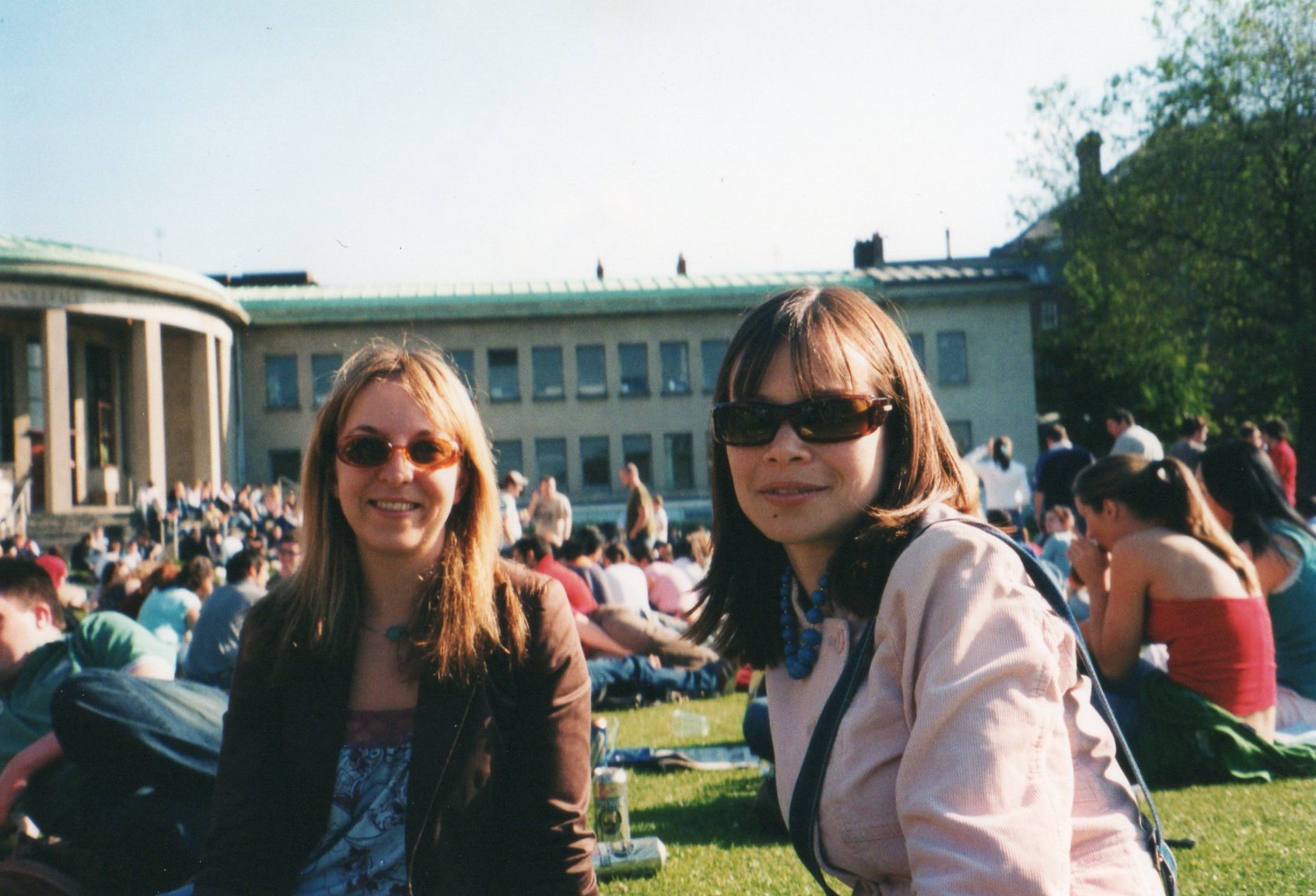
Emily visiting Emma Claire in Dublin four years after they first met

My friendship with Emily is founded on deep similarities – in tastes, and values, and goals – but it was a superficial difference that struck me first.

Emily is beautiful. It’s something anyone would notice about her. No wonder a Vidal Sassoon trainee was so keen for the chance to style her hair. When we’ve touched on our differences before, this has been for me the elephant in the room. Unlike Em, I am not the kind of woman that hairdressers stop on the street.

I distinctly remember the chopped style Emily sported back then, her blond highlights. The fairness of her hair was so striking against her olive skin that I looked at her during our first Japanese lesson, trying to discern her ethnicity. It seems so obvious to me now that she is half-English, half-Japanese that I find it absurd when people mistake us for sisters. Absurdly complimentary, too, that someone thinks I resemble Em.

It’s not that I’m plagued by poor self image. I rather enjoy my looks: my Celtic green eyes; my size three feet; my very English mousy hair. Emily’s beauty is simply a fact – something that, as her friend, I get to enjoy. I quickly came to value, for instance, that our shared love of fashion never slid into competition, that we would both just as likely order pie and chips as goat’s cheese salad.

But when we first met, before leaving for our teaching posts in Japan, a part of me must have assumed that someone as beautiful and trendy as Em would not want to be friends with me.

My most vivid memory of first meeting Em occurred just after our first Japanese lesson. A group of us were waiting for the lift when Emily mentioned her disappointment at being placed in Matsuyama – the capital of Ehime prefecture. She didn’t want to be out in the sticks. This amused me since Matsuyama has a population the size of Liverpool, and I surmised we might have little in common since I’d sought a job in a mountain village.

But I must also have sensed some promise of connection because I remember thinking: I’ll either find Emily too cool for school, or we’ll end up firm friends.

I’m not sure exactly how we went from that moment outside the lift to the strong foundations of friendship that we’d established just months later: gravitating outside during raucous parties; trading stories of the men we’d left behind; and, finally, sharing the writing we’d scribbled in secret. Em must have done the initial legwork; I would surely have been too scared of rejection.

Her honesty is one of the qualities I jotted in response to February’s challenge. It extends, at times, to making herself vulnerable: letting an old lover know that her feelings haven’t changed; leaving an unsatisfactory job; reaching out to a new friend. Her candour, which ensured that we did become firm friends, is a deeply beautiful quality, and one that I glimpsed very soon after my first impression of her lovely olive complexion and blond, cropped hair.

First Impressions: I liked her, right from the start

Looking back on the early days with Winifred Holtby, Vera Brittain would write in her memoir Testament of Friendship that ‘We did not, to begin with, like each other at all’. For my part at least, my first thoughts on Emma Claire couldn’t have been further from those words.

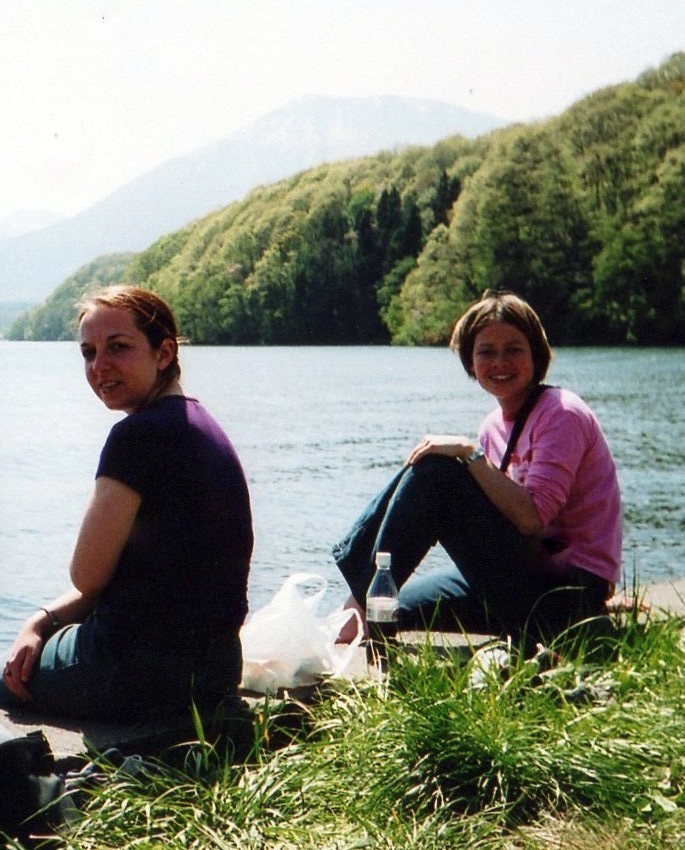
Em and I became friends when we were both working as English language teachers on the island of Shikoku, in rural Japan.

Travelling together in the Japan Alps in May 2002

We’d gone there as participants on the JET Programme, a Japanese government initiative to place native English speakers in the nation’s schools, but we actually met at the pre-departure orientation in London in July 2001.

I vividly remember stepping outside in a break between sessions and spotting Emma Claire sitting on the grass. She was with a small group of new JETs, all of them swapping stories about the little they knew of the towns and villages to which they were headed.

Of all the people sitting on the lawn that day – most, like us, in their earlier twenties and lacking any previous teaching experience – my feeling was that Emma Claire was someone with whom I had something extra in common.

Why I should have thought this, and from the start, is a lot more difficult to understand.

These days, people take us to be so alike that we have sometimes been confused for sisters, but, other than the fact we were both short and from the north of England, I don’t think we can have appeared particularly similar back then.

We were dressed very differently from each other that day, and my hair, unlike Em’s that flowed freely down her back, was chopped and cut up with streaks of blonde – although this was largely the result of having been accosted in the street just weeks earlier by an enthusiastic trainee stylist from Vidal Sassoon.

OK, you might think, but what about our shared interests? Surely there we would have found common ground. But I don’t remember hitting on a mutual taste in music or films, and I’m not sure either of us thought to mention books or favourite authors. Certainly, we wouldn’t have said anything about wanting to be writers, since at that stage we hadn’t even properly admitted that secret to ourselves.

What I do recall is my sense of disappointment when I realised that, although we’d be living in the same prefecture, Emma Claire would be living a couple of hours away from my house.

Holtby and Brittain, thrown together in their Oxford college, must have had to go out of their way to avoid each other in that early period of distrust. In marked contrast, it was clear to me right away that if Em and I were going to become friends we’d each have to make a special effort.

That summer’s day all those years ago, now seems like such a key moment in our lives that it really is painful to imagine just what we’d have missed out on if one of us, or both of us, had decided that the effort wasn’t quite worth our while.

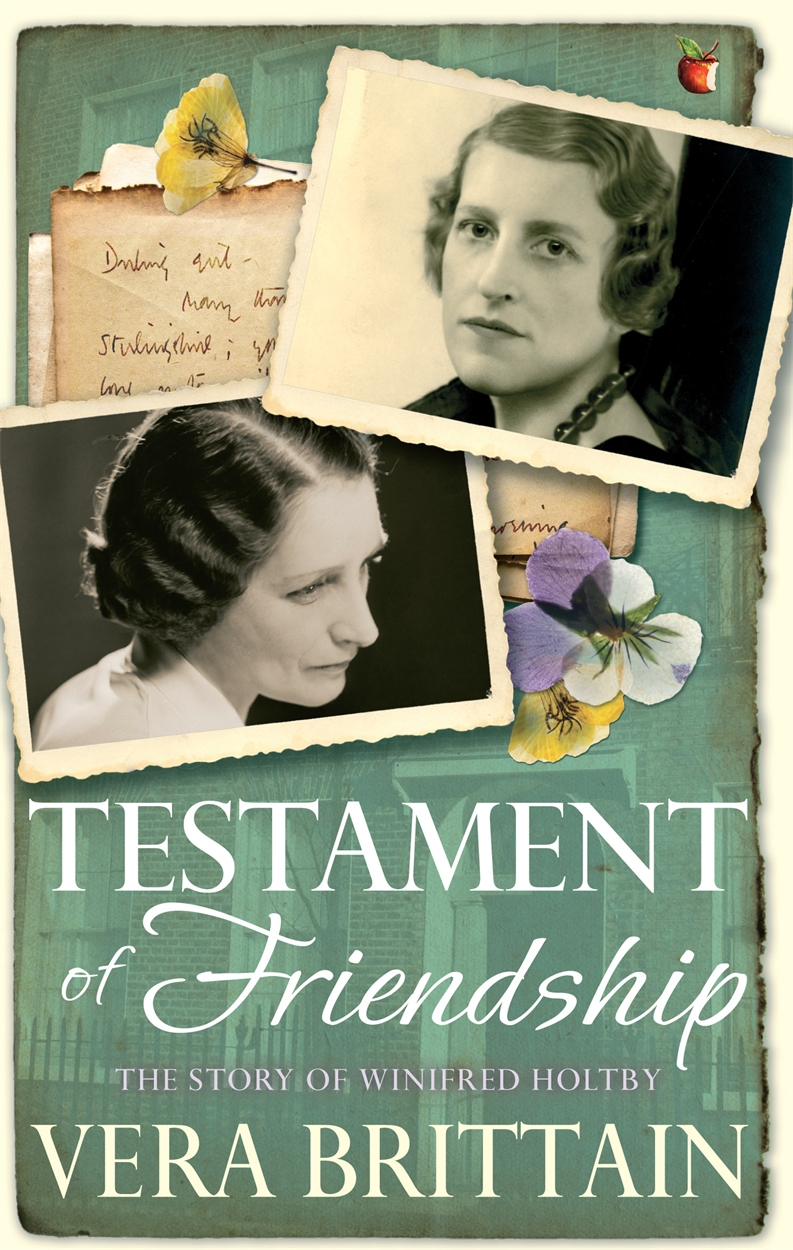
Vera Brittain and Winifred Holtby

Testament of Friendship
Image used with the kind permission of Virago.

Since we began asking for recommendations of literary friends for Something Rhymed, one pair has dominated the replies: Vera Brittain, who penned the classic First World War memoir Testament of Youth and Winifred Holtby, the author of South Riding.

Both committed feminists, pacifists and socialists, it’s surprising perhaps that when they met as students at Oxford, these two initially disliked each other. After suffering what she took to be a humiliation by Holtby during a university debate, Brittain was keen to avoid her college mate – this frostiness only being repaired when Holtby called on Brittain, who’d been fighting a cold, with the unexpected gift of a bunch of grapes.

Once they’d got over their initial feelings of distrust, they realised that, despite outward differences – Holtby was tall, blonde and gregarious, whereas Brittain was small, dark and more reserved – they had a great deal in common. They bonded over their shared experiences of war service and mutual aims to make their way as writers.

After university, they decided to move in together, so that they could encourage each other in their ambitions.They also, famously, lived together in later years when Holtby joined the family home that Brittain established with her husband George Catlin, and Holtby became an aunt figure to the couple’s two children.

During their sixteen-year friendship, they continued to actively support each other’s careers. Despite the soar-away success of Brittain’s Testament of Youth, this was very much a friendship between equals. They often critiqued each other’s finished writings (although, interestingly to us, rarely work-in-progress) and helped to shape their thinking on important issues of the day through their conversations and letters.

We find these two particularly fascinating because, like us, they met when they were close to the start of their literary journeys and became each other’s ‘travelling companions’, never afraid to acknowledge the depth of support they had given each other.

After Holtby’s death at the age of 36, Brittain would go on to immortalise their relationship in her book Testament of Friendship, a fitting tribute from the woman once described by her pal as ‘the person who made me’.

 Activity

Vera Brittain and Winifred Holtby’s friendship nearly failed to get off the ground due to their initial impressions of each other. Hopefully avoiding any risk to our friendship, we’ve set ourselves the challenge this month of casting our minds back to when we met to describe our first take on each other.

As always, we are interested in hearing your suggestions about other writing friendships we could profile on Something Rhymed. You can Tweet us or use the ‘Leave a Reply’ tab below to get in touch.


Celebrating Each Other’s Successes

NotebooksUnlike Maya Angelou and Toni Morrison, or Katherine Mansfield and Virginia Woolf, there was a huge disparity in the worldly successes of this month’s featured writers.

Although Anne Sharp wrote plays for her students to perform, and was able to use her sharp critiquing skills to give Jane Austen advice on her work, she has gone down in history as little more than a footnote in the life story of her illustrious friend.

We cannot know whether Sharp ever felt envious of Austen’s achievements, and the fact that her work had the chance to reach an audience far wider than her immediate social circle. Neither would we go as far as speculating that she could have been another Austen-in-the-making if life had dealt her a different hand of cards.

It is interesting to wonder, though, whether the governess might have attempted to pursue any similar ambitions if her family and financial circumstances had been different.

What we do know is that, despite their contrasting levels of commercial success, each woman rated the other. Sharp celebrated the publication of Austen’s novels along with her, but was also ready to tell her friend when she felt there was a flaw in the work – advice that Austen appears to have highly valued.

It’s nice to imagine that her decision to rename her novel First Impressions as Pride and Prejudice was her way of acknowledging in print the crucial support she’d received from Sharp.

It’s a notion that might mean something to last week’s guest bloggers. Antonia Honeywell and Rachel Connor discussed the pride they take, not just in each other’s creative output, but their long-running writing friendship too.

Antonia’s comment on the publication of Rachel’s first novel (ahead of her own book deal with Weidenfeld and Nicholson) was one that really struck home with us. ‘It felt like a great triumph not only for Rachel,’ she recalled, ‘but for the dedication with which we both carved out the time for our regular exchanges of work.’

As we’ve mentioned before on Something Rhymed, our own career trajectories have gone along roughly in tandem so far, but there is bound to be a point when – if only temporarily – one of us will accelerate past the other.

When that happens, we hope we can learn from the example of Antonia and Rachel, and Austen and Sharp too – that we will be able to enjoy this joint success for our writing friendship, rather than focusing on any perceived gulf that divides us as individuals.

Other news

We’re currently enjoying the BBC Radio 4 series Five Hundred Years of Friendship – episodes available to listen to on-line.

We’ll be moving on to the next profiled writers on Tuesday. We were advised to look into the friendship of Vera Brittain and Winifred Holtby by many of our readers, so we particularly look forward to sharing what we’ve discovered about them.

We’re still actively researching female writer pals, so do keep letting us know, by leaving a reply or Tweeting one of us, if there is any particular friendship you’d like to see profiled.

Rachel Connor and Antonia Honeywell: ‘a collaboration to be treasured’

In this month’s guest blog, long-time writer friends Rachel Connor and Antonia Honeywell take up the March challenge to send each other mementoes of their friendship…

Rachel

Antonia and I were connected even before we met: we were paired, in advance of the MA in Novel Writing at Manchester University, to submit work in the same workshop.

From the beginning, friendship and work have been intertwined.  For nearly a decade we’ve spent happy hours talking of books and our children; of our ambitions, hopes and passions.  There’s a geographical distance (I live in the north; Antonia in the south of England) but we snatch time together in person where we can.

When the MA ended, Antonia and I took turns to submit work by email, which was printed off by the other and returned with comments.  This loop of regular submission and feedback has sustained us ever since.

The pressures of work or childcare have sometimes interrupted the pattern but the firm foundation of a working relationship will always be there.  We are, for each other, cheerleader, editor and critical friend.

Antonia's gift for Rachel
Antonia’s gift for Rachel

When I received the beautiful locket Antonia sent me I was immensely touched.  It symbolises space – the space we have afforded each other and the space for development of our creative work.

When I opened it, I was surprised to see that it contains a tiny rose, to represent growth.  I’m not sure whether she thought of it, but the rose is a crucial image in a novel I’m working on right now (which is based on Charles Rennie Mackintosh).  Consciously or subconsciously, she must have picked up on that.

I do miss Antonia’s actual presence but I know that we’ve carved out an emotional and creative space in which we can both grow.  It’s a friendship and a collaboration to be treasured – just like the locket, in fact, which now takes pride of place on the bookshelves next to my writing desk.

Antonia

It’s possible that the early hours of the morning aren’t the best time to write, but on top of four small children, we have chronic illness in the house, a head teacher being an arse, and a cellar pump that keeps failing. Yet here I am, writing.

From the first days of our friendship, Rachel’s faith in my work has given me permission to write even, and especially, when life has conspired to make it impossible. Others know us as mothers, teachers, wives and workers, but to each other, we are writers first.

Rachel's gift to Antonia
Rachel’s gift to Antonia

The little book Rachel sent me symbolises what brought us together, what sustains our friendship and what is produced by it. No Anne Sharp could have been prouder of Jane Austen than I was of Rachel when Sisterwives was published: it felt like a great triumph not only for Rachel, but for the dedication with which we both carved out the time for our regular exchanges of work.

Those exchanges have ebbed and flowed with the vicissitudes of our other lives, but our writing relationship has always been one in which the words ‘I told you so’ hold no negative connotations.

We don’t meet in person very often, but every meeting is an oasis. The next will be on Rachel’s birthday this summer. The last time I was able to celebrate Rachel’s birthday with her in person, too long ago, I confided the seed of the idea that would become The Ship. This time, The Ship will be on the verge of publication.

It began with two women who wanted to write. The rose in the locket is a symbol of the wonders that can happen, when dreams are given a little space.

Rachel Connor’s novel Sisterwives was published by Crocus Books in 2011. Her radio play The Cloistered Soul will be broadcast on Radio 4 on 29th May this year.

Antonia Honeywell’s novel The Ship will be published by Weidenfeld & Nicolson in January 2015.

 Remember

We’re still searching for more famous female writer pals to feature in the upcoming months, so do let us know if there’s a pair you’d like to see profiled.

You can do this by leaving a reply to any of the posts on the site, or Tweeting us at @EmilyMidorikawa or @emmacsweeney.

You can keep up with Something Rhymed by following us via email, by clicking the button on the right of the screen.

My Box of Memories

Pears soap, Emma Claire’s recent trinket gift has a special place in my family history too. It was the choice of my father’s own Grandma and, because of the childhood memories he associated with it, a favourite of his too.

Consequently, at least in the early years, it was the only soap we used at home. On receiving this broken sliver of amber, I found myself immediately transported by its familiar stickiness and herb-like scent to long-ago bath times at Eastfield Crescent, sitting in the tub with my little sister, our singing voices competing with the noise of the electric fan.

Emma Claire, this trinket that stands both for Bam-Bam and the ghost of your novel in its earlier forms, has now been safely shut away in my own memory box. It’s been a discovery, though perhaps not an entirely surprising one, to learn that this tendency to memorialise our pasts is just another thing we share in common.

But, in keeping with the last of our February posts, I’m keener now to acknowledge the differences between us too. I’ve stored away a petalled pink and green ballet headdress, a tiny scented satin bag from Japan that (even after eighteen years) still somehow keeps its perfume, and – having grown up in a non-religious household – there are no equivalents to your christening bracelets.

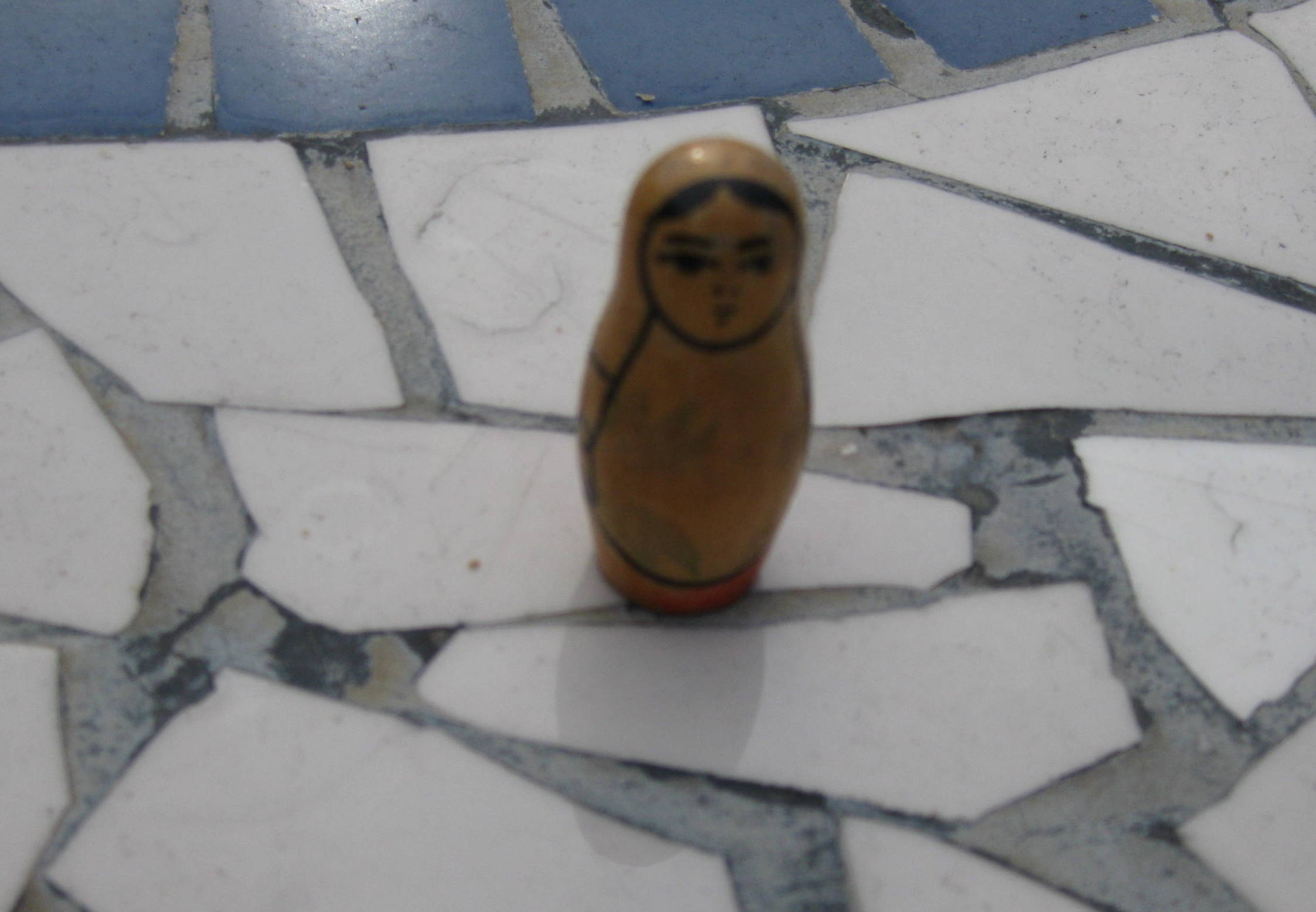
The trinket I have removed to make way for your soap, Em, is the inner-most part of a Russian Doll.

Gift for EmmaI have fractured memories of playing with its outer casings as a child, painted wooden shells that split apart to reveal the series of dolls inside them. I don’t know what happened to those exterior pieces. Did they get cracked, or lost over time? Did my mother pass the doll to a friend without realising its heart was missing?

At some stage, anyway, I must have found this solitary little doll, the only part that couldn’t be broken into two, and decided I wanted to save it.

Some of its varnish has come away and the red and green of the painted clothing has faded to nothing in places. But I feel certain that someone who can see the brighter amber in a broken bar of Pears soap will overlook the many scuff marks, and be able to enjoy this small memento of her friend from a time many years before she knew her.

Broken Things

Emma’s gift for Emily The trinkets contained in this jewellery box show that I was a child intent on self-memorialising: christening bracelets; gymnastics medals; my annual bus passes; the label from my first bra.

But the object that I’ve removed from the jewellery box to pass on to you, Emily, is a memento of Bam-bam – my grandma. After she died, when I was just nine, I took this bar of Pears soap as a keepsake and its scent of thyme still reminds me of her.

Bam-bam wore fur coats and visited the hairdresser every week; she fed me milk loaf and strawberry splits; people gathered around the piano when she played; the local librarians all knew her by name. After she died, we found exercise books stacked in her bedside cabinet all of them filled with her own handwritten poems.

For me, the search for literary ancestresses stems back to the discovery that my own grandma was a closet writer. My dad kept her exercise books and I have treasured her bar of Pears soap.

So now, Em, you have a little more insight into the importance of Pears soap in The Waifs and Strays of Sea View Lodge. Or, I should say, the significance it used to have. The soap is now only mentioned here and there, no longer carrying the symbolic weight it had in earlier drafts – drafts that you read and critiqued. Only you, who have accompanied me on every step of this long writing journey, would detect in the final version the lingering scent of Pears soap.

In a way, then, may this memento stand for everything that’s written out, for our shared dedication to voicing stories that have previously been silenced. After all, with its focus on female friendship – a neglected aspect of literary lore – this is what Something Rhymed is all about.

Sadly, this trinket must also stand for broken things. Although I’d kept the bar of soap intact for decades, packing and unpacking it every time I moved house, I dropped it when I reached into a high cupboard to fetch it for you.

After my initial dismay, I realised that there’s perhaps something appropriate about this. I’ve always been drawn to broken things: derelict funfairs; threadbare cardigans; people whose surface resilience hides their distress.

My grandma was broken by the death of her eldest son and the disintegration of her marriage. In writing this message to you, Em, it strikes me that in my novel I offer an elderly woman a last chance to be healed – a chance my grandma never seized.

But there’s beauty in the broken, isn’t there, Em? I know that you too will appreciate the brighter amber that was revealed when the bar of Pears soap splintered, its headier scent of thyme.