Tales of Two Sisters: George Eliot, Harriet Beecher Stowe and Middlemarch

This year, Emma and I have spent a lot of time thinking about sisterhood – the kind of literary sisterhood we’ve been exploring here on Something Rhymed, and the ties that bind flesh and blood female siblings.

Jane Austen enjoyed a famously close bond with her sister Cassandra. So did Charlotte, Emily and Anne Brontё; and Virginia Woolf and Vanessa Bell.

George Eliot by Frederick William Burton – this image is in the public domain.

Unlike these other writers who will feature in our forthcoming book, George Eliot’s relationships with other family members had been brought to an abrupt end some fifteen years before she began her alliance with Harriet Beecher Stowe. In her mid-thirties, Eliot had begun to live out of wedlock with George Henry Lewes. On discovering this, her sister and half-sister had heeded the warnings of their scandalised brother and cut off all contact. This cruel treatment may have made Eliot particularly happy when she received her first letter from Stowe. In this missive of spring 1869, the American author – who Eliot had never met – addressed her both as a ‘dear friend’ and a ‘sister’.

In Emma’s June post, she talked of reading Mrs Dalloway as a teenager with her sister, Lou. This got me thinking about my own sister, Erica, and the novels we enjoyed when we were young.

I remember us both reading Jane Eyre and  Wuthering Heights, and watching a BBC costume drama of The Tenant of Wildfell Hall, going to the cinema to see Sense and Sensibility, first encountering A Room of One’s Own.
322px-middlemarch_1
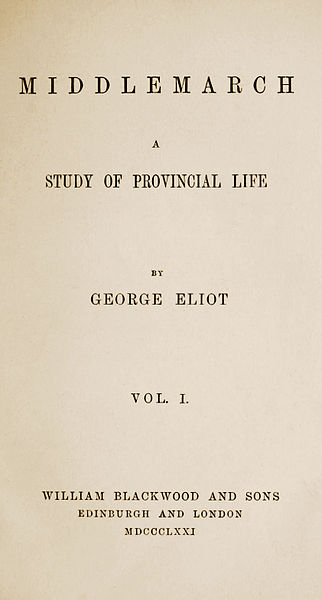
First edition title page – this image is in the public domain.

Back then, we often used to talk about the books we read, sharing recommendations. I couldn’t remember us ever discussing Middlemarch, though. Although Erica is a year younger than me, I had come to Eliot’s work considerably later than her and by the time I read the novel we were no longer both living at home.

As I have recently been re-reading Middlemarch, I thought I would ask Erica about her memories of the book. It was a long time since she’d read it, it turned out, so she remembered the atmosphere far better than the intricacies of the plot. The character she recalled best was Dorothea Brooke – the intelligent, deeply pious young woman, whose story (one of several major interlocking plot lines) opens chapter one.

Dorothea struck Erica – who’d read Middlemarch as a teenager in the 1990s – as an amazingly well-developed character, a young woman who becomes locked into a marriage with a with joyless older man, and whose complex personality Erica found interesting on so many levels. It was with a sense of happiness that she recalled meeting Dorothea on the page for the first time and feeling, she said, that she was reading truly great writing.

Well over a century earlier, the character of Dorothea had also captivated Harriet Beecher Stowe and, like Erica, there was a good deal she admired more generally about the book. But Stowe’s letters to Eliot over the period when she was reading Middlemarch, in serialised form, also express her frustration with what she regarded as Eliot’s high-mindedness and her story’s lack of ‘jollitude’.

Reading this time with Stowe’s criticism in mind, I couldn’t help feeling that the verdict was too harsh. There are more challenging passages to Middlemarch, certainly. The book’s Prelude, for instance, grabbed me far less than the first chapter proper, which introduces Dorothea.  Her tale, too, is often sad, but none the less gripping for that. There are also quite a number of light comic moments, many of which I had forgotten. As Erica said, the main impression she retains of the novel is that of an enormous literary achievement – and one to which, having chatted about it with me, she would like to return.

I would certainly encourage my sister to do that. As I have found, on coming back to Eliot’s novel at the age of thirty-six, Middlemarch absolutely rewards a re-reading. Just as Emma and I found when we returned to Jane Eyre some months ago, scenes that made the greatest impressions on me when I was younger are not always the ones that affected me the most now.

This time round, with sisterhood on my mind so much of late, Dorothea’s relationship with her sister Celia is the one that stayed with me the most in between stints of reading the novel. Dorothea is serious, Celia more lighthearted. Dorothea’s mind is always on study and religious matters, whereas Celia is concerned with the day to day world around her. But despite their seeming differences, the two sisters – Kitty and Dodo as they affectionately call each other – could not be closer.

Eliot and Stowe’s personalities were also markedly different, so different that many biographers have doubted that they could really have been friends. Eliot’s letters to Stowe reveal her as the more rational and measured of the pair. Stowe, by contrast, is impulsive, sometimes careless – occasionally shockingly so.

But as the example of Celia and Dorothea reminds us, major differences needn’t be an impediment to friendship. Familial ties were what united the Middlemarch sisters. For Stowe and Eliot, it was the sense that – for all that divided them – they were bonded together by being part of the same literary sisterhood.

Next month

We’ll be discussing Harriet Beecher Stowe’s novel, Uncle Tom’s Cabin, and the impact it had on her friendship with George Eliot.

We’ll also be running two friendship-themed writing workshops in Spalding and Boston (Lincolnshire), on Saturday 15th and Sunday 16th October respectively. We still have some tickets available, so if you would like to reserve a place, do please get in touch with us at somethingrhymed@gmail.com. More information about the workshops can be found here.

Out Now! Owl Song at Dawn by Emma Claire Sweeney

In the midst of turbulent times here in Britain, it is good to have things to look forward to.


As many of our readers will know, throughout the two-and-a-half years that we have been running Something Rhymed, and more recently writing a non-fiction book together, Emma has also been working on a novel.

I have written before about the joys of being able to follow the progress of Owl Song at Dawn – a project that has been a real labour of love for Emma.

As a reader, I quickly fell in love with its story too, even in its earliest, least polished drafts. For what feels like a very long time now, I have been waiting for the day when readers beyond Emma’s family and friends will be able to share in her wonderful book.

Owl Song at Dawn is a warm and deeply evocative novel. Its indomitable protagonistMaeve Maloney – the octogenarian proprietor of the Seaview Lodge boarding house – has spent a lifetime in the seaside town of Morecambe, trying to unlock the secrets of Edie, her exuberant yet inexplicable twin. These are characters who will move you, and stay with you long after you’ve finished reading.

When Emma called me up to tell me that the publishing house Legend Press had acquired the rights to Owl Song at Dawn, it was a wonderful moment for both of us. While we’ve been hard at work on our joint book since then – and with Emma’s publication date creeping ever closer – it’s been fun to remain somewhat involved with her novel too.

We’ve talked a lot about early drafts of book covers, for instance, and the literary events Emma has planned for this summer. Recently, I was privileged to be able to get a special preview of a short story of hers, which will be coming out at around the same time as the book.

Now, finally, on the first of July 2016, the launch day of Owl Song at Dawn has arrived. And, not as Emma’s friend, but simply as someone who loves good writing, I urge you to buy a copy.

The novel is available to order here. It has, in fact, been available for pre-order for several months but I confess that I haven’t ordered it myself.

You see, ever since I first read a page of Owl Song at Dawn, I have looked forward to the day when I will be able to pick up a printed and bound copy from a bookseller’s display, glance at Emma’s name on the cover and then hand over my money with the lovely, satisfied feeling that my friend wrote this.

After waiting all this while, how could I deprive myself of that?


Behind the Doors of the Red House – former home of Mary Taylor, adventurous friend of Charlotte Brontë

Working on our book, A Secret Sisterhood, has given us the perfect excuse to visit some of the places most associated with our literary heroines.

Some of these, such as Jane Austen’s former home at Chawton, are geographically close to where we live. Others, like Harriet Beecher Stowe’s house in the Connecticut town of Hartford, or the site of the school Charlotte Brontë attended in Brussels – both on the agenda for research trips this month – are considerably further afield.

A few are fixtures on the tourist trail, attracting many thousands of literary pilgrims each year; others are not usually open to visitors; others still, though they welcome the public, are nowhere near as well-known as they deserve to be.

A couple of months ago, I returned to my home county of Yorkshire to gain a stronger insight into the close and startlingly frank bond between Charlotte Brontë and Mary Taylor.

Regular readers of Something Rhymed may recall that I visited the Brontë Parsonage with my sister as a child – the two of us spending a long time in the gift shop picking out souvenir brooches bearing the images of Charlotte and Emily Brontë.

Walking on the moors by the Parsonage - as you can see from my scarf, there was a wuthering wind!
Walking on the moors by the Parsonage – as you can see from my flying scarf, there was a typically wuthering wind!

Once again, on this most recent trip, that famed grey-stone building on the edge of the moors was back on my itinerary. But this time I sought out other locations too: the house purchased by the intrepid Mary Taylor in her later years, once she’d returned to Yorkshire from New Zealand; the boarding school she and Charlotte Brontë attended as teenagers; and Taylor’s family residence, the Red House.

Situated in the village of Gomersal, its pleasant gardens and warm red brickwork make Taylor’s old home a welcoming sight. Inside, the marble-like pillars and wide-open balcony above the entrance hall give a markedly different impression from the dim downstairs corridor of the Haworth parsonage where her friend, Brontë, grew up.

The Red House - photographs of the interior of the house, including the stained glass and paintings mentioned in this post are available on their website.
The Red House – photographs of the interior of the house, including the stained glass and paintings mentioned in this post can be viewed on their website.

Thanks to the writings of both women, some features of the Red House felt pleasingly familiar to me.

In her novel, Shirley, Brontë reimagines it as Briarmains – the home of the Yorkes, who she based on the lively and opinionated Taylor clan. And in letters Taylor wrote to Elizabeth Gaskell, when she was preparing to write her biography of Brontë, Taylor recalled her late friend’s visits to the Red House – occasions when the once socially-conservative young Brontë was coaxed out of her usual reticence to engage in lively political arguments with the radical Taylor siblings.

Walking through the rooms of the Red House that day, scenes I’d last experienced in the written words of Brontë and Taylor kept resurfacing in my mind. It was a thrill to go into the back parlour and pick out the pair of stained glass windows and picture of Mount Vesuvius erupting  – mentioned in the pages of Shirley – and to imagine the young Brontë first coming face-to-face with the drama of that painting, and the sparkling purple and amber lights bouncing off the panes of stained glass.

We’ll look forward to sharing many more stories about the Red House, and Brontë and Taylor’s fascinating friendship in our forthcoming book, which comes out in late 2017.

In the meantime, we’ll feature another post about this literary pair, here on Something Rhymed, this month:

Discussing Jane Eyre together in March, made us curious to read Mary Taylor’s ground-breaking feminist novel, Miss Miles. Rather than doing an audio interview, this time we’ve decided to vary things by giving you our thoughts in a video, which we’ll post two weeks from now. We hope you’ll come back then to take a look.

Our book: A Secret Sisterhood

Having blogged about the subject of female writers’ friendships for the past two years, we’re delighted to have now been given the chance to explore this fascinating subject in much greater depth.

Our book, A Secret Sisterhood, will look at the literary bonds between Jane Austen and amateur playwright, Anne Sharp; Charlotte Brontë and feminist author, Mary Taylor; George Eliot and Harriet Beecher Stowe; and Virginia Woolf and Katherine Mansfield.

A Secret Sisterhood will be published, by Aurum Press in the UK and Houghton Mifflin Harcourt in the USA, in late 2017. The year coincides with the bicentenary of Jane Austen’s death.

An announcement appears in the Bookseller today, and we’ll look forward to sharing more details about these trailblazing relationships with our readers over the coming months.

As many of you know, it was our own writing friendship that first sparked our interest in these historical creative pairings. But it was the support we’ve received from Something Rhymed readers that encouraged us that there would be an audience for this book and convinced us to start writing it together.

So, thank you. We are both extremely grateful to all our Something Rhymed friends.

Remember

We’ll soon be following up on last month’s conversation about Jane Austen’s Emma with a new post on The Absentee by Maria Edgeworth – a novel that Austen enjoyed discussing with her friend, Anne Sharp. Over the coming months, we’ll look forward to sharing our thoughts on other books by, or associated with, the authors we’ll write about in A Secret Sisterhood.


A Second Year of Hidden Friendships… and More Unexpected Connections

As 2015 draws to a close, this feels like another good moment to look back on the friendships we’ve profiled on Something Rhymed, and the surprising, often intergenerational, connections between some of our literary heroines.

Daphne du Maurier, whose friendship with Oriel Malet we featured in June, is well-known to have been a fan of Haworth’s most famous sisters. Du Maurier’s most famous novel, Rebecca, has drawn comparisons with Charlotte Brontë’s Jane Eyre, and du Maurier also wrote a biography of Charlotte’s troubled brother, Branwell, published in 1960.

On reading du Maurier’s letters to Malet, though, we were surprised to find several references – not just to the Brontës – but also to Katherine Mansfield.

Katherine Mansfield - this image is in the public domain.
Katherine Mansfield – this image is in the public domain.

An admirer of Mansfield’s writing when she grew older, du Maurier’s fascination with the author of The Garden Party went all the way back to her earliest years. As a child, du Maurier used to look out of the night nursery window of her Hampstead home and see a light burning bright in the opposite house. She used to wave at the light each evening and wonder whose lamp it was.

Only years later would she discover that she had been looking in at the window of Mansfield’s bedroom, a place to which she was sadly often confined thanks to the health problems brought on by her tuberculosis.

Noticing these sorts of unexpected links between the different authors we have profiled has been one of the pleasures of our research into their literary friendships. This has been particularly so when we’ve stumbled upon these links by chance, when we were looking for other things.

George Eliot - this image is in the public domain.
George Eliot – this image is in the public domain.

On re-reading the opening of Agatha Christie’s 1926 Murder of Roger Ackroyd while preparing to write our April post on her friendship with Dorothy L. Sayers, we spotted an admiring reference to George Eliot delivered by one of the novel’s principal characters.

And when we were studying the friendship between Elizabeth Bowen and Iris Murdoch the month before, we were delighted to learn that, in the 1940s, Bowen wrote a radio play for the BBC on the life of Jane Austen.

Over the two years that we’ve been running Something Rhymed, we’ve come upon so many of these unanticipated branches between our literary heroines that it’s become difficult to hold them all within our heads. So we’ve set ourselves the challenge this month of creating a ‘family tree’ depicting some of these fascinating connections.

We hope you’ll join us again next week to see the literary ancestral lines that we’ve traced back through the ages.


For Someone to Get Me, They Have to Know Her: Lauren Elkin and Joanna Walsh

After reading our recent guest blog by Sarah LeFanu and Michèle Roberts, writer and 3:AM fiction editor Joanna Walsh got in touch to tell us about her friendship with writer and critic Lauren Elkin. In this month’s guest blog, the two share some thoughts on the things that make their relationship work…

Lauren

Joanna and I went to the Latitude festival together a while back. She was part of the festival, doing some kind of craftsy thing in the woods that involved making capes out of cellophane and spraying synthetic snow on them. I don’t remember why.

Joanna is a performance artist before anything else and she likes to make things. I am a critic and a writer, a dealer in abstractions. She makes the stuff herself. I admire that about her.

At this particular festival, it rained so hard and there was so much mud that we had to drink a lot to cope with it. We sat on a tree trunk masquerading as a bench, I think we probably put plastic bags down so we wouldn’t sit in the wet, and we drank beers, and talked about Lacan and Freud and twee Britannia, while all around us frolicked the fine fleur of British youth.

I was miserable, wet, and hungry. Joanna, when she is those things, gets kind of rascally, and makes it all much more bearable. Dinner was some chips, consumed while some boys we met recited ‘The Dream of the Rood’ in Old English. We drank even more. And then we camped.

My inevitable hangover the next day was so bad Joanna had to get the festival’s medical services to peel me off the floor of our tent and install me on a cot next to where Anna Calvi played a thudding set that seemed to go on for hours.

Because of my migraine we missed our train back to London and had to spend the night in nearby Southwold. A lesser friend would have wanted to kill me. But instead, as I recovered, Joanna and I walked next to the angry Northern Sea talking about Sebald and camping shoes and gastropubs and penis-bearing know-it-alls and how I really, really need to eat dinner when I’m drinking.

All of this has nothing and everything to do with why Joanna and I have an enduring friendship that both is and isn’t sustained by the fact that we’re both writers.

I don’t know what else to say about this except that as I told her last night, I feel like for someone to get me, they have to know her.

Lauren Elkin and Joanna Walsh at their recent event at the Shakespeare & Co bookshop in Paris.
Lauren Elkin (left) and Joanna Walsh at their recent event at the Shakespeare & Company bookshop in Paris.

Joanna

So here we are, Snow White & Rose Red, Dorothy and Lorelei, Flaubert’s blonde and brunette (who are exactly like redheads, of course, so what’s the difference?). Lauren’s from the US, I’m from the UK (Lauren’s now French). Lauren’s a critic who writes fiction; I’m a writer who also reviews.

There’s enough distance (I think). There’s tension, but it’s the right kind of tension. We read each other’s work before publication, well, some of it. She reins me in when the rhetoric threatens the logic, or I’m just going off on one. She can tell me I’m wrong without our falling out (so far).

We both like to read, and drink, and look at expensive clothes we don’t buy. We have some of the same lipsticks, and a lot of the same books. We give each other our duplicate copies.

I’ve chaired her at events and she’s chaired me. I always wonder whether we’ll forget we’re in public and start talking about something private: it’ll happen one day…

When things are good, when things are bad, she’s the person I want to talk to: she knows it all. One day we’ll write something together. And we’re just as likely to talk about books behind closed doors.

Lauren Elkin’s next book, Flâneuse: Essays in Wandering, will be published by Chatto & Windus in 2016.

Joanna Walsh’s memoir / essay collection Hotel was published by Bloomsbury this year.

Elizabeth Barrett Browning and Mary Russell Mitford

After our summer hiatus, we are back this month with the story of a friendship between two much-loved nineteenth century writers. We are grateful to Lydia at Persephone Books for recommending we profile this literary pair.

Elizabeth Barrett Browning - this image is in the public domain.
Elizabeth Barrett Browning (1806-1861) – this image is in the public domain.

Elizabeth Barrett Moulton Barrett was always fiercely ambitious. Growing up, her juvenile literary output was so great that her father nicknamed her the ‘Poet Laureate of Hope End’ – this being the name of the family’s picturesque Herefordshire estate.

Her mother showed support for the girl’s talent by transcribing many of her poems for household ‘publication’. Later in life, eight years after Mrs Barrett’s death, another influential maternal figure would take the author, then aged thirty, under her wing.

Mary Russell Mitford was almost fifty when she and, a decidedly nervous, Browning were introduced in 1836. Unlike Browning, Mitford, had, from a young age, often needed to write to make ends meet – thanks to her father’s spending of his wife’s inheritance on political campaigns, entertaining and gambling. By the time the two women became friends, Mitford was the highly successful author of poetry, plays and prose – including, most famously, Our Village: Sketches of Rural Life and Scenery.

Browning, who had yet to meet her fellow-poet husband Robert, greatly appreciated the encouragement of a well-established figure like ‘ever dearest Miss Mitford’ as she was soon calling the writer in her letters. Such support had arrived at just the right moment: Browning’s book, Seraphim, and other Poems, would come out the following month and the early years of their friendship coincided with a time when the literary establishment was beginning to take notice of her work.

But this was also a turbulent period. Browning’s personal life was blighted by serious bouts of illness and family tragedy, culminating in the deaths of two of her brothers in swift succession.

800px-Mary_Russell_Mitford_by_Benjamin_Robert_Haydon
Mary Mitford Russell (1787-1855) by Benjamin Robert Haydon – this image is in the public domain.

The accidental drowning of ‘Bro’, her favourite brother, hit Browning particularly hard, and she confided in Mitford that the experience was ‘a very near escape from madness, absolute hopeless madness’.

In addition to their frequent correspondence, Mitford consoled her friend through these darkest times by sending her gifts. As well as the regular delivery of flowers, in 1841 she gave her the spaniel Flush, the offspring of her own dog, (and later to be immortalised by Virginia Woolf in her imaginative biography of the same name).

A decade on, the friendship hit shakier ground when Mitford published her Recollections of a Literary Life. In a section intended as a warm tribute to Browning, she related the sad tale of Bro’s death, deeply upsetting her friend who believed that such personal details should have remained private.

The pair had experienced tensions before – not least in Mitford’s initial disapproval of Robert Browning. Thankfully, on this occasion too, they ultimately managed to negotiate this bump in the road and their relationship survived until the end of Mitford’s life.

Although today, she is the less well-known of the two, she is remembered, not just for her most popular work Our Village, but also the witty and engaging correspondence she maintained with many famous nineteenth century figures – most importantly, her closest literary friend, Elizabeth Barrett Browning.

Activity

Mitford went to great lengths to console her friend after the loss of her brother. This month, we will reflect on the role consolation played in other literary friendships that we have profiled on Something Rhymed.

Medieval Murderers… and Friends: Susanna Gregory and Karen Maitland

Our guest interview this month comes from two bestselling authors. Susanna Gregory is the author of numerous medieval murder mysteries, Restoration whodunits and other historical crime fiction – something that drew her together with Karen Maitland, the writer of medieval thrillers. They are the sole female members of the Medieval Murderers, a group of popular authors who write historical crime novels together.

Authors with Edwin and Sharon Gregg
Susanna Gregory (left) and Karen Maitland, on a visit to Northern Ireland in 2014, as part of Libraries NI’s Crime Week.

SR: How did the two of you meet? Can you tell us about your first impressions of each other?

Karen: Our first official meeting was when I joined the Medieval Murderers, but in fact I’d first seen Susanna about two years earlier when I was an audience member at a talk she gave about The Tarnished Chalice, the year before my first historical novel was published. I was awe-struck by her knowledge of the medieval period, but also how gentle and self-effacing she was, even though she was such a successful novelist. I couldn’t believe she’d once been in the police-force. Her description of medieval Lincoln in the novel was so well-written and researched, that even though I’d already lived in that city for eight years, it was another six years before I dared set one of my novels in medieval Lincoln.

Susanna: Our first meeting was at an event we did together in Margham Country Park, near Neath, and I remember feeling an instant liking for Karen as we strolled slowly around the shell of the old house there. We chatted nineteen to the dozen to each other, while the others were more interested in finding somewhere to get some lunch! I suppose we should have been talking about the ‘performance’ we were about to give, but what I remember is being rather stressed about having an orthodox Jewish friend to stay, and making sure I got everything right for him diet-wise – I’m not Jewish, and didn’t want to make a stupid mistake. Karen gave me a lot of helpful advice and encouragement – which I’m sure she wasn’t expecting to have to do just before an event! I was very grateful.

SR: From our research into writer friends Agatha Christie and Dorothy L. Sayers, who collaborated on works by the Detection Club, we know that writing as part of a collective of authors can present both joys and challenges. How do the Medieval Murderers manage to make things work?

Karen: The six Medieval Murderers authors are scattered all over the UK and most of us live in rural areas. So as most writers based outside London will know, you can feel cut off from the literary scene. You can’t just pop along to launch party for an hour after work. But the advantage modern writers have, which Dorothy L. Sayers and Agatha Christie didn’t, is email. One of the MMs, Ian Morson, has kept copies of all the emails the MM’s members have exchanged over the years, which reveals every step in the process of our writing collaboration throughout the ten MM novels, which should make fascinating reading for researchers in the future, if only to reveal the dark and twisted imaginations of six crime writers.

Susanna: When we collaborate, we probably generate hundreds of emails – someone has a concept, and the rest of us respond with answers and opinions. Usually, one of us comes up with some central theme that will hold all our stories together – such as a dangerous book, a curse or a weapon – and then we toss ideas around between us for a while, until we have something that works. Naturally, there’s a fair amount of tweaking along the way, but it’s a lot of fun.

SR: Can you tell us about something you particularly admire in your friend’s approach to writing?

Karen: I hugely admire Susanna’s ability to plot historical crime, whether it’s in a long novel or novella. It seems effortless, though I know it isn’t. She can judge exactly how many murder suspects, clues and twists there needs to be in different lengths of stories and that’s something I tried to learn from her when I began to write the MM novellas. She also has the skill to make the reader feel they know the characters in depth as living people, regardless of whether she has an entire novel to develop them in or just a novella.

Susanna: Karen’s research into her era is meticulous, and she knows far more about some aspects of life in medieval times than I do, particularly about women and fringe religions. My research tends to be manuscript-based, and as most scribes were monks, I tend to have their view of events, but Karen’s research is much more wide-ranging. As I have male protagonists, the Latin sources are usually fine, but I’ve learned a lot about 14th century attitudes to women from Karen, which has helped me greatly with my stories.

SR: Writing seems to be central to your friendship. Do you ever see each other in other contexts?

DSCF1305
Susanna and Karen, appearing together at Libraries NI’s Crime Week.

Karen: We share a love of rescue chickens. I used to keep them and Susanna does now, so we’ve exchanged tips such as coaxing them into a hen-house at night with tinned sweet corn and we’ve sympathised with each other when we’ve lost birds we adore. Hens, especially those who suddenly experience freedom after a life in a cage, radiate such joy. It’s contagious.

Susanna: I would certainly ask Karen for help if I was stuck with some aspect of my research, but I also confide in her as you do with any friend. We talk about our families, our work, our publishers, our likes and dislikes – just like any two people with a lot in common and a respect for each other’s opinions. Karen helped my husband and me a lot with advice and moral support when we got our beloved chickens – having birds as pets isn’t always easy, and Karen is always sympathetic and understanding when things go wrong. And she listens so patiently when I blather on about their antics, and is always ready with a smile!

SR: We set up Something Rhymed because we’d noticed that literary bonds between famous female authors are generally less well-known than the great male writing friendships. Do you have any thoughts on why this might be?

Karen: If women begin a professional literary friendship, in most cases it seems to rapidly become a personal friendship. In the past, male to male friendships appeared to be more task-based and operate in public through work, sports or hobbies. So, I wonder if the reason female friendships are less well-known is because the famous female authors themselves talked and wrote publically much less often about their friendships than men did, perhaps regarding these friendships as private, if what they discussed was more deeply personal.

Susanna: The first thought that springs into my mind is that there have been more ‘famed’ male writers than female, historically speaking, which means it isn’t really a fair comparison. Give us a few years …

Karen: I’ve noticed in the email writing circles that I belong to that many of the male authors join in discussions when it’s about writing/publishing/promotion, whereas female authors also talk about family life and problems in these groups. The women often temporarily cut the men out of the group email address list when the discussion turns deeply personal or is about emotional issues. Are male authors doing the same and cutting female authors out of group emails when discussing certain topics? I’d love to know!

Susanna Gregory’s most recent novel is A Poisonous Plot: The Twenty-First Chronicle of Matthew Bartholomew, published by Sphere. She also writes with her husband Beau Riffenburgh, under the name Simon Beaufort.

Karen Maitland’s most recent novel is The Raven’s Head, published by Headline Review.

Buying Ballet Shoes as a Grown-up

One of the struggles Emma Claire and I face when we compose our profiles on each month’s literary pair is how to condense many years of friendship into just a few hundred words. Interesting episodes and key details about each woman’s personality often have to go by the wayside for the short-form writing we do here on Something Rhymed.

Marianne Moore’s commitment to lifelong learning, well into old age, was an aspect of her life that almost failed to make the cut. Moore’s enthusiasm for dance and even creative writing classes, though intriguing, didn’t seem to be quite relevant enough to her friendship with fellow poet Elizabeth Bishop.

But when we thought of the great affection with which Bishop had written about this aspect of Moore’s character, we decided it was something we wanted to explore through our writing this month.

The subject of adult education had, in fact, been floating around my mind ever since February’s Something Rhymed challenge, when I took Emma Claire to see a gallery exhibition about the Russian ballet The Bolt.

This image is in the public domain.

Ballet has been a love of mine for many years, and – having previously had lessons from the ages of four to eighteen – I took it up again as a hobby a few years ago. Like Emma Claire’s morning yoga sessions, it is an activity that hovers around the fringes our friendship. I’ve occasionally met her before or after an evening at the studio, and have mentioned class to her in passing, but a lack of shared vocabulary means I’d never thought to talk of it in detail, thinking it would be boring for her.

That trip to the gallery made me rethink my reticence, though – its costumes, rehearsal photographs and choreographer’s notes sparking questions from Em, not just about the exhibition itself, but also my own long-held fascination with this dance form. I was soon recalling the elderly babysitter, Mrs Tomlinson, who had enchanted my imagination at four-years-old with her crayon drawings of the Nutcracker’s Sugar Plum Fairy and the sad story of Swan Lake. I told Em of my childhood (highly unrealistic) dream of becoming a professional dancer, and also the rewarding but humbling experience of returning to ballet as an adult after such a long hiatus.

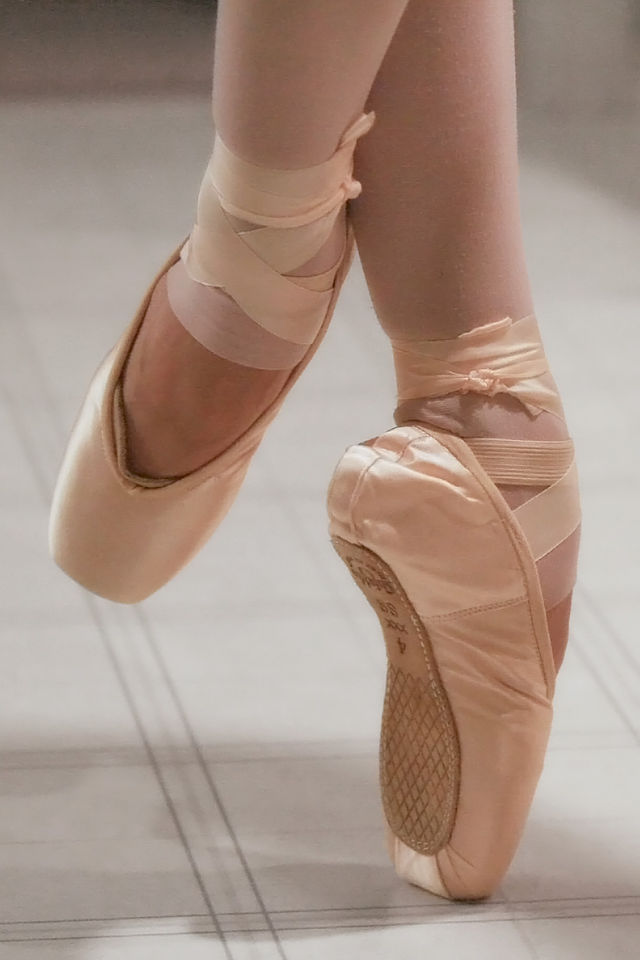
An idea for a story about dancing had pushed me to take the plunge and buy a new pair of ballet shoes. I’d wanted to immerse myself in that world again, because I wanted to write about it.

But taking class has, in fact, enriched my life in other unpredicted ways. It’s a part of the week to which I now always look forward. An hour-and-a-half of ballet makes for a wonderful way to change gears after several hours at my desk. The concentration required to try to master the steps empties my mind of any work-related stresses, and afterwards I feel refreshed and more enthusiastic about whatever I have to do tomorrow.

Being an initially extremely rusty student has also helped me in my work as a teacher. The experience of being unable to remember where to place my arms, and finding my feet no longer seem to work as they used to, has served as a great reminder of how daunting it might be for one of my adult writing students, who finds themself sitting in a classroom again after many years out in the world of work.

Though it’s unlikely we’ll ever find ourselves standing together at the barre, I’d been wondering, since our visit to the Bolt exhibition, about other ways in which Emma Claire and I might enjoy ballet again together. Then I heard about the Royal Ballet’s new production Woolf Works – based on the writing of Virginia Woolf – which opens in London this month.

Emma Claire and I have just bought tickets, and I’m excited to go and see a performance with her for the first time. Not only should it give me the chance to share with her something more of my love of ballet, but the subject matter will surely open up new conversations about one of Em’s own great passions, the writing of Virginia Woolf.