We Speak the Same Language: Julie Sarkissian & Haley Tanner

When Laura MacDougall of Hodder & Stoughton contacted us about the friendship between one of her authors, Julie Sarkissian, and fellow US novelist, Haley Tanner, we were keen to learn more. So, we interviewed them for this month’s guest post.

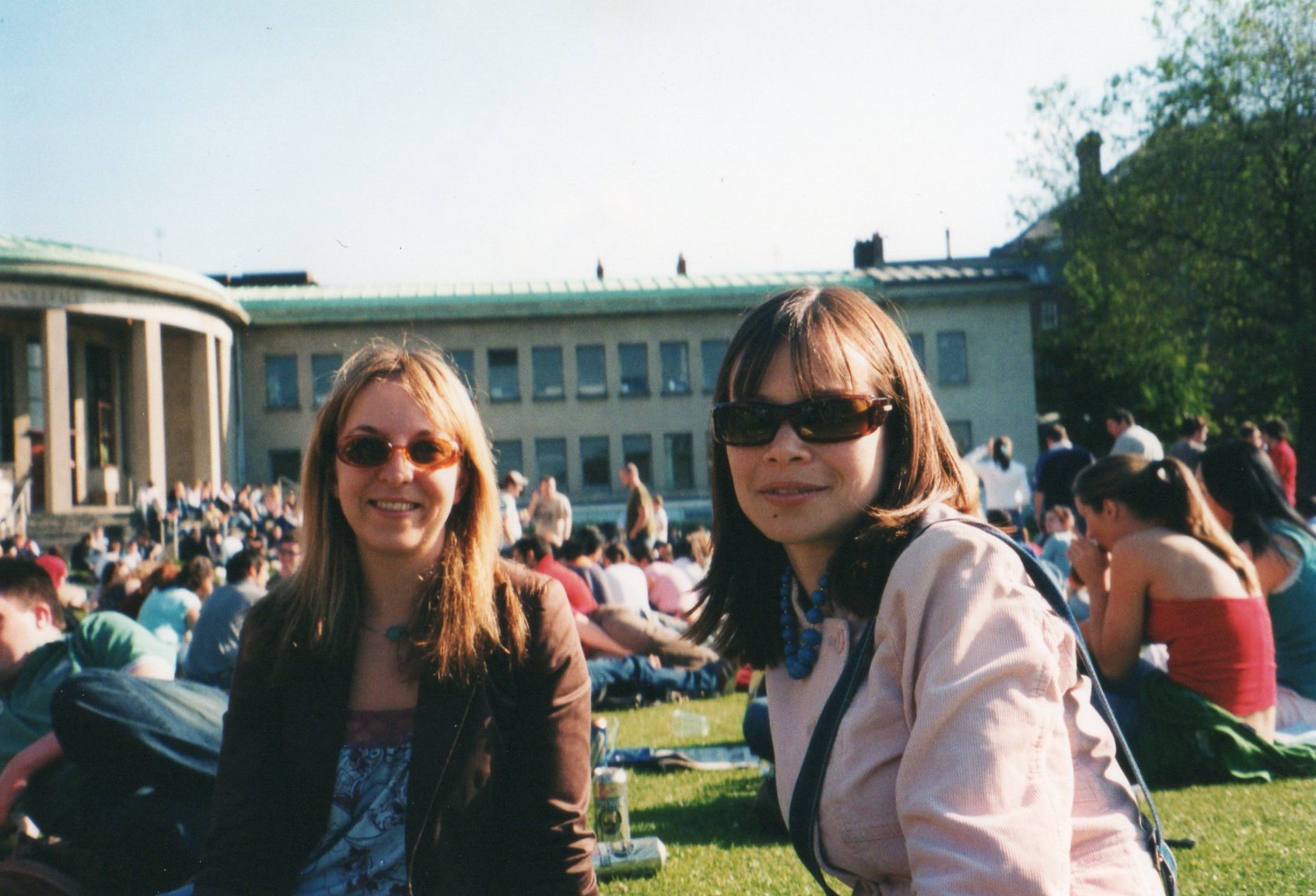
Julie (left) with Haley (right)

Something Rhymed: What were your first impressions of each other and how did you become friends?

Haley: The first time I saw Julie I wanted to become her friend instantly.  It was the first week of the MFA program we did together and during these awful get-to-know you exercises where everyone tried as hard as possible to impress everyone else with their apathy and pretension – in the middle of all that she was a shining beacon of honesty and ease and genuine enthusiasm.  Then we had our first workshop together and the story she brought to the table was just beautiful and strange and so impressive – I still remember lines from that first story – and I thought she’d never be my friend – she just seemed so brilliant – and way too cool for me.  I think she must have done the first inviting-out-to-drinks – I don’t remember – but I’m pretty shy about those things so I bet it was her.  The first time we went out together I could not believe that this gorgeous intense-genius person was so down-to-earth, so real and wonderful and so human.

Julie: A few of us students were standing around after some kind of orientation and I remember thinking Haley was very hip, was totally beautiful and very charming and engaging. We later found ourselves in class together but we didn’t talk outside class until the day her writing was workshopped for the first time. I was blown away by her talent. I went up to her after class and said, your writing is amazing, I have this feeling we speak the same language, let’s go get a drink. So we went to a bar that us MFA kids would go to after class and we stayed up talking long into the night. After that, we took all our classes together and, after we graduated, we saw each other almost as much as we had in school.

Something Rhymed: What qualities or interests do you share and in what ways do you differ?

Julie: Haley’s an adventurer and I’m a creature of habit. I’ve worked in the same restaurant for ten years, had the same therapist for seven years, had the same boyfriend/now husband for nine years. In that amount of time Haley has travelled the world many times over. We are both pretty extroverted, we both love a good in-depth, no holds barred heart-to-heart. Needless to say we both love to read and love to talk about books.

Haley: Oh my goodness! There isn’t anything I wouldn’t like to do with Julie by my side. We both procrastinate by baking or cooking or cleaning when we should be writing. Julie was the first writer I met who would admit that there were many times that we’d rather do anything – anything AT ALL, than write. What ways do we differ? Julie is far more social than I am. She’s a real girl’s girl – she has this incredible ability to create an amazing space where women can be supportive of each other and let go and have real fun.  I remember Julie throwing an all-girls holiday party, cranking Mariah Carey’s ‘All I Want For Christmas’ and getting everyone to dance around the room. I think Julie should be held up as an example that being an incredible literary genius does not mean that you cannot throw a great dinner party, kick off your heels, and dance around the room.

Julie is an amazing friend, and she’s an amazing friend to a long list of very lucky people. I’m sort of a homebody – Julie has always drawn me out of my shell, and taught me, by example, how to be a better friend.

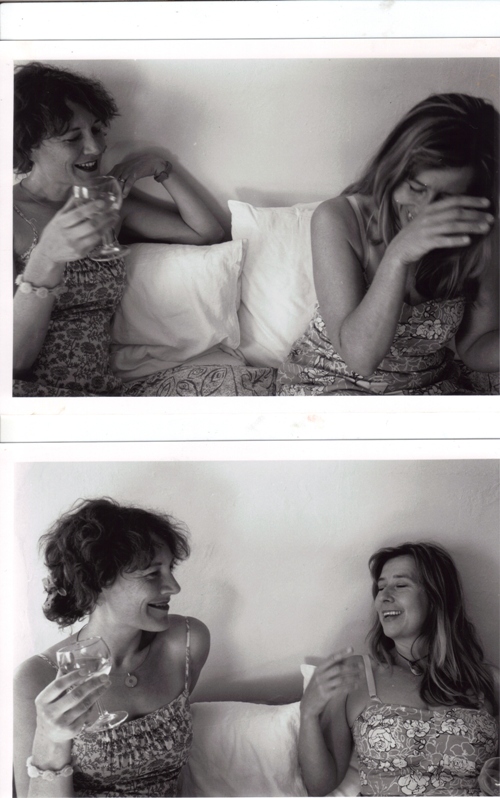
Julie (left) & Haley (right)

Something Rhymed: Can you tell us about the role of writing in your friendship?

Haley: Julie is the only person on the planet with whom I can share some of my darkest writing troubles – she’s so unguarded, I can tell her anything. Julie helped me write my first query letter to an agent – and she forced me to send it. I wouldn’t have a career without her encouragement.  I still have all of Julie’s handwritten edits on the early versions of the manuscript for my first novel – those pages are the only edited rough-draft relics I’ve saved – if only for her handwriting and genius.

Recently we’ve been talking about motherhood – it’s an entirely new world we’re both entering.  It’s essential to survival to have someone by your side who knows who you were before you were a mom.  For me, writing has taken on an entirely new importance – it’s a way to spend time in my mind – to reclaim some of the territory lost to the baby and the breastfeeding and the sleep struggles.  I think that having a friend who is also exploring this alien land can keep you from losing your mind.

Julie: Haley is one of the only people whom I am very, very close with that I feel can empathize with the struggles of writing, publishing, the disappointments, the jealousies, the confusion. I rely on her to validate many of my ambivalent, painful feelings about writing and being a writer that are hard to express to other friends. Our friendship is so much more than just about writing, but we first connected over writing and confiding in each other about writing was the basis of a deep intimacy.

Something Rhymed: Have the two of you ever experienced any feelings of literary rivalry and, if so, how did you find a way to manage them?

Julie: When Haley sold her novel and I was still editing mine with my agent I was definitely jealous. I wanted so badly to have what she had. But I think the word rivalry implies one person desiring to be superior and that I have not necessarily experienced. Haley was the first person to read my novel and vice versa, so we were invested in each other’s novels from the very beginning.

Haley: I have never, never, felt any sort of rivalry with Julie – and no envy.  I truly love her, and I’ve only felt true happiness at her success.   I think there’s a very pervasive and damaging idea floating out in the universe that writing – or any art – is a zero-sum game – that someone else’s success is your loss. That’s ridiculous and harmful – and it sabotages real, supportive, loving relationships.  Throughout all of the early struggles I always believed that one day Julie and I would be lucky enough to do interviews like this – to talk about our books and our lives together.

Julie Sarkissian’s novel, Dear Lucy, is published by Hodder & Stoughton

Haley Tanner’s novel, The Adventures Of Vaclav The Magnificent And His Lovely Assistant Lena, is published by Cornerstone.

The Uncompetitive Gymnast

We all get lumbered with mythologies about our character long after we’ve outgrown them. In my family, for instance, I’m thought to be fiercely competitive, keen only to do those things at which I excel.

This version of me came about with good reason: at about ten years old, I asked my mum whether I stood a chance of getting into Oxford or Cambridge; in my teens, I could hardly enjoy exam success if a classmate got 98% when I got only 96; I was so appalled at my ineptitude at driving that once, during a lesson with my dad, I stormed out of the car at traffic lights, leaving him to take the wheel. My parents were amused and bemused by the precocity and ferocity of my ambitions, wondering how I’d acquired such traits.

Friends I first met in my twenties, such as Emily, rarely recognise my family’s characterisation of me. In my own narrative, my competitive streak disappeared during my university years. At Cambridge, I tell myself, I learnt to study simply for the joy of it; I became privileged enough to consider reading and writing and thinking as ends in themselves.

But when Emily commissioned me to write about gymnastics, the memories I mulled over complicated my own version of this change in me.

After years of pestering my parents, they let me join a gym club when I turned seven. Even at that young age, I was acutely aware of the need to catch up with those who’d been training since they were three: I’d get really worked up about competitions, not allowing my parents to watch, and eventually feeling devastated when an excruciating 3.0 on the asymmetric bars led to my demotion from the squad.

But I carried on training throughout my teens, attending as many as five sessions per week, long after I’d accepted that I’d never get back into the first team, let alone really make it as a gymnast.

The experience of practising something that didn’t come naturally gave me a tiny glimpse into my sister’s life. Lou’s cerebral palsy and autism make everyday tasks at least ten times harder for her than they are for me. After years of hearing me talk nineteen to the dozen, she kept on sounding out words in front of the mirror until she eventually said them clearly enough for us to comprehend; after years of watching me cartwheel around the garden, she managed her first steps at six.

Emma Claire and Lou
Emma Claire and Lou


More remarkable still, Lou undertakes her daily graft with such aplomb that it rarely comes across as onerous. She’ll introduce herself to strangers, trying out her favourite phrases, and she’s invariably the first one on the dance floor and the last one off. Lou’s zest for life is never based on achievement or competition, her sense of self-worth never reliant on beating someone else.

When I made the choice to continue with gymnastics, I came to value the journey without getting fixated on the destination – a lesson that’s served me well when it comes to writing. It strikes me now that I was unwittingly following Lou’s example by doing something simply for the love of it: a quality that comes naturally to her but that was at least ten times harder for me.

Emily Dickinson and Helen Hunt Jackson

tumblr_mevs2yhzId1rnvzfwo1_1280
Emily Dickinson (far left) and Helen Hunt Jackson (in purple dress) pictured on the Amherst Community History Mural. The picture is used with the kind permission of Jim Wald

The abiding image of Emily Dickinson is that of a reclusive poet, dressed only in white, and known among her neighbours as The Myth. So we were surprised and delighted to discover that she had been friends with one of the most famous writers of her generation, someone whom Ralph Waldo Emerson described as the best of America’s poets.

Dickinson’s celebrated friend was Helen Hunt Jackson – a name that, to our shame, we found unfamiliar. Although her reputation as a poet has failed to stand the test of time, she is still well remembered in the USA as a campaigner for the rights of Native Americans, and her novel Ramona has never been out of print.

Like Mansfield and Woolf, theirs was an unlikely friendship. Jackson was a social animal, whose successful career stood in stark opposition to that of Dickinson – an intensely private poet.

Indeed, during Dickinson’s lifetime, she saw only a handful of her poems go to press. Jackson actually shepherded one of them to publication, cajoling her into this by saying that: ‘It is a cruel wrong to your “day and generation” that you will not give them light’.

Dickinson also held Jackson’s work in high esteem, once claiming that – with the exception of George Eliot – she considered Jackson’s poems stronger than those of any woman since Elizabeth Barrett Browning.

Thomas Wentworth Higginson, who acted as a literary mentor to both writers, introduced Dickinson and Jackson to each other’s work. However, the two women had actually known each other since childhood. They both came from the small town of Amherst, Massachusetts but, whereas Jackson had roamed far and wide, Dickinson had stayed firmly put. Once they’d reconnected, Jackson visited Dickinson on her return trips to Amherst. So – unlike many of Dickinson’s friendships – the two writers conversed in person as well as through letters.

Their friendship even influenced some of their work. Jackson acted on occasion as muse, commissioner, and recipient of poems by Dickinson. And, for her part, Dickinson is widely thought to have inspired the central character in Jackson’s first novel: a woman who wears only white, and who writes strange and dazzling poems.

Activity

Helen Hunt Jackson once commissioned Emily Dickinson to write her a poem about an oriole – an orange-breasted blackbird common in the north east of America. Dickinson responded with ‘The Hummingbird’.

This month, we will be commissioning each other to write about a particular topic – although, like Dickinson, we reserve the right to go on a bit of a tangent!

As always, we’d be grateful for suggestions of other female writer friends you’d like us to research.

The Stuff of Legend

It was a question that prompted us to launch Something Rhymed, a question that eluded easy answers: why have so many female writer friends, unlike their male counterparts, failed to make legends of each other?

We wondered whether women had traditionally conducted their relationships privately while men had more opportunities to promote each other in public. Coleridge, for instance, had the freedom to up sticks to the Lakes where he could collaborate with Wordsworth on the Lyrical Ballads. At around the same time, Jane Austen’s abode was entirely at the whim of her family and she still felt she had to publish anonymously.

However, closer investigation showed us that women too have long been attempting to make legends of each other. After all, Charlotte Brontë travelled cross country to stay with Elizabeth Gaskell (a pair we’re sure to profile since so many of you have suggested them), and after Brontë’s early death Gaskell published the first biography of her friend.

This month’s pair, Vera Brittain and Winifred Holtby, emerged very much from this trailblazing tradition, embracing mutual publicity from the start: debating at the Oxford Union, campaigning for their shared social and political causes, publishing prolific amounts of journalism. Indeed, the pair became so entangled in people’s minds that Winifred Holtby was once introduced at a meeting as ‘Miss Vera Holtby’! It is fitting, therefore, that after Holtby’s early death, Brittain edited and promoted her friend’s final novel and then memorialised their relationship in Testament of Friendship.

Question Mark

We took rather longer to expose our friendship to public scrutiny. For the first decade since our initial meeting, we critiqued each other’s work in the privacy of our own homes, and we published entirely separately. But ever since The Times commissioned us to write about female writing friendship, we’ve become far less publicity shy, looking to Brittain and Holtby as our role models.

Our attempts to follow in their footsteps has brought us many unexpected and joyful connections, from drinking Prosecco in Kiliney Castle with writer pals Anne Enright and Lia Mills to gaining our first hits on this site from Korea and Kyrgyzstan. The generous coverage Something Rhymed has received from Slightly Bookist and Women Writers, Women, Books has resulted in particularly strong contingents of blog followers from Canada and the USA, and tweets from the likes of the New York Public Library. Just recently, we received some especially interesting suggestions from our new North American friends, who alerted us to the epistolary relationship between George Eliot and Harriet Beecher Stowe, as well as the friendship that A.S. Byatt managed to forge with her literary heroine, Iris Murdoch.

Murdoch also came up on the back of a connection we’ve forged closer to home. When the Yorkshire Post picked up on Holtby’s (and Emily’s) Yorkshire connections, one of their reader’s got in touch to tell us about Murdoch and the philosopher Philippa Foot, whose extraordinary friendship eventually survived a sexual interlude and even a massive bust-up.

Mercifully, our friendship has not only survived but thrived since we made the decision to follow the example of Brittain and Holtby. But our investigation into female writers and publicity has not yet produced an answer to our initial question. Instead, the question itself has changed. So now we’ve begun to ask ourselves this: why do women’s attempts to make legends of each other tend to get written out of literary lore?

The Elephant in the Room

Emily visiting Emma Claire in Dublin four years after they first met

My friendship with Emily is founded on deep similarities – in tastes, and values, and goals – but it was a superficial difference that struck me first.

Emily is beautiful. It’s something anyone would notice about her. No wonder a Vidal Sassoon trainee was so keen for the chance to style her hair. When we’ve touched on our differences before, this has been for me the elephant in the room. Unlike Em, I am not the kind of woman that hairdressers stop on the street.

I distinctly remember the chopped style Emily sported back then, her blond highlights. The fairness of her hair was so striking against her olive skin that I looked at her during our first Japanese lesson, trying to discern her ethnicity. It seems so obvious to me now that she is half-English, half-Japanese that I find it absurd when people mistake us for sisters. Absurdly complimentary, too, that someone thinks I resemble Em.

It’s not that I’m plagued by poor self image. I rather enjoy my looks: my Celtic green eyes; my size three feet; my very English mousy hair. Emily’s beauty is simply a fact – something that, as her friend, I get to enjoy. I quickly came to value, for instance, that our shared love of fashion never slid into competition, that we would both just as likely order pie and chips as goat’s cheese salad.

But when we first met, before leaving for our teaching posts in Japan, a part of me must have assumed that someone as beautiful and trendy as Em would not want to be friends with me.

My most vivid memory of first meeting Em occurred just after our first Japanese lesson. A group of us were waiting for the lift when Emily mentioned her disappointment at being placed in Matsuyama – the capital of Ehime prefecture. She didn’t want to be out in the sticks. This amused me since Matsuyama has a population the size of Liverpool, and I surmised we might have little in common since I’d sought a job in a mountain village.

But I must also have sensed some promise of connection because I remember thinking: I’ll either find Emily too cool for school, or we’ll end up firm friends.

I’m not sure exactly how we went from that moment outside the lift to the strong foundations of friendship that we’d established just months later: gravitating outside during raucous parties; trading stories of the men we’d left behind; and, finally, sharing the writing we’d scribbled in secret. Em must have done the initial legwork; I would surely have been too scared of rejection.

Her honesty is one of the qualities I jotted in response to February’s challenge. It extends, at times, to making herself vulnerable: letting an old lover know that her feelings haven’t changed; leaving an unsatisfactory job; reaching out to a new friend. Her candour, which ensured that we did become firm friends, is a deeply beautiful quality, and one that I glimpsed very soon after my first impression of her lovely olive complexion and blond, cropped hair.

Broken Things

Emma’s gift for Emily The trinkets contained in this jewellery box show that I was a child intent on self-memorialising: christening bracelets; gymnastics medals; my annual bus passes; the label from my first bra.

But the object that I’ve removed from the jewellery box to pass on to you, Emily, is a memento of Bam-bam – my grandma. After she died, when I was just nine, I took this bar of Pears soap as a keepsake and its scent of thyme still reminds me of her.

Bam-bam wore fur coats and visited the hairdresser every week; she fed me milk loaf and strawberry splits; people gathered around the piano when she played; the local librarians all knew her by name. After she died, we found exercise books stacked in her bedside cabinet all of them filled with her own handwritten poems.

For me, the search for literary ancestresses stems back to the discovery that my own grandma was a closet writer. My dad kept her exercise books and I have treasured her bar of Pears soap.

So now, Em, you have a little more insight into the importance of Pears soap in The Waifs and Strays of Sea View Lodge. Or, I should say, the significance it used to have. The soap is now only mentioned here and there, no longer carrying the symbolic weight it had in earlier drafts – drafts that you read and critiqued. Only you, who have accompanied me on every step of this long writing journey, would detect in the final version the lingering scent of Pears soap.

In a way, then, may this memento stand for everything that’s written out, for our shared dedication to voicing stories that have previously been silenced. After all, with its focus on female friendship – a neglected aspect of literary lore – this is what Something Rhymed is all about.

Sadly, this trinket must also stand for broken things. Although I’d kept the bar of soap intact for decades, packing and unpacking it every time I moved house, I dropped it when I reached into a high cupboard to fetch it for you.

After my initial dismay, I realised that there’s perhaps something appropriate about this. I’ve always been drawn to broken things: derelict funfairs; threadbare cardigans; people whose surface resilience hides their distress.

My grandma was broken by the death of her eldest son and the disintegration of her marriage. In writing this message to you, Em, it strikes me that in my novel I offer an elderly woman a last chance to be healed – a chance my grandma never seized.

But there’s beauty in the broken, isn’t there, Em? I know that you too will appreciate the brighter amber that was revealed when the bar of Pears soap splintered, its headier scent of thyme.

Jane Austen and Anne Sharp

emma-anne-sharp1
The presentation copies of Emma that Jane Austen sent to Anne Sharp (image used with kind permission from Bonhams)

When we realised that we knew all about the great male literary friendships but little of their female counterparts, we both immediately wondered whether Jane Austen had a writer friend. But since so little is known of her life, we weren’t confident of discovering much.

However, after a bit of sleuthing, we found out that Austen did have ‘an excellent kind friend’. What’s more, this support came from an unexpected source: her niece’s governess, Anne Sharp.

This name will be familiar to those of you who’ve been following Radio 4’s 15 Minute Drama, The Mysterious Death of Jane Austen. You might not be aware, however, that Sharp was herself a writer.

Austen was attracted to Sharp’s keen intelligence and wit, combined with independence of spirit – sensibilities that transcended class lines. But Sharp lived an even more financially precarious existence than Austen – something Austen worried about on her friend’s behalf. Rehearsing the match-making role of her heroine, Emma, she dreamt that Sharp might marry a wealthy employer.

Like Austen, though, Sharp never did wed. The demands of fulltime teaching prevented her from pursuing writing professionally. However, she did get to flex her literary muscles by writing plays for her pupils to perform. Austen herself likely acted in one such play (interestingly, cast in the role of governess), and Sharp was known to pen male roles for herself.

Fascinatingly, one of her theatricals was entitled Pride Punished or Innocence Rewarded. Several years later, Austen decided to change the title of one of her novels from First Impressions to Pride and Prejudice, and it’s hard to imagine that she hadn’t been influenced by the work of her friend.

She certainly valued Sharp’s critical faculties, electing her as the only friend to whom she sent one of her precious presentation copies of Emma. The candour with which Sharp answered her request for a critique shows the level of trust between these two writer friends. Sharp pointed out a flaw in one of the sub-plots, ultimately rating this latest novel somewhere between Pride and Prejudice and Mansfield Park.

After Austen’s early death, her sister sent Sharp a lock of Austen’s hair, a pair of clasps, and a small bodkin as mementoes – mementoes of a radical friendship that refused to be bound by the constraints of class, or to be defined by divisions between the professional and the amateur; mementoes of an influential literary alliance, yet one that has been all but forgotten.

Activity

This month, we’re going to send each other a trinket accompanied by a note that explains why it should stand as a memento of our friendship. Like the gifts that Anne Sharp cherished, something as small as a hairclip or needle might be all it takes to bring back memories.

As usual, please also share with us any more female writing friendships that you’ve discovered.

We Beg to Differ

Emma Claire Sweeney and Emily Midorikawa on Read Me Something You Love, discussing the differences that fired the friendship between Katherine Mansfield and Virginia Woolf

A sister can be seen as someone who is both ourselves and very much not ourselves, a special kind of double – Toni Morrison

Michèle Roberts recently advised us to acknowledge our differences.

As fans of her work and beneficiaries of her teaching on UEA’s Creative Writing MA, we were particularly keen to learn from her. With male friends, she told us, differences are delightfully obvious, but with fellow women we must mine deeper to discover the disparities between us:

‘Mothers and daughters identify with each other because they are of the same sex, and yet also they have to recognise themselves as separate people; the struggle for them to differentiate from each other can be troubled at times. With women friends, particularly, perhaps, if they are very close, and particularly, perhaps, if they are very idealistic about friendship, this struggle can occasionally be re-enacted. One of the roles of friends is to cherish and respect their differences as well as delight in their identification!’

Since our similarities are so obvious and we’ve never once had a feud, we found Michèle’s advice simultaneously resonant and troubling.

In our profile of Maya Angelou and Toni Morrison, we mention that they are often grouped together for the crudest of reasons. This is something that we’ve experienced too. We’re both writers; both northern; both brunette and petite; both teach at the same universities; both share a taste for vintage fashion, second-hand bookshops, and long conversations over afternoon tea. We even share variations of the same name: Emma and Emily. When one of our colleagues persistently mistakes us for the same person, we roll our eyes and laugh but are secretly pleased.  

Emily’s poem, ‘Things We Didn’t Do’, depicted a childhood very similar to Emma Claire’s: we both staged plays in our back gardens, practised cartwheels, created dens, shared secret cigarettes.

Yet it is our differences that might have most enhanced our formative years: in Emily Midorikawa’s home, you would have found chopsticks that rubbed along easily with the knives and forks, whereas at Emma Claire Sweeney’s you would have been more likely to stumble across holy water contained in a bottle the shape of Our Lady; Emma Claire could have eavesdropped on conversations between Emily’s academic parents, whereas Emily could have discovered a less obvious kind of intelligence in Emma Claire’s autistic sister.  

More important and problematic, though, are the differences in our characters and in the lives we’ve forged for ourselves. If we fail to accommodate them, they could damage our friendship in the long run.

One of the things Emma Claire admires in Emily, and tries (but frequently fails) to emulate is her ability to broach difficult matters with honesty. It takes a particular kind of tact and courage to acknowledge the things that divide us: if we go about it the wrong way, we risk falling out.

We learnt from Katherine Mansfield and Virginia Woolf that competition can be constructive – something that tends to go without saying about male friendship but is still taboo about women – but we don’t want to repeat their cycle of feud and reconciliation.

In the process of writing this post, we’ve realised that Maya Angelou and Toni Morrison have already taught us a thing or two about positive recognition of difference. In our responses to this month’s activity, for instance, Emily mentions that she’s never ‘known anyone quite like Emma Claire for taking an idea and running with it’, whereas Emma Claire admires the way Emily ‘accurately predicts the length of time a task requires and only undertakes work she can complete to the highest of standards’. These are attributes and yet they are also often our undoing. Looked at from another angle: Emma Claire needs to learn to say ‘no’, whereas Emily could more often say ‘yes’.

Something Rhymed may never have got off the ground without Emma Claire’s drive, but it could not have thrived without Emily’s pragmatism. We have only scratched the surface when it comes to acknowledging our differences, but we’re exploiting some of them each and every time we make a post on this site.

Ten Things Sarah Butler and Tessa Nicholson Love About Each Other

When novelist, Sarah Butler, and screen writer, Tessa Nicholson, posted up pictures of their beautiful letters on Twitter, we were delighted to discover that they were following Something Rhymed and joining us in dedicating 2014 to friendship. Since each chapter of Sarah’s début novel, Ten Things I’ve Learnt About Love, begins with a list, we asked them to share the lists they wrote in response to February’s challenge in this month’s guest blog.

We met, aged 19, at University: both reading English, both slightly overawed by the academia of Cambridge. We were friends from the off – easy in each other’s company, interested in each other’s lives, encouraging of each other’s dreams.

Fifteen years on, we are still firm friends, and now we are both writers. Something Rhymed’s letter writing activity for January helped us to forge another, written aspect of our friendship – which has been especially delightful now that we live in different cities.

Following the example of Ten Things I’ve Learnt About Love, we decided to write a list of ten things we admire about each other.

Sarah on Tess

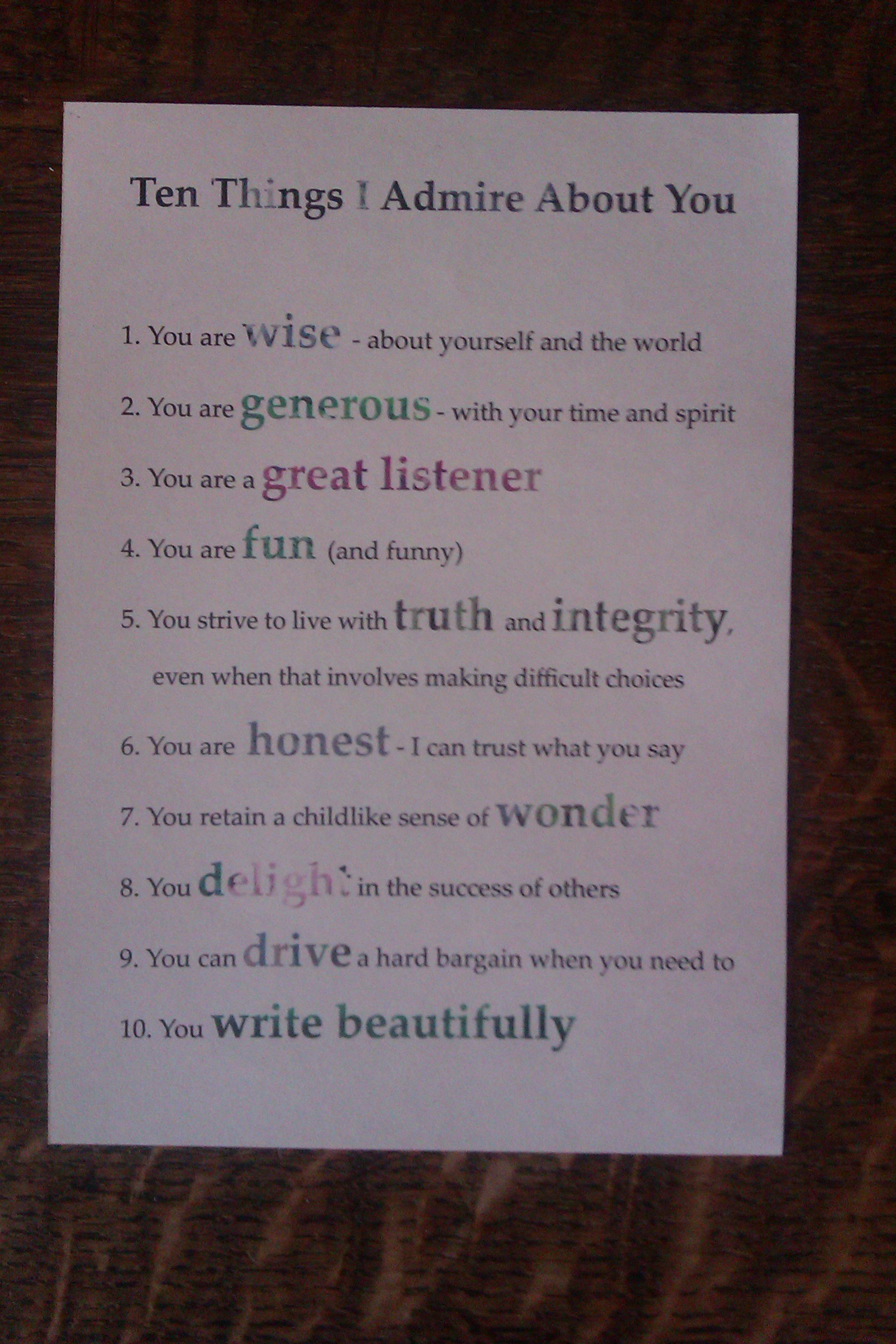
Ten Things I admire about Tessa

Sarah: It felt like a treat to take the time to really think about what makes Tessa such a great person and friend. As I wrote, certain words jumped out at me: wise, fun, generous, honest, so I decided to make a simple list which emphasised these words. I thought about which colours I associate with Tessa, which, it turns out, are muted pinks, greens and greys, so I used these colours for each key word, using images of tree bark, flowers, leaves and stone. The list’s title is ‘cut out’ of a photo of the college at Cambridge where we first met.

Tessa: Reading Sar’s list made me realise how lucky I am to have her as a friend. It is very fitting that this exercise was Sar’s suggestion – from our early days at university I was struck by her discipline and work ethic. Living beside her from the day we were able to choose rooms, I strove to work as hard and as productively as she did – and definitely failed. Today she continues to inspire me – doggedly carving a name for herself among the literati! Am so proud of her. And of our friendship. Her list felt like a big reassuring hug and an encouraging hand on my back pushing me up the hill.

Ten Things I Admire About Sarah

Tess on Sarah

TessaThere are many things to admire in Sar, so I had to be selective when putting it down on paper. First of all, I thought I would write my list by hand – but my writing is messy and difficult to read. So then I had what I thought was a better idea, to cut the letters out of the paper (the Guardian and Grazia Magazine to be precise). I now have a lot of respect for kidnappers because ransom notes really take forever. I berated a lot of journalists during the process but am now up to date on current affairs and Victoria Beckham’s rise from Spice Girl to haute couture.

Sarah: I want a wall-sized version of Tessa’s list in my office! It’s funny – I was half-hoping Tess would handwrite the list because I love her handwriting so much, but I love the ransom note – beautiful, colourful, quirky, just like her. I was touched by all of it, but especially number 3: ‘you make me feel at home’ – which links so beautifully to Maya Angelou’s essay ‘Home’ in Letter to my Daughter.

Sarah Butler’s novel, Ten Things I’ve Learnt About Love, was first published by Picador in 2013 and is just out in paperback.

Tessa Nicholson writes for PORT Magazine and the culture-vulture digital site Nowness.

Remember:

We’d love to hear about the things you admire in your friend. And if, like Tessa and Sarah, you’d like to send us a picture of your response to February’s challenge, then please email it to somethingrhymed@gmail.com or post it on Twitter along with #SomethingRhymed.

We’re on the look out for famous female writer pals to feature next month, so do let us know who you’d like to see profiled.

Jill Dawson and Kathryn Heyman: competition and correspondence

When Kathryn Heyman read our profile of the rivalrous friendship between Kathryn Mansfield and Virginia Woolf, she told us about the role of envy in her long-distance friendship with fellow novelist, Jill Dawson. So we decided this week to feature a guest blog from them.

Jill Dawson and Kathryn Heyman

You either want to kill your competitors or become their friends. We chose friendship. But perhaps it’s slightly disingenuous to present it that way: when we feel that competitive spirit, it’s partly because we are attracted to the very qualities which we have – or aspire to have – ourselves.

Like Woolf, who wanted to be a better writer because she believed Mansfield had set a high standard, when one of us is successful it spurs the other on. We have allowed ourselves to be truthful about the role envy plays in our friendship because envy, after all, is a way of discovering what it is that we want.

Because we are in the same field, there are inevitably times of difficulty, of one achieving something the other wants. Award shortlists, film deals, new book deals, invitations to international events: we are, in some ways, competitors, at least if we chose to believe that there is not enough to go around. Both of us would say that we would prefer to be the one winning the Booker Prize in a given year, for instance – but if the other won it the same year, that would be a pretty neat next best thing.

We live on opposite sides of the world now, which causes us some pain. But we talk to each other every week. Our conversations are about writing, gossip, lipstick, what to wear to events, children, husbands, our works-in-progress. We’ve been alongside each other for each of our novels – thirteen between us – and know the stages of writing. ‘I thought it was going so well,’ one of us will say, ‘but now it all seems so flat. I can’t hold it together, it’s going to collapse.’ ‘Yes,’ the other will say. ‘You always say that at precisely this stage, just before you discover something wonderful; remember the last book? And the one before that?’

We write to each other regularly too. Like Woolf and Mansfield, we discuss our novels-in-progress, money matters, the books we are reading, our mutual friends. At one point, the notion of the ideal reader cropped up in our correspondence, the person who we really write for, the one who is capable of understanding the depth and intelligence of our work. And we realised then that we’ve found in each other our ideal reader – the one writer in the world for whom we would value ourselves as a reader as much as a writer. We are extraordinarily blessed that the competitor we most fervently admire is also the friend who we adore.

Kathryn Heyman’s fifth novel, Floodline, was published by Allen and Unwin in 2013.

Jill Dawson’s eighth novel, The Tell-tale Heart, will be published by Sceptre in 2014.

This post is adapted from a longer article by Kathryn Heyman, originally published in Vogue in 2008.

Remember: 

We’d love to hear about the letters you’ve exchanged, or perhaps you would like to share some reflections on the role of envy in your friendship.

We’re still on the look out for famous female writer pals, so do keep them coming too.