The Lost Art of Letter Writing

Letter to Emily

Emily and I are lucky to live nearby these days – a luxury that, until recently, we hadn’t re-experienced since we first became friends back in 2001.

As we now get to see each other regularly, I tried to include in my letter some things that we might not discuss in person because of embarrassment, fear, or simply the deviations of conversation.

In a loose way, I was also influenced by the kinds of things Woolf wrote about in her letter to Mansfield: reflections on writing, reading, gender, friends.

Here are the ideas I jotted down to include in my letter to Emily:

  • Recommend The Faraway Nearby by Rebecca Solnitt
  • Are there no societal rules for friendship?
  • Is friendship between women still somehow considered subversive?
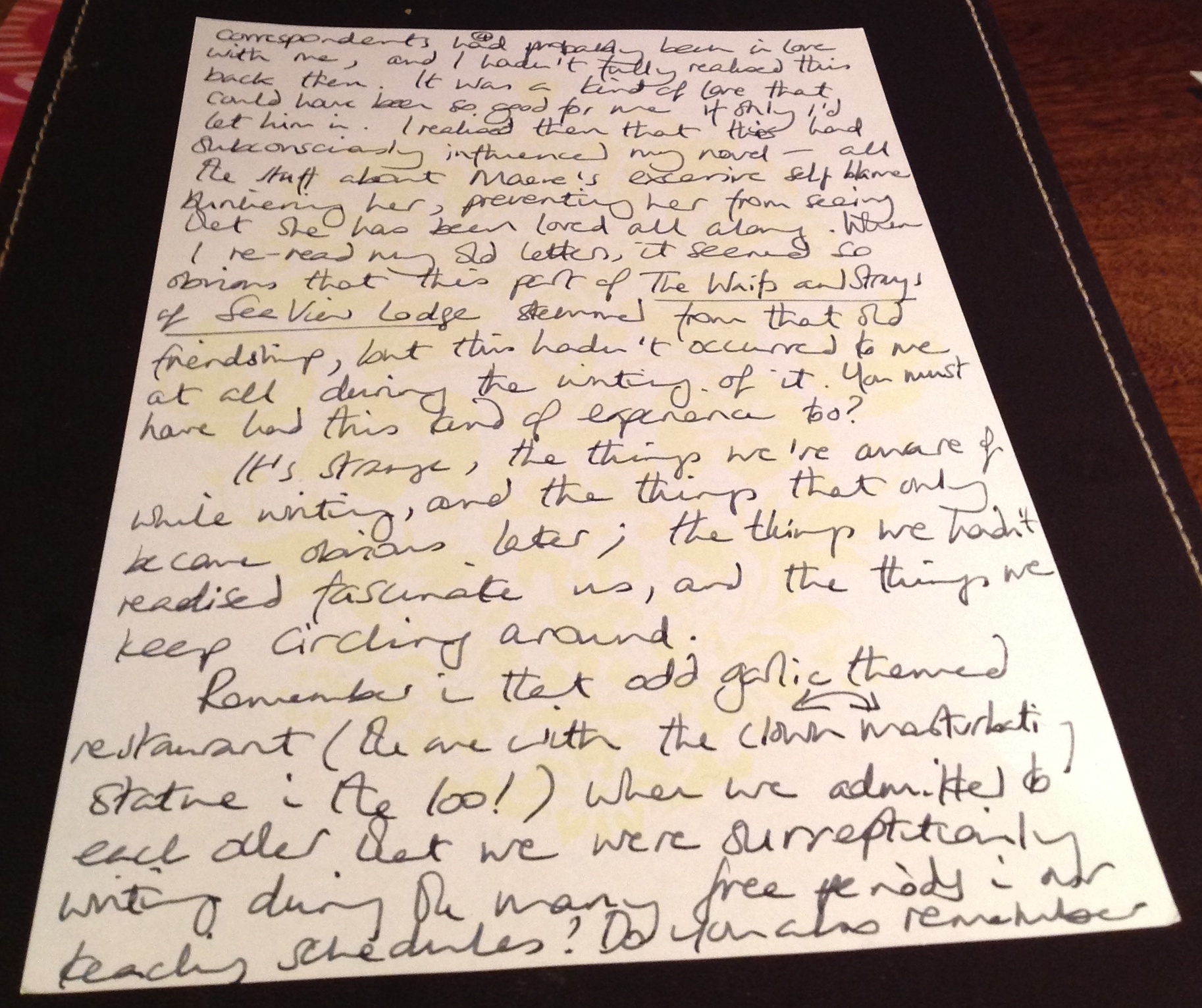
  • Unexpectedly autobiographical roots to certain aspects of our novels
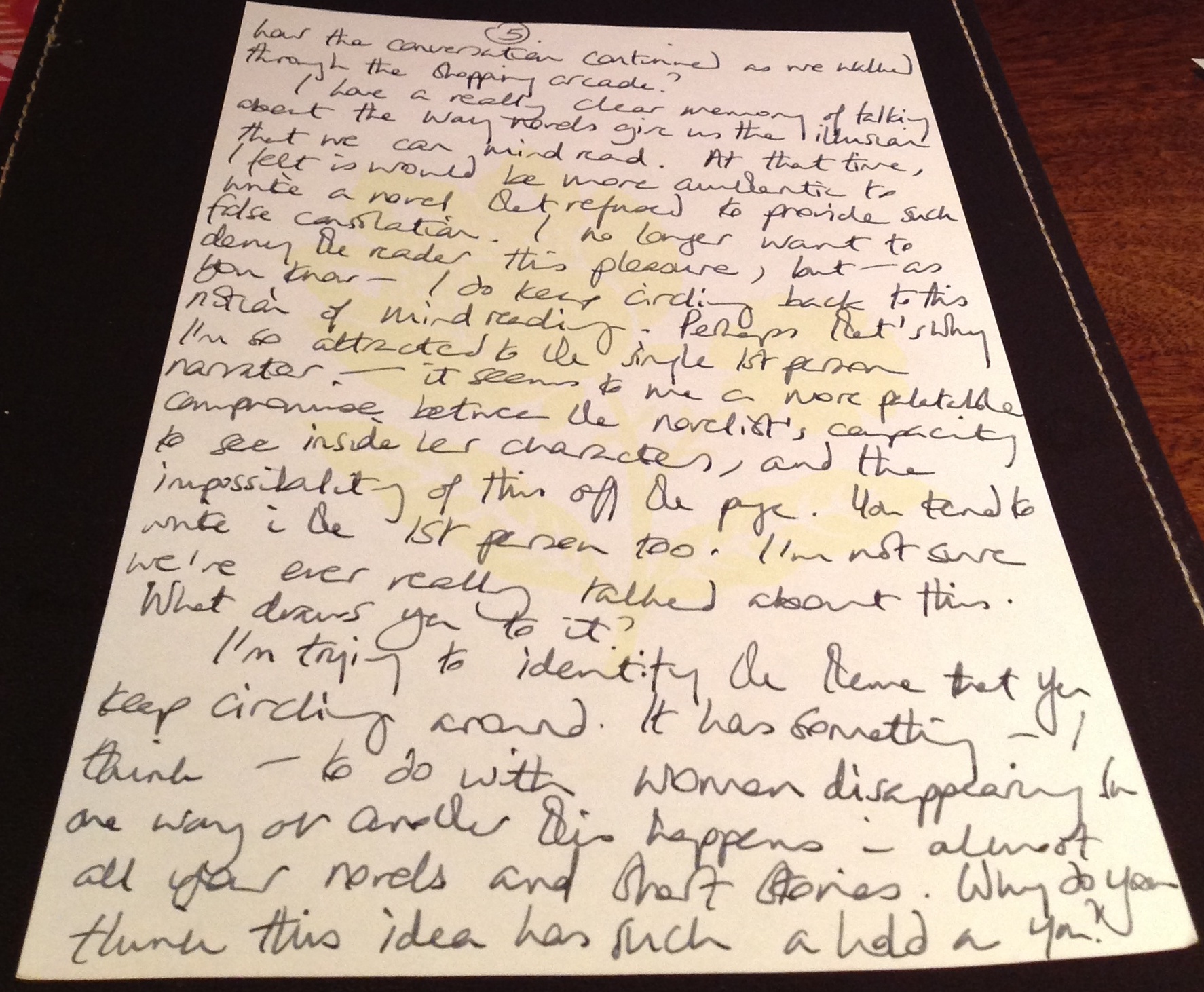
  • The themes we keep circling around
  • Getting lost

I’ve included pictures of the letter itself so you can click and zoom to see how I ended up exploring these ideas.

There was something comforting about using the fountain pen that Emily bought for me a few years back – the half-forgotten rub of the nib against paper, paper I bought in San Francisco when I visited one of our mutual friends.

The letter itself became a kind of meditation on the lost art of letter writing: the way in which the pen can explore ideas too difficult for the tongue; the eye can receive ideas too difficult for the ear.

Getting lost has itself become a lost art now that so many of us have satellite navigation systems in our cars and GPS on our phones. Through writing to Emily, I realised just how much I valued my many experiences of getting lost with her – most recently in Notting Hill on the way back from Book Slam; but also last year in Bayswater on the way to Porchester Spa; and once when we were stranded at a remote station in Cumbria with no idea of our hostel’s address.

In this letter, I reminisced about the times we first got lost together in rural Japan – joyful occasions when we began to realise just how much we shared – and, as I wrote, it occurred to me that the experience felt surprisingly like being found.

Page 1Page 2Page 3Page 4Page 5Page 6Page 7Page 8

Over to you:

Please use the ‘Leave a Reply’ facility below to let us know about the kinds of things you wrote in your letters. We can’t wait to hear.

Click here if you’d like to be reminded of this month’s challenge.

Katherine Mansfield and Virginia Woolf

Katherine Mansfield and Virginia Woolf

Virginia Woolf’s scathing first impression of Katherine Mansfield as ‘a civet cat that had taken to street-walking’ had always led us to put them down as enemies, but when our novelist friend Jill Dawson suggested them for our Times article on female writing friendships we began to question this preconception.

It turned out that Mansfield and Woolf considered themselves dear friends: they sought each other’s opinions on the books they traded; they exchanged gifts of Belgian cigarettes, loaves of bread, coffee beans, and columbine plants; they sent each other umpteen letters; and discussed their work over tea.

The two women were unlikely pals: Mansfield hailed from the far-flung colonies, whereas Woolf’s family was firmly entrenched in the English intelligentsia; Mansfield embraced her youthful desires with bohemian exuberance, whereas Woolf approached intimacy with timidity.

Both women experienced chronic illness, had complex relationships with editor husbands, and felt ambivalent about their childlessness. But it was really their shared literary endeavours that fired their friendship. Indeed, after spending a weekend with Woolf, Mansfield remarked that it was ‘very curious & thrilling that we should both, quite apart from each other, be after so very nearly the same thing’.

Although their friendship was relatively brief – from 1917 until Mansfield’s death in 1923 – its effect on their work was profound. During this time, Mansfield produced most of her celebrated stories (one of which Woolf published), and Woolf forged her trademark style. Although we more readily associate Woolf with the stream of consciousness technique, it was actually Mansfield who tried it out first.

In fact, Woolf seems to have been the more dependent of the pair: she was hurt (but likely also stimulated) by Mansfield’s damning review of her second novel; she worried when her letters failed to elicit a swift response; and references to Mansfield haunt her journal, showing her friend’s continued influence from beyond the grave.

Both friends recognised each other’s literary prowess: Woolf claimed that Mansfield’s was the only prose to have made her jealous, and Mansfield said that reading Woolf made her proud.

We too feel proud of our literary ancestresses – these women whose relationship could accommodate support and rivalry, criticism and praise; who were open to each other’s influence; and whose important friendship we’d been all too ready to write off.

Activity

Katherine Mansfield and Virginia Woolf enjoyed corresponding with each other. In this letter, Woolf describes jotting in her diary ideas she wanted to share with Mansfield. This way, she wouldn’t forget to mention them the next time she wrote to her friend.

This month, we will follow their example. Like Woolf, we will use our notebooks to keep track of the things we’d like to discuss. Then we will write about these ideas in letters that we will post to each other.

We’d appreciate any suggestions of other friendships between famous female writers (living or dead) that you’d like us to feature in future posts.