Vera Brittain and Winifred Holtby

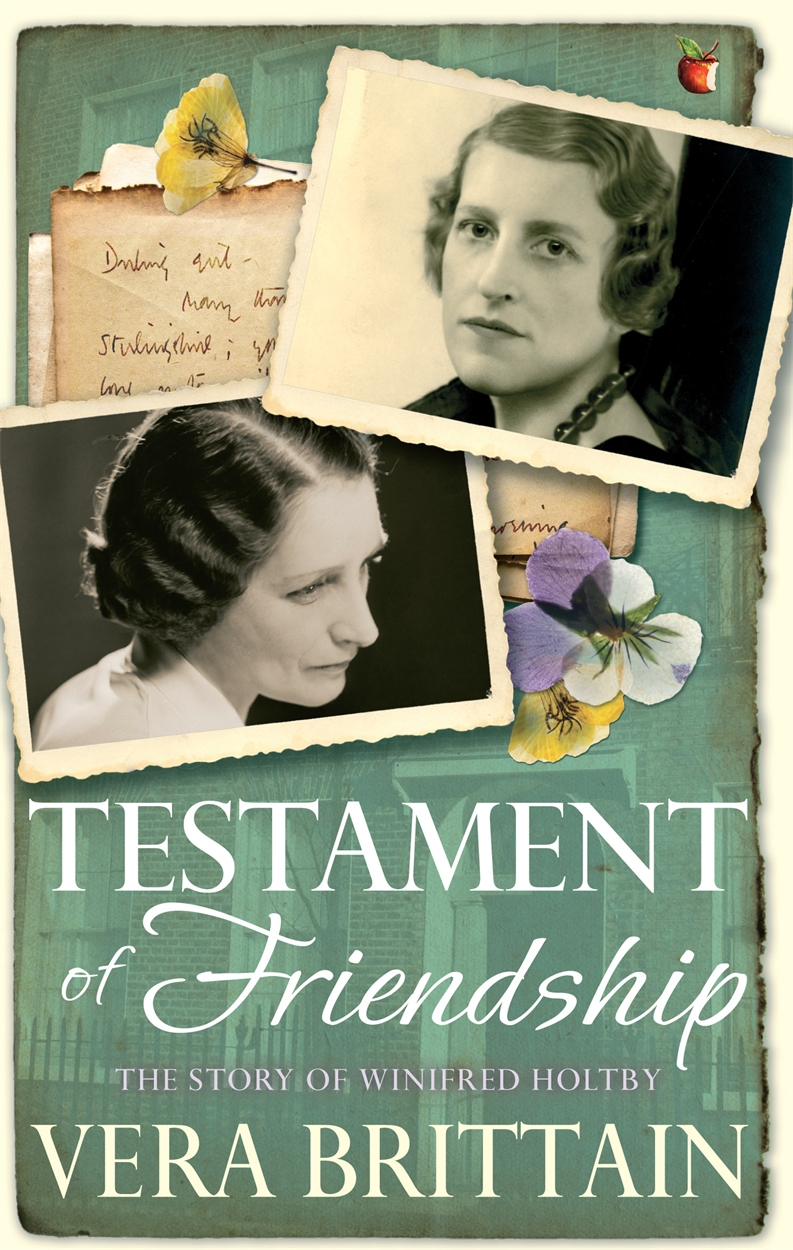
Testament of Friendship
Image used with the kind permission of Virago.

Since we began asking for recommendations of literary friends for Something Rhymed, one pair has dominated the replies: Vera Brittain, who penned the classic First World War memoir Testament of Youth and Winifred Holtby, the author of South Riding.

Both committed feminists, pacifists and socialists, it’s surprising perhaps that when they met as students at Oxford, these two initially disliked each other. After suffering what she took to be a humiliation by Holtby during a university debate, Brittain was keen to avoid her college mate – this frostiness only being repaired when Holtby called on Brittain, who’d been fighting a cold, with the unexpected gift of a bunch of grapes.

Once they’d got over their initial feelings of distrust, they realised that, despite outward differences – Holtby was tall, blonde and gregarious, whereas Brittain was small, dark and more reserved – they had a great deal in common. They bonded over their shared experiences of war service and mutual aims to make their way as writers.

After university, they decided to move in together, so that they could encourage each other in their ambitions.They also, famously, lived together in later years when Holtby joined the family home that Brittain established with her husband George Catlin, and Holtby became an aunt figure to the couple’s two children.

During their sixteen-year friendship, they continued to actively support each other’s careers. Despite the soar-away success of Brittain’s Testament of Youth, this was very much a friendship between equals. They often critiqued each other’s finished writings (although, interestingly to us, rarely work-in-progress) and helped to shape their thinking on important issues of the day through their conversations and letters.

We find these two particularly fascinating because, like us, they met when they were close to the start of their literary journeys and became each other’s ‘travelling companions’, never afraid to acknowledge the depth of support they had given each other.

After Holtby’s death at the age of 36, Brittain would go on to immortalise their relationship in her book Testament of Friendship, a fitting tribute from the woman once described by her pal as ‘the person who made me’.

 Activity

Vera Brittain and Winifred Holtby’s friendship nearly failed to get off the ground due to their initial impressions of each other. Hopefully avoiding any risk to our friendship, we’ve set ourselves the challenge this month of casting our minds back to when we met to describe our first take on each other.

As always, we are interested in hearing your suggestions about other writing friendships we could profile on Something Rhymed. You can Tweet us or use the ‘Leave a Reply’ tab below to get in touch.


Celebrating Each Other’s Successes

NotebooksUnlike Maya Angelou and Toni Morrison, or Katherine Mansfield and Virginia Woolf, there was a huge disparity in the worldly successes of this month’s featured writers.

Although Anne Sharp wrote plays for her students to perform, and was able to use her sharp critiquing skills to give Jane Austen advice on her work, she has gone down in history as little more than a footnote in the life story of her illustrious friend.

We cannot know whether Sharp ever felt envious of Austen’s achievements, and the fact that her work had the chance to reach an audience far wider than her immediate social circle. Neither would we go as far as speculating that she could have been another Austen-in-the-making if life had dealt her a different hand of cards.

It is interesting to wonder, though, whether the governess might have attempted to pursue any similar ambitions if her family and financial circumstances had been different.

What we do know is that, despite their contrasting levels of commercial success, each woman rated the other. Sharp celebrated the publication of Austen’s novels along with her, but was also ready to tell her friend when she felt there was a flaw in the work – advice that Austen appears to have highly valued.

It’s nice to imagine that her decision to rename her novel First Impressions as Pride and Prejudice was her way of acknowledging in print the crucial support she’d received from Sharp.

It’s a notion that might mean something to last week’s guest bloggers. Antonia Honeywell and Rachel Connor discussed the pride they take, not just in each other’s creative output, but their long-running writing friendship too.

Antonia’s comment on the publication of Rachel’s first novel (ahead of her own book deal with Weidenfeld and Nicholson) was one that really struck home with us. ‘It felt like a great triumph not only for Rachel,’ she recalled, ‘but for the dedication with which we both carved out the time for our regular exchanges of work.’

As we’ve mentioned before on Something Rhymed, our own career trajectories have gone along roughly in tandem so far, but there is bound to be a point when – if only temporarily – one of us will accelerate past the other.

When that happens, we hope we can learn from the example of Antonia and Rachel, and Austen and Sharp too – that we will be able to enjoy this joint success for our writing friendship, rather than focusing on any perceived gulf that divides us as individuals.

Other news

We’re currently enjoying the BBC Radio 4 series Five Hundred Years of Friendship – episodes available to listen to on-line.

We’ll be moving on to the next profiled writers on Tuesday. We were advised to look into the friendship of Vera Brittain and Winifred Holtby by many of our readers, so we particularly look forward to sharing what we’ve discovered about them.

We’re still actively researching female writer pals, so do keep letting us know, by leaving a reply or Tweeting one of us, if there is any particular friendship you’d like to see profiled.

Rachel Connor and Antonia Honeywell: ‘a collaboration to be treasured’

In this month’s guest blog, long-time writer friends Rachel Connor and Antonia Honeywell take up the March challenge to send each other mementoes of their friendship…

Rachel

Antonia and I were connected even before we met: we were paired, in advance of the MA in Novel Writing at Manchester University, to submit work in the same workshop.

From the beginning, friendship and work have been intertwined.  For nearly a decade we’ve spent happy hours talking of books and our children; of our ambitions, hopes and passions.  There’s a geographical distance (I live in the north; Antonia in the south of England) but we snatch time together in person where we can.

When the MA ended, Antonia and I took turns to submit work by email, which was printed off by the other and returned with comments.  This loop of regular submission and feedback has sustained us ever since.

The pressures of work or childcare have sometimes interrupted the pattern but the firm foundation of a working relationship will always be there.  We are, for each other, cheerleader, editor and critical friend.

Antonia's gift for Rachel
Antonia’s gift for Rachel

When I received the beautiful locket Antonia sent me I was immensely touched.  It symbolises space – the space we have afforded each other and the space for development of our creative work.

When I opened it, I was surprised to see that it contains a tiny rose, to represent growth.  I’m not sure whether she thought of it, but the rose is a crucial image in a novel I’m working on right now (which is based on Charles Rennie Mackintosh).  Consciously or subconsciously, she must have picked up on that.

I do miss Antonia’s actual presence but I know that we’ve carved out an emotional and creative space in which we can both grow.  It’s a friendship and a collaboration to be treasured – just like the locket, in fact, which now takes pride of place on the bookshelves next to my writing desk.

Antonia

It’s possible that the early hours of the morning aren’t the best time to write, but on top of four small children, we have chronic illness in the house, a head teacher being an arse, and a cellar pump that keeps failing. Yet here I am, writing.

From the first days of our friendship, Rachel’s faith in my work has given me permission to write even, and especially, when life has conspired to make it impossible. Others know us as mothers, teachers, wives and workers, but to each other, we are writers first.

Rachel's gift to Antonia
Rachel’s gift to Antonia

The little book Rachel sent me symbolises what brought us together, what sustains our friendship and what is produced by it. No Anne Sharp could have been prouder of Jane Austen than I was of Rachel when Sisterwives was published: it felt like a great triumph not only for Rachel, but for the dedication with which we both carved out the time for our regular exchanges of work.

Those exchanges have ebbed and flowed with the vicissitudes of our other lives, but our writing relationship has always been one in which the words ‘I told you so’ hold no negative connotations.

We don’t meet in person very often, but every meeting is an oasis. The next will be on Rachel’s birthday this summer. The last time I was able to celebrate Rachel’s birthday with her in person, too long ago, I confided the seed of the idea that would become The Ship. This time, The Ship will be on the verge of publication.

It began with two women who wanted to write. The rose in the locket is a symbol of the wonders that can happen, when dreams are given a little space.

Rachel Connor’s novel Sisterwives was published by Crocus Books in 2011. Her radio play The Cloistered Soul will be broadcast on Radio 4 on 29th May this year.

Antonia Honeywell’s novel The Ship will be published by Weidenfeld & Nicolson in January 2015.

 Remember

We’re still searching for more famous female writer pals to feature in the upcoming months, so do let us know if there’s a pair you’d like to see profiled.

You can do this by leaving a reply to any of the posts on the site, or Tweeting us at @EmilyMidorikawa or @emmacsweeney.

You can keep up with Something Rhymed by following us via email, by clicking the button on the right of the screen.

My Box of Memories

Pears soap, Emma Claire’s recent trinket gift has a special place in my family history too. It was the choice of my father’s own Grandma and, because of the childhood memories he associated with it, a favourite of his too.

Consequently, at least in the early years, it was the only soap we used at home. On receiving this broken sliver of amber, I found myself immediately transported by its familiar stickiness and herb-like scent to long-ago bath times at Eastfield Crescent, sitting in the tub with my little sister, our singing voices competing with the noise of the electric fan.

Emma Claire, this trinket that stands both for Bam-Bam and the ghost of your novel in its earlier forms, has now been safely shut away in my own memory box. It’s been a discovery, though perhaps not an entirely surprising one, to learn that this tendency to memorialise our pasts is just another thing we share in common.

But, in keeping with the last of our February posts, I’m keener now to acknowledge the differences between us too. I’ve stored away a petalled pink and green ballet headdress, a tiny scented satin bag from Japan that (even after eighteen years) still somehow keeps its perfume, and – having grown up in a non-religious household – there are no equivalents to your christening bracelets.

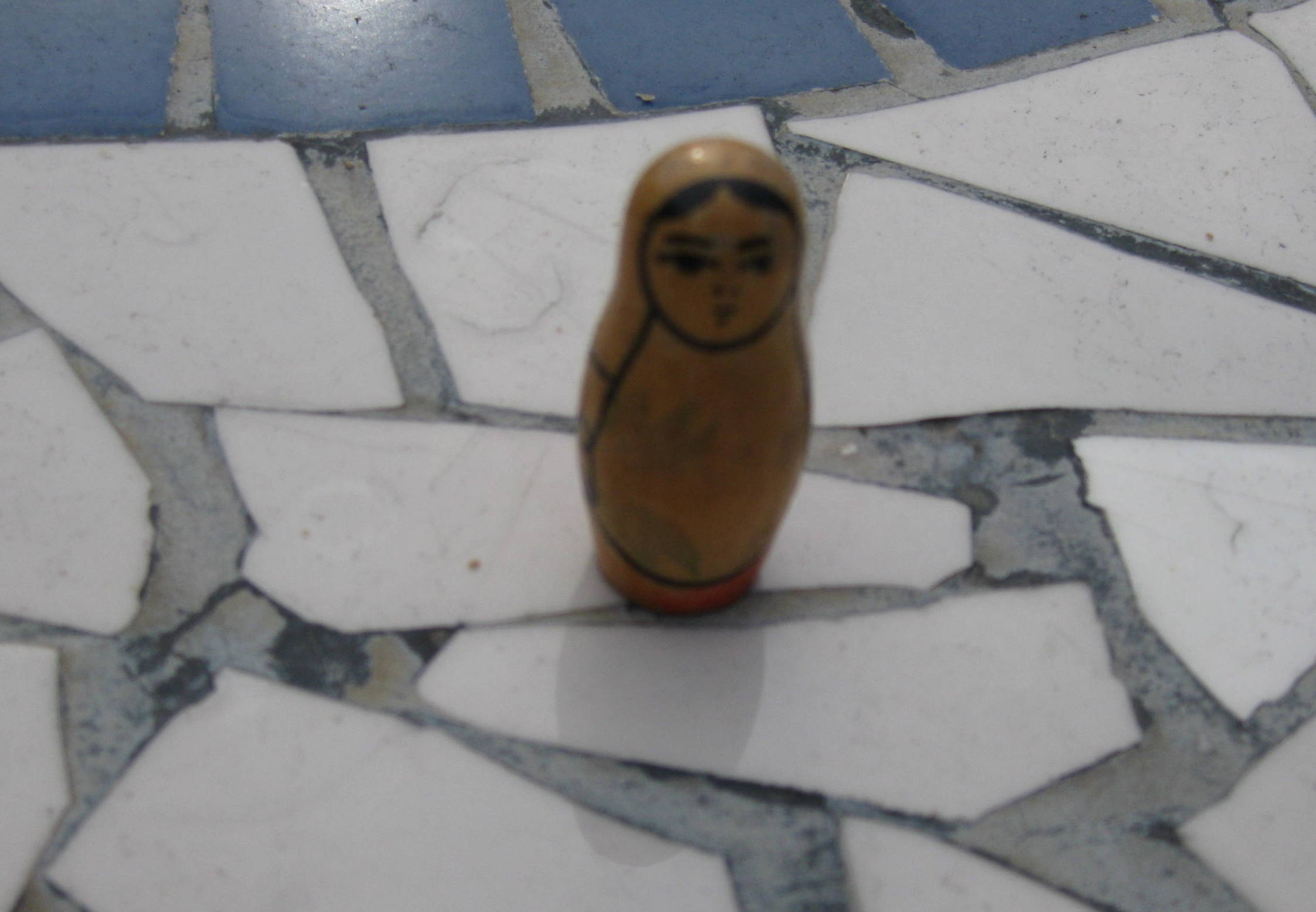
The trinket I have removed to make way for your soap, Em, is the inner-most part of a Russian Doll.

Gift for EmmaI have fractured memories of playing with its outer casings as a child, painted wooden shells that split apart to reveal the series of dolls inside them. I don’t know what happened to those exterior pieces. Did they get cracked, or lost over time? Did my mother pass the doll to a friend without realising its heart was missing?

At some stage, anyway, I must have found this solitary little doll, the only part that couldn’t be broken into two, and decided I wanted to save it.

Some of its varnish has come away and the red and green of the painted clothing has faded to nothing in places. But I feel certain that someone who can see the brighter amber in a broken bar of Pears soap will overlook the many scuff marks, and be able to enjoy this small memento of her friend from a time many years before she knew her.

Two gifts: a ‘collection of books’ and a poem

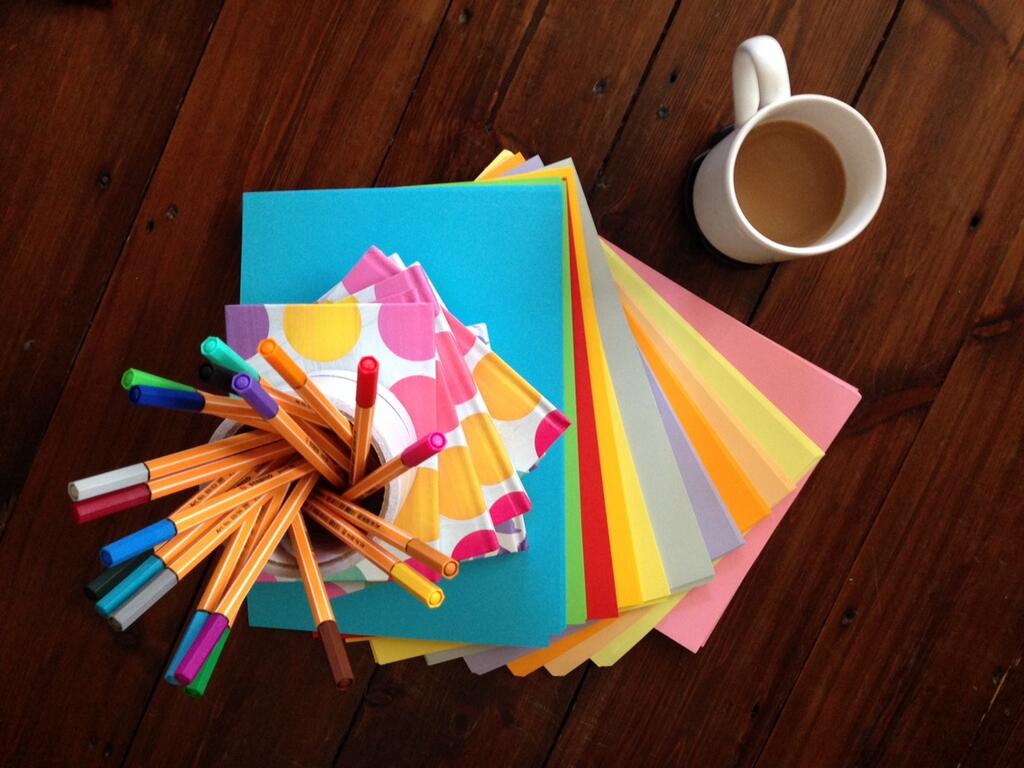
If you are on Twitter, you might know that Emma Claire posted a photo last week, saying that she had just started her response to this month’s Something Rhymed activity.

Emma's February activity

Like you, I could see pens, notebooks, coloured paper, a cup of tea. And I had absolutely no idea what she had planned.

So I was delighted to receive a stack of ‘books’ this week, each of them decorated with my name and a make-believe title. Amongst these were One Honest Friend, Speaking Up and my personal favourite The Lost Art of Getting Lost.  Each book had a related back-cover blurb too, summing up something my friend admired about me.

IMG_1032

Although I can’t help feeling that Emma Claire has been over-generous in her praise, I was really touched by what she said and the highly original way she found to say it.

This was the first time I’d received anything like this from her, and that encouraged me to step out of my comfort zone and try my hand at something I rarely attempt.

IMG_1036

I had already made a list of her many qualities at this stage. These included:

  • Her superior levels of insight as a writer and a reader
  • Her sensitivity towards other people – she’s amazingly good at predicting when someone may be feeling down and thinking of practical ways that she can help.
  • That she is more of a doer than a dreamer – I have never known anyone quite like Emma Claire for taking an idea and running with it.
  • The fact she’s very good at pulling a meal together, never ever getting flustered in the kitchen meals at Emma Claires are always served with warmth.

I wanted to do something text-based in response, and, although in no way do I consider myself a poet, I thought poetry might be a good form for what I wanted to say.

I’d also been thinking about the letters we wrote to each other as part of January’s activity, and how we’d both said there had been times when we’d regretted not meeting earlier in our lives. This element crept into the piece below too, which ended up suggesting something of the spirit of my list rather than being constructed of the original words I scribbled down.

You can read the poem by clicking on the title below:

Things we didn’t do

As always

We are very keen to hear your responses to this month’s challenge. And do keep those recommendations of female literary pairings coming in too. You can get in touch by using the ‘leave a reply’ button below. We really look forward to hearing from you.

Maya Angelou and Toni Morrison

Maya Angelou and Toni Morrison at the My Sheer Good Fortune event at Virginia Tech. (Photo used with their kind permission.)
Maya Angelou and Toni Morrison at the Sheer Good Fortune event at Virginia Tech. (Photo used with their kind permission.)

When Maya Angelou was honoured at the USA’s 2013 National Book Awards, it was Toni Morrison who presented her with the Literarian Award for Outstanding Service to the American Literary Community.

At the ceremony, Morrison spoke with clear emotion of her ‘personal pleasure’ at being able to hand over the prize to a friend who ‘inspires delight as well as awe’.

Now both in their eighties, it wasn’t the first time that one of these grandes dames of American letters had taken the opportunity to lavish praise on the other in public. The previous year, Angelou was a member of an all-female trio who hosted an event called Sheer Good Fortune in honour of Toni Morrison.

The title was inspired by the dedication from the author’s novel Sula, ‘It is sheer good fortune to miss somebody long before they leave you’, and this sentiment is clearly something that her friend has taken to heart for some time. When Morrison won the Nobel Prize for Literature back in 1993, Angelou decided to throw her a party because, as she would later recall, she felt it was something the United States should have done.

As two African Americans, two women, two writers of a similar age, these two have sometimes found themselves grouped together for the crudest of reasons. Morrison in particular has sometimes been keen to distance herself from Angelou in a literary sense – describing the author of I Know Why the Caged Bird Sings as a very different writer from her.

Nonetheless, they clearly have the greatest respect for each other, both as artists and women. As Angelou says they have been ‘sister friends’ for decades, and have been able to call on each other over the years for personal as well as public support.

They especially enjoyed being able to bond with each other at a past book festival at Wales’s Hay on Wye, when both were far away from home at a time when their mothers were ill. And, as Morrison recalled in her recent awards tribute speech for her friend, when her son died one Christmas, Angelou was the very first non-family member to call her up on the phone with what she describes as ‘that unmistakable voice of sheer balm’.

Activity

In Toni Morrison’s recent speech to honour her friend, she described Maya Angelou’s many attributes, which range from the artistic to the personal to the culinary. As she says, ‘Maya can cook.’

This month we’re challenging ourselves to make lists of all the things we admire in each other and then we’re going to do something creative with it. Maybe we’ll polish up the wording and mount it on a card or, like Morrison, we might turn it into a crafted prose piece, or perhaps a poem. Or we could come at things from a different angle entirely, working parts of our lists into a painting or collage, even icing them onto a cake.

We’ll be letting you know what we decide to do and showing you something of what we produce.

We are interested in hearing recommendations of other female writing friendships that we could showcase on this site. If you know of a literary pair of women, past or present, who have supported each other’s work, do please get in touch.


Goodbye to Mansfield and Woolf

If we’re honest, we both felt some trepidation on 31 December 2013. On the day before we launched Something Rhymed, each of us had the same questions. Would anyone, other than our nearest and dearest, want to visit this website? Is the subject of female literary friendships one that interests other people?

We’ve been delighted to discover that it has struck a chord with so many of you: 3000 hits on the site so far, the majority from the UK, USA, Canada, Ireland and Australia, but from other corners of the globe too. We’ve heard from emerging and established authors, readers, academics, literary bloggers, editors at publishing houses and literary magazines, agents, publicists, owners of writing retreats and more.

The Independent on Sunday featured our website in their Between the Covers column, and Book Oxygen, Books by Women and Writers’ Centre Norwich all asked us to talk more about Something Rhymed in the guest blogs we wrote for them this month.

There have been hundreds of tweets about the site, and many more of you have got in touch, by sending a message or leaving a comment, to add your thoughts to the discussions we’ve started and to recommend pairs of writer pals we could profile.

Some suggestions focused on friendships we’d already heard something about, but others were entirely unknown to us. We’re keen to explore all of your ideas, so do please keep them coming in.

We were also delighted to learn that some of you had joined us in this month’s letter writing activity.

Elaine, who wrote to to her long-standing friend Frieda, seems to have shared some of the same feelings that we encountered, noting that ‘In these days of e-mail and Facebook we have instant if rushed communication on tap, but my rambling missive penned whilst enjoying traditional afternoon tea on a winter’s Sunday afternoon, gave me a chance to experience a much less frequent pleasure nowadays’.

Novelist Sarah Butler and screenwriter Tessa Nicholson used their letters to talk about the business of writing itself and to give each other advice. Sarah told us how much she appreciated her friend’s wisdom, singling out two tips in particular: ‘Your competitive streak is like a motor. Don’t be ashamed of it’, and ‘You’ll have to learn to put your blinkers on and write more for you’.

Tessa Nicholson's response to January's challenge with this a letter to her friend Sarah Butler
Tessa Nicholson’s response to January’s challenge – a letter to her friend Sarah Butler

Others said that they were already in regular correspondence, including Jill Dawson and Kathryn Heyman, the authors of last week’s wonderful guest post.

It seems that, for some of this blog’s readers at least, letter writing is not such a lost art after all. As author and journalist Erina Reddan pointed out in a comment on the site, ‘Letters pull you down and into a place that conversation does not take you’.

On Saturday, we’ll be saying goodbye to Katherine Mansfield and Virginia Woolf and letting you know about the next pair of famous writing pals.

Sarah Moore was the first to mention Maya Angelou when she left a response to our first post of the year, which mentioned the author’s friendship with Jessica Mitford.

But this was followed by separate suggestions on Twitter from the writers Wendy Vaizey and Salena Godden. They cited Angelou too, but it was another one of her friendships that they thought we should consider.

And so, after much deliberation, we’ve decided to go with that duo next: Maya Angelou and Toni Morrison. If you return here on 1 February, you’ll find lots more information about that relationship and also details of the month’s activity. And if you have any thoughts you’d like to share about this pair, do please get in touch. As always, we’d love to hear from you.

Don’t forget, if you want to make sure you don’t miss out on any Something Rhymed updates, you can sign up to follow us via email using the tab on the right of the screen.

Until Saturday then…

Letter Writing in Modern Times

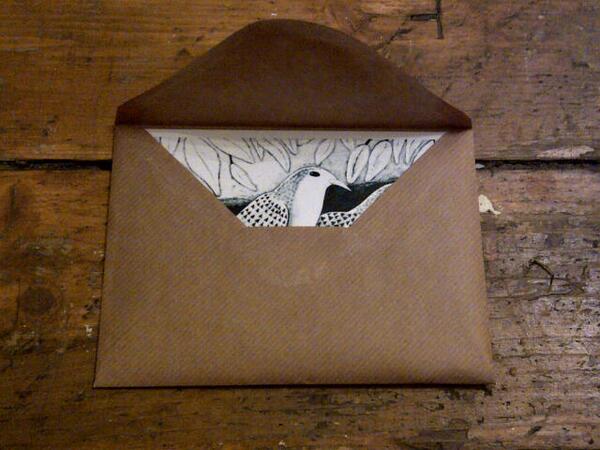
Emily's letter envelope
Addressed envelope all ready to go, with the origami windmill

When the letter from Emma Claire arrived last week, I brewed myself a pot of tea and sat down in an armchair to read it again.

I’d already sneaked a look at its contents on-line, when Emma Claire posted images of its eight pages here, but a postal delivery of this kind is such a rarity these days that I wanted to make more of an occasion of it, away from my computer screen.

What struck me as I sat there, the paper bending and rustling between my fingers, was how rewarding it can be to give your full attention to a letter. Time seems to slow as you focus only on your friend’s voice in your head. It’s a different sort of experience from opening an email on a busy day, when you find yourself painfully aware, even as you read, of the dozens of other messages building up in your inbox.

Prior to hearing from Emma Claire, I had already started jotting ideas in my notebook about things I wanted to discuss with her. These included:

  • Memories of our time in Japan, and how it kick-started our writing
  • Some things I admire about her prose style
  • Recurrent themes I’ve noticed in her work
  • Her influence on me as a writer
  • The Persephone Book of Short Stories, which I planned to recommend

Not all of these things made it into my reply. Influenced by the issues Emma Claire raised in her own letter, I found that I wanted to discuss some of them in more detail instead.

I ended up talking about the many ways in which I value her friendship, about memory itself, the similarities and differences in how each of our minds had preserved important recollections, and how I hoped we would correspond like this again. I also told Emma Claire about an earlier letter she once wrote to me, which I read again a few days ago, and the images of the past it immediately brought back.

I was inspired by the beauty of the stationery Emma Claire sourced, but was unable to find anything I liked as much myself. And so I took some plain sheets and decorated them with strips of coloured origami paper – something that seemed apt, considering how our time in Japan featured heavily in both of our letters

From one of the leftover scraps, I made a simple miniature windmill and added it to the envelope. If you are interested in having a go at this origami yourself, instructions can be found here.

As Emma Claire did in her last post, I’ve included pictures of the pages I wrote, which you can click and zoom in on below.

Emily's letter 1 Emily's letter 2Emily's letter 3Emily's letter 4

Emily's letter 5Emily's letter 6Emily's letter 7

Don’t forget

We’d love for you to join us in this activity by writing a letter of your own to a friend. Please use the ‘Leave a Reply’ facility below to let us know about the kinds of things you wrote in your letters.

Click here to find out about this month’s challenge in more detail.