Same Material, Different Approaches

Red is a colour I rarely wear in hot climates, since my skin tends to flush in the sun.

I am also prone to smatterings of heat rash and mosquito bites. When I lived in Japan, other women at the school where I worked used to voice concern at my freckled complexion, and recommend I confine myself largely indoors during the warmest months.

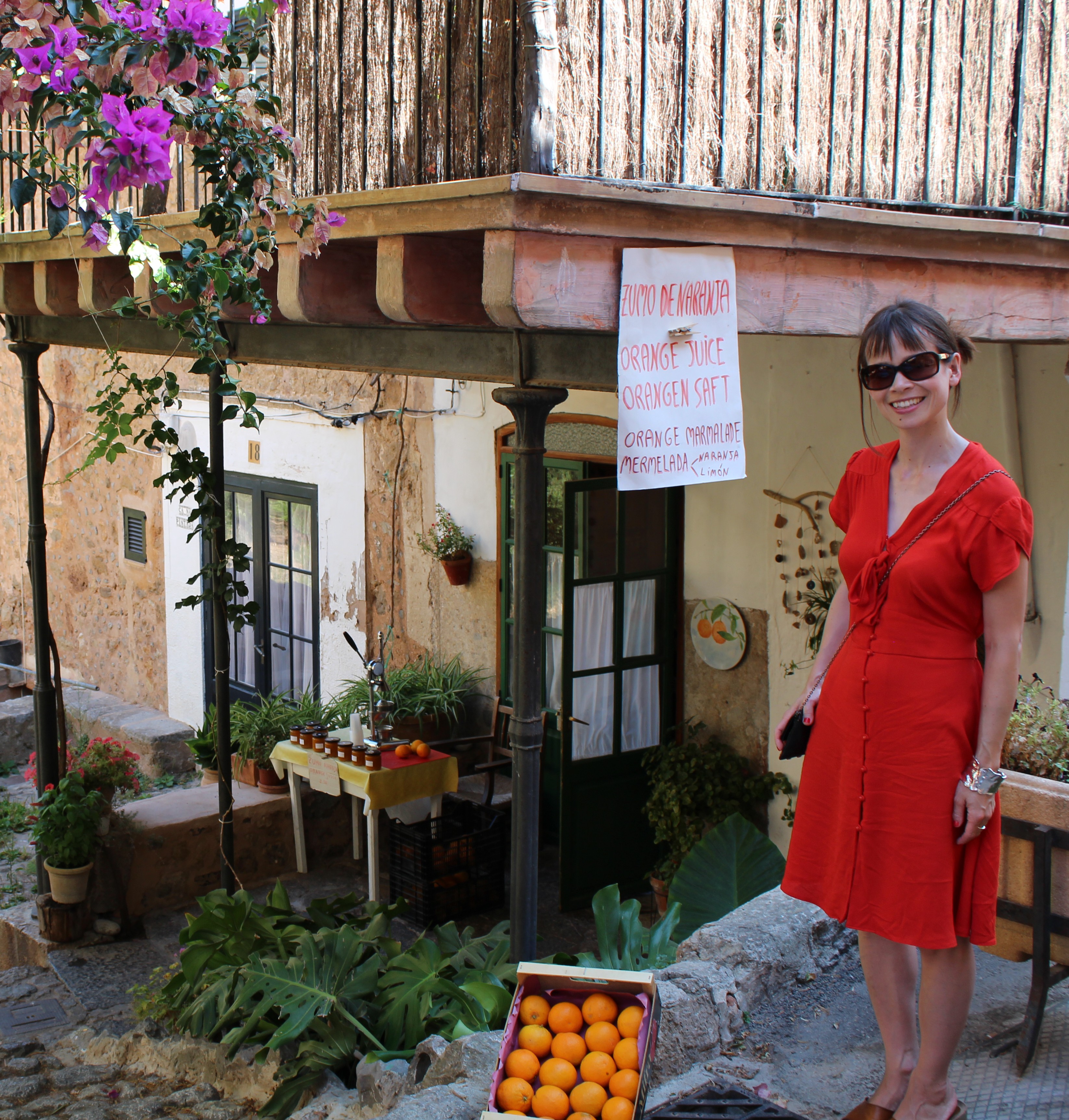
Still, I was inspired by the clothes swapping of writer friends Maxine Kumin and Anne Sexton to borrow a red dress from Emma Claire just before a week’s trip to the Spanish island of Mallorca, and so I ended up fitting the outfit carefully into the top of my suitcase just before I zipped up the bag.

IMG_1144Em had told me she’d previously worn this red dress for a successful PHD interview, but, even when I first tried it on in the cooler temperatures of my London bedroom, I knew I’d never have worn it for an important academic meeting.

When I lifted it from my bag after my arrival at our villa, I found that feeling magnified by the sun’s bright light pouring in through the windows.

Of course, I am only thinking of this as an outfit for myself here; Emma Claire will have looked thoroughly professional on the date in question. But owing to differences in our figures, I had to compensate for gaps that opened in its button-up seam with several strategically-placed safety pins that I’d have feared might show – further proof if it was needed that this was very much a holiday outfit for me, rather than something I’d wear to an interview.
IMG_2701
About to buy marmalade in Deià

Despite the skirt also soon getting all scrunched in the heat of the car, I had a wonderful time wearing Em’s dress for a day out with my partner, exploring the remoter reaches of the island.

Walking along dusty hilltop lanes, breathing in the scents of bright vine flowers, it struck me how the same material can be so vastly altered by placing it in a new context or hanging it on the frame of another person.

This is, in fact, a familiar feeling. When Emma Claire and I first sit down to write a feature article together, or plan a forthcoming joint talk, we’ll sometimes find that, though we come to the table with the same basic ideas, we each envisage the end result from quite separate angles.

This has been known to lead to heated discussions – occasions when I’m not necessarily as measured as Em might have it – but we’ve come to really value this way of working.

The process challenges each of us to stop sticking to our usual approaches, but to break out and try on our friend’s way of doing things. And it’s turned out to be incredibly helpful in developing a distinct voice and style for the pieces we write together.

The Kind of Friendship that Shores You Up: Susan Barker and Rima Haque

A work connection brought Ruth Rendell and Jeanette Winterson together. In this month’s guest blog, novelist Susan Barker and journalist Rima Haque tell us about the lucky circumstances that led to their friendship.

Susan

SusanBarker Beijing Photo 3I first met Rima when we had summer jobs at the Statue of Liberty in 1999. Rima was working in the gift shop, and I was outdoors in a kiosk selling hot dogs to the tourists. She was 19, I was 20, and we were both wearing unflattering green uniforms.

My first impression of Rima was that she was pretty (my then boyfriend used to call Rima ‘the elfin girl’), and very sharp, with a dry sense of humour that unsettled our co-workers at times.

That summer we took cigarette breaks together, and in the evenings we’d hang out at dive bars in the East Village where we weren’t ID-ed. It didn’t take long to establish we had a lot in common. We’d both grown up in Essex, as the children of Asian immigrants, and both had a similar sense of being caught between two cultures, and not fully belonging to either.

But mostly we had books in common. Rima was a consummate reader, and would lend me her eclectic second-hand book shop finds. Fifteen years later, I still have one of those ‘borrowed’ paperbacks, in my bookcase at home.

Rima and I reunited in London after that summer, and though I have been living in Asia half the time since then, we have kept in touch. She’s the first person I look up when I am back in the UK, and my favourite person to go to the pub and talk literature with.

For the past decade or so we have also had in common the ritual of locking ourselves away to write fiction (and in Rima’s case, journalism) and the highs and lows of our vocation to share and commiserate over too.

Rima is relentlessly interesting, funny and subversive company. A blog post is not nearly enough to describe how fortunate I am to have her in my life.

Rima

Zakia photoI wanted to be friends with Susan based on her recalcitrant attitude towards customer service. I didn’t know what we had in common until much later, but I thought her tattoo and predilection for vodka and Marlboro Reds was cool.

Our exchange of books happened early. In New York, I read a combination of half-understood theory and old novels. Susan introduced me to contemporary writing that I might have reached by a more winding route, but I’m glad I didn’t.

She lent me Sam Lipsyte’s Venus Drive, and Gwendoline Riley’s Cold Water, which both blew me away stylistically. We don’t always agree on the novels we like (which I love), but she continues to introduce me to technically fascinating writers.

Her genuine, sometimes gruff, encouragement with my writing was a factor in making me come back to fiction periodically, and then finally apply to a creative writing course. I also still think of her description, on a packed night-bus home to North London, of the novel as a ‘will-to-power’ exercise – seeing writing well as a challenge to yourself above anything else. The idea helps me to focus when I get neurotic or needy about ‘success’ or the lack of it.

Our backgrounds played a huge part in why we got along but there was also a shared love of similar music and film, and a tendency to see the comical in most things. We spent a lot of time in clubs, bars, and the kitchens of my various rented houses when she moved to London.

We’ve lived in different countries for a long while now, but the discussions when we sporadically see each other in England feel so much richer with time. What I value equally are the heartfelt, revelatory, honest conversations about work, relationships and the future, which usually make me feel realistic, tough and more hopeful afterwards.

This is the kind of friendship that shores you up.

Susan Barker’s third novel The Incarnations was published by Transworld this month.

A selection of Rima Haque’s journalism can be read at http://zaktivities.net/

A Telephone Call that Made All the Difference

The camellia, Mum's favourite flower
The camellia, Mum’s favourite flower (Creative Commons licence)

It is a Sunday in March 2012. I have had only a few hours’ sleep. My mother died in the early hours of the morning, and now I am sitting on the bamboo frame sofa in her old conservatory with a paper list divided into two before me, the cordless phone in my lap.

My sister and I have been through Mum’s address book and written down the numbers of everyone to call. Some names are familiar to us, those of people we’ve often seen at her house in the years since she fell ill. Others are now-misted figures from our childhoods, who, nevertheless, we think we ought to let know.

I have added Emma Claire to my half of the list. She is the first person I call.

By the time I end the last of those conversations, perhaps an hour-and-a-half later, I will feel as if part of me has been sapped away through the earpiece of the phone. I’ll have heard everyone say how sorry they are. Some will have cried, with such emotion in a few cases that I’ve found myself saying things I don’t mean, trying to show them a supposed bright side to what’s really just a sad, sad situation.

Talking with Em is nothing like that. She’s sincere but brief in her condolences, sensing without me having to tell her that I can’t linger over this call. She tells me that we will talk again later, and that she will help in any way she can.

Emma Claire is not the only person who makes this kind offer. Over the next few days, many people will tell my sister and me that they want to help. But the thing is, usually they can’t. No one else can make the arrangements for our mother’s funeral, organise her death certificate, deal with the coroner or the hospital. No one else can decide at which hotel she’d have wanted us to arrange her funeral tea, or the words to be carved on her grave.

Of course, Em can’t help with any of this either. Where she swoops in and makes all the difference is with my work. In my grief-muddled state on that first Sunday, I am convinced I only need three days off in order to get on with arrangements. I plan to go back to London to teach a university class on the Thursday before returning to my mother’s home again.

The next time we speak, Em tells me at once that I am being ridiculous. She will teach this class for me. She knows the subject matter already. No, she doesn’t need a detailed lesson plan, thank you; this is not what I should be concentrating on right now.

For several years, we have laughed at the similarity of our CVs – how we’ve ended up teaching at the same institutions – but now everything falls into place. Emma Claire works out all the details with the university management. I barely have to get involved. She ends up covering for me the next week too when she discovers that, once again, I’m planning to rush down to London and back, this time the day before the funeral.

And although she’s insistent that I mustn’t do this, she makes the same journey in reverse the day afterwards. I spot her at the ceremony when I stand up to give my reading, sitting beside another close writer friend of mine in a row just off to the left.

And as so often is the way, the very presence of Emma Claire brings me reassurance.

Ruth Rendell and Jeanette Winterson

Ruth Rendell and Jeanette Winterson at the Theakstons Old Peculier Crime Writing Festival 2013 (Copyright Fenris Oswin)

At first glance, the friendship between two of Britain’s best-loved writers, Ruth Rendell and Jeanette Winterson, might seem a tad unlikely. For starters, their fiction is radically different. And then there’s the obvious difference in age.

Now in her eighties, Rendell is almost thirty years Winterson’s senior and, certainly in the friendship’s earliest days, she took on the role of nurturer. Winterson, whose relationship with the woman who adopted her as a baby was famously troubled, writes of Rendell with great affection in her memoir, describing her as ‘the Good Mother – never judging, quietly supporting’.

This side of their friendship, reminded us of the maternal element to the relationship between Charlotte Brontë and Elizabeth Gaskell, despite there only being a six-year age difference in their case.

Rendell took Winterson under her wing from the beginning. Hearing that the younger writer was looking for a place to stay, she invited her to move into her own home while she was abroad. She had no qualms about handing over the keys to someone she’d only just met, claiming to have known ‘at once that she was absolutely trustworthy and honest and honourable’.

Rendell’s nurturing was professional as well as personal, leading Winterson to describe the older author – to whom she has sometimes even turned for writerly advice – as her ‘role model’. When Hammer commissioned Winterson to write a horror novel, she sought out Rendell’s guidance on how to maintain a page-turning plot.

Winterson is keen to reciprocate the generosity in different ways, often for instance, buying Rendell gifts of earrings. But other attempts to treat her friend haven’t always quite gone to plan, thanks to Rendell’s more private nature. Winterson recalls how on the occasion of her pal’s birthday one year she’d thought of taking her out for dinner and champagne. But she says Rendell responded with ‘oh, do I have to?’ and so she ‘went round to her house and cooked scrambled eggs instead’.

This incident, narrated with good humour by Winterson, seems to encapsulate both the differences and the closeness between these two women. It’s a simple memory, but, to us at least, it speaks volumes about an outwardly unusual literary pairing that transcends differences in creative output, age and personality.

Activity

When Ruth Rendell offered Jeanette Winterson a place to stay, it made all the difference to the young author, who was then struggling to find somewhere to write.

This month, we’ll be letting each other know about a time of our own when the help of our friend made all the difference.

Do keep those recommendations for other pairs of writing friends coming in.

A Gift to a Writer: After Leaving Mr Mackenzie by Jean Rhys

IMG_1109


Since I first picked up a copy of Jean Rhys’s novel in my late teens, I have pressed it on a number of people. I say pressed, because I’m not sure it’s always been a welcome recommendation, the response often being that it’s depressing.

This is a valid comment, and each time I’ve returned to the book over the years I’ve found it sadder than I did on the previous reading. But there are flashes of dark humour there too, in Rhys’s wry observations, and her sharp-drawn depiction of the titular Mr Mackenzie’s pomposity.

What really attracts me to After Leaving Mr Mackenzie, though, is the unaffected beauty of the writing. Rhys’s second published novel came out in 1931 and the story is firmly of its era, but the unfussy, hypnotic prose retains a freshness that’s stood the test of time.

I have thought about buying this book for you before, Emma Claire, but have always held back – perhaps because a favourite book can come to seem like a part of your own history. Unreasonable as it is, it’s hard not to take it as a personal slight if your friend then goes and tells you they didn’t like it.

But I think – I hope – you will like it, because you have such a musical ear. You’re always picking out riffs and melodies within written stories, or even spoken conversations, which other people might not care about, or miss.

Set in grey London and Paris, After Leaving Mr Mackenzie – the story of a woman who has, in reality, been left by yet another man – lacks the lush imagery of Rhys’s much-lauded later novel Wide Sargasso Sea. Neither is it as formally inventive as Goodnight Midnight (although I like it the better for that).

But there is an integrity about this novel that I love. To read it is to be transported to dingy hotel rooms and low-lit streets, and shabby bars that reek of quiet desperation, all rendered by the author with a unique kind of beauty.

But my main reason for choosing After Leaving Mr Mackenzie as this month’s gift is this:

When I discovered this book, it changed the way I thought about writing forever.

It showed me that a good novel could be about much more than a gripping plot and characters that linger long in the mind, or even a beguiling setting or atmosphere.

From Rhys I learned that good writing could sing a song to its reader. In this case, it’s a melancholic song about half-broken things, but – knowing of your literary tastes, Em – I wonder if you might like it all the more for that?


Charlotte Brontë and Elizabeth Gaskell

Image used with the kind permission of Oxford University Press.

When we first became interested in female writing friendship, we wrote off Elizabeth Gaskell and Charlotte Brontë as mere acquaintances.

In between their first meeting in the Lake District in 1850, and Brontë’s untimely death just five years later, they met only a handful of times, and, undoubtedly, each of them was closer to other women.

Brontë had been a pal since childhood with the loyal Ellen Nussey. She was deeply influenced by the feminist Mary Taylor, and inextricably bonded with her famous sisters Emily and Ann. In the more sociable Gaskell’s case, she moved in exulted social circles and counted Florence Nightingale and Harriet Beecher Stowe amongst her friends.

But something about the relationship between Brontë and Gaskell kept nagging away at us. We found it intriguing that Patrick Brontë – a man fiercely protective of his late daughter’s memory – had chosen the author of Cranford as her biographer. Brontë’s sojourns to 84 Plymouth Grove, the home of the Gaskell family, also piqued our interest, as did the frequency of the correspondence between the two women.

Wondering whether we had been too hasty in overlooking this pair, we turned to their letters to investigate further. Here, we discovered a relationship based on mutual support, and shared artistic and professional concerns.

We found that Gaskell and Brontë regularly exchanged candid views on literature and publishing, sometimes accompanying their letters with recommended books. On a personal level, Gaskell took the ailing Brontë under her wing. When it came to their writing, though, it was Brontë who provided the greater share of support by acting as a sounding board for her friend’s literary ideas and giving her generous advice on how she could improve her novels.

Brontë even persuaded her publisher to delay the release of Villette, because it would have clashed with the publication of Gaskell’s novel Ruth.

Gaskell would, of course, one day seek to return this generosity by styling her Life of Charlotte Brontë as a tribute to her friend, someone of whom she’d once said, ‘I never heard or read of anyone who was for an instant, or in any respect, to be compared to her’.

Activity

Charlotte Brontë included a copy of Wordsworth’s Prelude with her first letter to her literary pal.

This month, we’ll be sending each other a book and writing a dedication on the inside cover.

If you know of any more writer friends that you think we ought to profile on this site, please do tell us about them.

A Friendship Important in So Many Ways

'A rainbow in somebody's cloud' - Maya Angelou Image taken at the Hay Festival, 28 May 2014)
‘A rainbow in somebody’s cloud’ – Maya Angelou
(Image taken at Hay Festival, 28 May 2014)

We are saddened by the death of Maya Angelou, a writer whose life and work has been an inspiration to people the world over, and a woman from whose great capacity for friendship we’ve learned so much this year.

Regular readers of Something Rhymed will know that we profiled Angelou’s relationship with Toni Morrison back in February. Influenced by their championing of each other’s achievements, we set ourselves the task, on a much smaller scale, to follow their example.

We made lists of the things we admired about each other and developed them into pieces of creative work. Although we’d always considered our friendship to be a very open one, we were surprised by how many of the points we noted down we had never spoken of before.

It made us wonder how long we might have gone on silently appreciating, but never expressing, that we valued these qualities if we hadn’t paid attention to Angelou and Morrison.

When we discovered that Morrison would be appearing at Wales’s Hay Festival this year, we quickly bought tickets to hear her talk. We knew that she and Angelou had bonded years ago at Hay, when both women found themselves far away from home at a time when their mothers were ill. And so it felt particularly poignant that it was during yesterday’s festival session that many audience members (ourselves included) first heard that Angelou had died.

Morrison eloquently gave voice to the gasps that rippled through the vast tent when she spoke of her personal loss. ‘I thought she was eternal,’ she said. ‘I thought she always, always would be there.’

As writer friends ourselves, it is difficult to listen to language like this without wondering how one of us would cope in a similar situation, how we would feel if the person we’d come to rely on to such an extent was suddenly gone from our life.

Morrison, who called Angelou ‘a real original’, was understandably reluctant to say too much about her death. ‘It hurts so much that I have no treasurable, powerful, elegant words to say about that,’ she told the crowd. ‘I need time to talk about Maya. She was important in so many ways.’

But what struck us as we listened was the extent to which each of these women had already made significant efforts to commemorate the life of her friend.

Morrison’s speech in praise of Angelou at the USA’s most recent National Book Awards was a case in point, as was the party Angelou threw for her friend in 1993 – a response to what she saw as a lack of official national acknowledgement when Morrison won the Nobel Prize for Literature.

We are thankful for what we have learned from this literary pair: that it is important to celebrate the lives of our close ones, not just in fine tributes once they are gone, but also when they are still here.

In Unexpected Places

For May’s Something Rhymed activity, Emma Claire commissioned me to write about ‘the provinces’.

For the benefit of our international readers, some of whom may more commonly use this term in a different way, it’s worth mentioning that by ‘the provinces’ she meant those areas of the country away from the capital and other major cities.

I am, you might say, a city girl, which goes some way to explaining one of Emma Claire’s early impressions of me. Being mixed-race – I’m half-English and half-Japanese – I’ve generally felt more at home in the metropolis than the less ethnically-diverse smaller towns where, through accidents of birth and circumstance, I have actually spent the greater part of my life.

There are many things that I could say about this subject, some of which I touched on in a longer memoir, written for the Tangled Roots project last year. But since this is a relatively short blog post, and not an essay, I have taken a leaf out of Emily Dickinson’s book and interpreted Emma Claire’s assignment loosely.

Here, I have set down some thoughts about my first home, on the outskirts of York, in a part of the UK that could be regarded as firmly within the provinces.

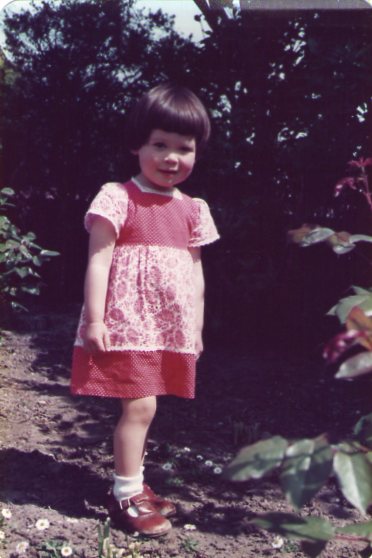
1982-5-Emily
Emily in the garden, aged two-and-a-half

It was an ordinary semi-detached house on the Badger Hill estate.

I had never seen a badger anywhere in its vicinity. The name was merely a ghost of the wooded landscape that must have preceded the tarmac, brown brickwork, and fenced-off areas of lawn.

Our neighbours were an elderly couple, the Ks, who my little sister and I really liked. Although, as a rule, they had no time for ‘foreigners’, like most people with these sorts of prejudices, they were apt to make exceptions.

Our mother had managed to win them over early, due in part to what they believed was her miraculous ability to predict the weather. It didn’t matter that she’d told them she was simply a keen watcher of the BBC forecast, they were adamant it was all down to some mystical Asian charm.

The Ks would keep an eye out for those mornings when our mother emerged from our back door with a bagful of washing, and this would usually be followed an hour or so later by Mrs K stepping outside with a fresh load of her own. This meant, effectively, that if there was a full clothes line in our garden, there would almost always be laundry hanging outside our neighbours’ house too.

Externally, our house may have been indistinguishable from that of our neighbours, but inside there were noticeable differences between where we lived and the houses of our school friends.

In later years, after the deaths of both my parents, people who knew us back then would often recall the ‘exotic’ scents of Mum’s cooking drifting out of our kitchen, the Japanese scrolls and prints hanging on the walls, the miniature stringed koto on the windowsill with its melancholic plinking sound.

There were other differences too, like the many books in my parents’ study and the fact there was a study at all – where my parents worked at desks side-by-side – but it was the Japanese elements, so at odds with the Englishness of that building, that seem to make the biggest impression, probably because they were the least expected.

These seeming contradictions were, of course, entirely normal to me. I had grown up with them. But I’m sure I was influenced by these reactions, which included open-mouthed surprise at times.

In fact, it could have been the first spark of a fascination in me with objects or people that appear in unexpected places and the ways others react to them – a major theme, I’ve realised recently, in a lot of the writing I’ve done in the years since then.

By the time we met, I felt as though I already knew her: Kadija ‘George’ Sesay and Dorothea Smartt

Our April guest bloggers are poets Kadija ‘George’ Sesay and Dorothea Smartt. They’ve shared with us their conversation about their first impressions of each other…

Kadija George


Kadija
The first time I met Dorothea, she was a figment, yet a fixture of Centerprise, a community centre in East London, that housed a community publishing project. In 1995, I became the Black Literature Development Worker, a newly created post that replaced Dorothea’s role in the publishing project, which she ran with Bernadette Halpin. There wasn’t anything I could do that wasn’t compared to Dorothea!

Are you going to run workshops (like Dorothea)? Are you going to set up performance poetry evenings (like Dorothea)? Can you publish our poems in books (like Dorothea)?

Who was this Dorothea person I had to compete against?

In the meantime I took home the Word Up! Women’s Café anthology that Dorothea had edited, and realised why this woman was so missed by those she’d worked with. This was a classic anthology of women’s performance poetry in London, published in the mid-Nineties. There was nothing else like it.

DSafro byRT IMG_7860

Dorothea
I can’t remember when I first heard about Kadija. I had heard of her before I met her because she was working at Centerprise where I had worked, at one of the most enjoyable and rewarding jobs that I had had, up until that time.

Although I left Centerprise under a cloud I was glad to see there was someone taking up the reins. One of my main regrets was that I always felt I should have published more Black people. At the point when I left, we had our publishing resources removed so when she brought out Calabash, a newspaper for writers of African and Caribbean descent, I thought: oh good, she is getting around that, by putting out a resource in newspaper format.

Kadija
By the time I met Dorothea, I felt as though I already knew her – I can’t even remember the exact time, except I published one of her poems in my first anthology, Burning Words, Flaming Images for which she says, till this day, it is the only poem she has published that she has ever been paid for, so I’m proud of that.

Dorothea
I remember reading at the launch event for the book at Centerprise. I still have the photo of Jacob Ross, Bernardine Evaristo, Courttia Newland, Chris Abani… It could very well have been the first time we met in person.

Around that time, Kadija organised the first Writer’s Hotspot in The Gambia in 1996. When she asked me to go a second time to be one of the tutors, I couldn’t believe it. I went again and shadowed Kadija.

She pointed me out and said, ‘On the next trip, she’s the Boss Lady.’ It gave me a lot of confidence that she selected me.

Kadija
I knew Dorothea had a good reputation so there was mutual respect on both sides.

Dorothea
And here was someone who liked travelling as well. I believed in Kadija and what she was doing. I knew that whatever she did was gonna get done!

Kadija ‘George’ Sesay is the publisher of SABLE LitMag. Her poetry collection Irki was published by Peepal Tree Press.

Dorothea Smartt’s third poetry collection Reader I married him and other strange goings on will be published by in 2014.

They are currently co-directors of the Inscribe programme for professional development for writers of African and Asian descent, based at Peepal Tree Press.

First Impressions: I liked her, right from the start

Looking back on the early days with Winifred Holtby, Vera Brittain would write in her memoir Testament of Friendship that ‘We did not, to begin with, like each other at all’. For my part at least, my first thoughts on Emma Claire couldn’t have been further from those words.

Em and I became friends when we were both working as English language teachers on the island of Shikoku, in rural Japan.

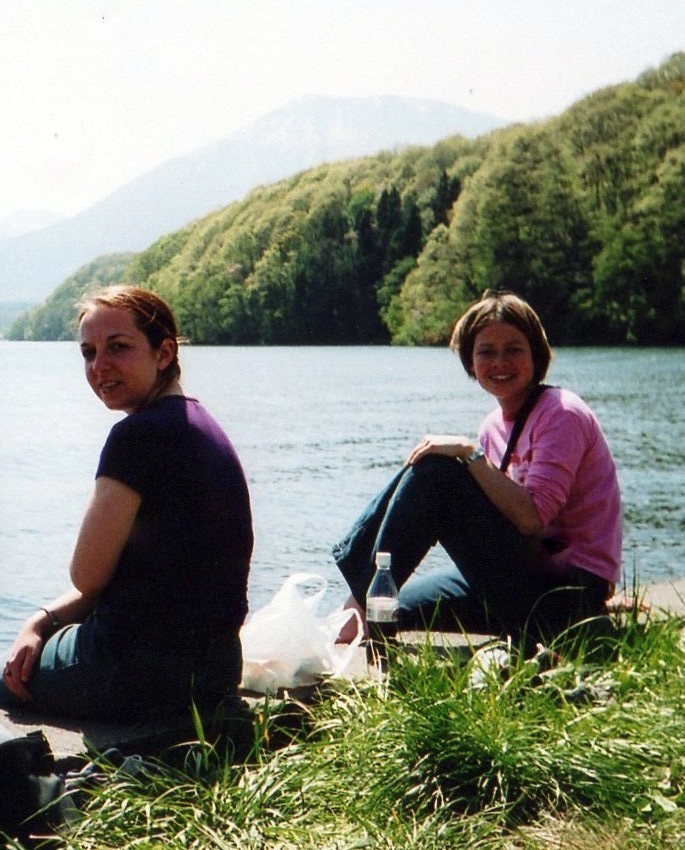
Travelling together in the Japan Alps in May 2002

We’d gone there as participants on the JET Programme, a Japanese government initiative to place native English speakers in the nation’s schools, but we actually met at the pre-departure orientation in London in July 2001.

I vividly remember stepping outside in a break between sessions and spotting Emma Claire sitting on the grass. She was with a small group of new JETs, all of them swapping stories about the little they knew of the towns and villages to which they were headed.

Of all the people sitting on the lawn that day – most, like us, in their earlier twenties and lacking any previous teaching experience – my feeling was that Emma Claire was someone with whom I had something extra in common.

Why I should have thought this, and from the start, is a lot more difficult to understand.

These days, people take us to be so alike that we have sometimes been confused for sisters, but, other than the fact we were both short and from the north of England, I don’t think we can have appeared particularly similar back then.

We were dressed very differently from each other that day, and my hair, unlike Em’s that flowed freely down her back, was chopped and cut up with streaks of blonde – although this was largely the result of having been accosted in the street just weeks earlier by an enthusiastic trainee stylist from Vidal Sassoon.

OK, you might think, but what about our shared interests? Surely there we would have found common ground. But I don’t remember hitting on a mutual taste in music or films, and I’m not sure either of us thought to mention books or favourite authors. Certainly, we wouldn’t have said anything about wanting to be writers, since at that stage we hadn’t even properly admitted that secret to ourselves.

What I do recall is my sense of disappointment when I realised that, although we’d be living in the same prefecture, Emma Claire would be living a couple of hours away from my house.

Holtby and Brittain, thrown together in their Oxford college, must have had to go out of their way to avoid each other in that early period of distrust. In marked contrast, it was clear to me right away that if Em and I were going to become friends we’d each have to make a special effort.

That summer’s day all those years ago, now seems like such a key moment in our lives that it really is painful to imagine just what we’d have missed out on if one of us, or both of us, had decided that the effort wasn’t quite worth our while.