
Comedians Hannah Croft and Fiona Pearce became friends at school, followed each other to Oxford and then on to drama school before starting to write and perform sketch comedy together as Croft & Pearce. Their synchronicity didn’t end here – they even became pregnant in the same week!
We asked Hannah and Fiona about their experiences of writing and female friendship.
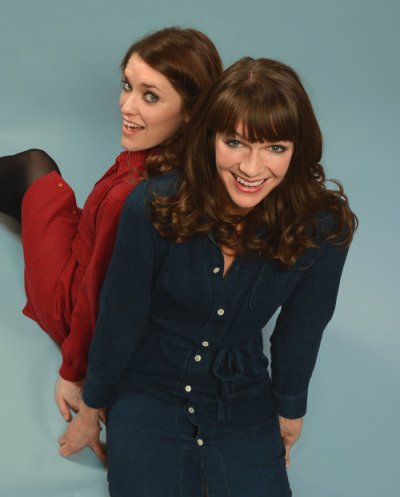
What were your first impressions of each other?
Hannah: We first met in sixth form when Fi joined my school. I remember seeing a geeky-looking new girl sitting alone in the common room and thinking ‘look at that friendless loser…I think I’ve found a kindred spirit!’
Fiona: Hannah didn’t seem to have many friends despite having been at the school for five years, which was ideal for me. I remember she was very colour co-ordinated – her top matched her necklace which matched her belt which matched her eye shadow – so my first impression of her was ‘purple’.
How did you come to write and perform comedy together?
Hannah: Having discovered this new friendship we clung to it with all our might and followed each other to Oxford and then on to drama school. It was when we were trying and failing to forge our careers as the greatest classical actresses of our generation that we took a step back and began to laugh at ourselves and at the world.
Fiona: I had some friends who were running a sketch comedy night in a basement below a pub on London’s Great Portland Street and they offered us a three-minute set, which we thought would be too short and ended up being around two and a half minutes too long.
Describe your co-writing process?
Hannah: It has chopped and changed over the years as we’ve found our feet, but on the whole we each allow ourselves to be inspired by the everyday and we each make notes separately of things that have made us laugh. Then we put our heads (and lists) together and start to develop the ideas.
Fiona: We tend to come to each other with what we think are completely amazing ideas, and then work them up together and gradually realise they’re flawed, and then very slowly make them better. We improve ideas and start writing from there, either in a room together (normally with tea, coffee and cake that Hannah has made) or over Skype.
Hannah: Our benchmark for a good idea is whether it makes us laugh or not. If it passes that test we deem it worthy of being tested out in front of an audience. You get very direct feedback in comedy, so we tend to let the audience be our script editors.
How do you manage the personal and professional aspects of your relationship?
Hannah: We’ve discovered over the years that our friendship is a very powerful procrastination tool and we tend to kick off each writing session chatting away as friends until we finally give into the inevitable and begin to work, work, work, usually hurrying to make up for lost time. We never learn. But I find it such a joy to have this great excuse to spend so much time hanging out with my best friend and I prize our relationship above all else.
Fiona: Yes, we are still friends above all, which makes it all so much more fun when things are going well, and so much more manageable when we encounter setbacks.
What have been the most significant changes in your writing friendship?
Hannah: We have gradually eased into becoming much more direct with each other as time has passed. In the early years we’d try to be very tactful with each other and humour (no pun intended) each other’s less promising ideas, whereas now, with evermore projects to juggle at the same time, we’ve become less pussyfooty.
Fiona: Yes, less pussy, more footy. At the same time we’ve become more relaxed and playful with our ideas and willing to try things out that we’re not sure will work, which comes from having lots of experience with different audiences on tour.
What are your hopes for your writing and performing careers, together and separately?
Hannah: We’d love to get ourselves on more comedy writing teams – even some in LA where they have comedy writers’ rooms…hell, why not put that out there! – and the big dream is to have our own show on TV.
Fiona: Everyone says it’s hard to get a show commissioned but we are still naive enough to believe in our dreams. It was a great experience to write our own series for BBC Radio 4 and we’d love to make something for TV. We’ve been lucky to be taken under the wing of some great comedy writers already and we’d love to work with other experienced comedy greats like Armando Iannucci and Tina Fey…Hell, why not put that out there!
Croft & Pearce won a 2014 Edinburgh Spirit of the Fringe Award and in 2015 they were a BBC Next Big Thing Act. Their episode of BBC Radio 4’s Sketchorama was nominated for Best Scripted Comedy at the BBC Audio Drama Awards and this led to the commission of their first solo sketch show for BBC Radio 4, The Croft & Pearce Show, which was broadcast in March 2016. Following a Total Sell-Out run at the Edinburgh Fringe in 2016, they launched a podcast with their hit characters June & Jean, and embarked on their second UK tour.
Croft and Pearce will be taking their new show, Double Take, up to the Edinburgh Fringe this year. You can find out more about their show here.
You can follow them on Twitter @croftandpearce


 Something Rhymed