Goodbye to Mansfield and Woolf

If we’re honest, we both felt some trepidation on 31 December 2013. On the day before we launched Something Rhymed, each of us had the same questions. Would anyone, other than our nearest and dearest, want to visit this website? Is the subject of female literary friendships one that interests other people?

We’ve been delighted to discover that it has struck a chord with so many of you: 3000 hits on the site so far, the majority from the UK, USA, Canada, Ireland and Australia, but from other corners of the globe too. We’ve heard from emerging and established authors, readers, academics, literary bloggers, editors at publishing houses and literary magazines, agents, publicists, owners of writing retreats and more.

The Independent on Sunday featured our website in their Between the Covers column, and Book Oxygen, Books by Women and Writers’ Centre Norwich all asked us to talk more about Something Rhymed in the guest blogs we wrote for them this month.

There have been hundreds of tweets about the site, and many more of you have got in touch, by sending a message or leaving a comment, to add your thoughts to the discussions we’ve started and to recommend pairs of writer pals we could profile.

Some suggestions focused on friendships we’d already heard something about, but others were entirely unknown to us. We’re keen to explore all of your ideas, so do please keep them coming in.

We were also delighted to learn that some of you had joined us in this month’s letter writing activity.

Elaine, who wrote to to her long-standing friend Frieda, seems to have shared some of the same feelings that we encountered, noting that ‘In these days of e-mail and Facebook we have instant if rushed communication on tap, but my rambling missive penned whilst enjoying traditional afternoon tea on a winter’s Sunday afternoon, gave me a chance to experience a much less frequent pleasure nowadays’.

Novelist Sarah Butler and screenwriter Tessa Nicholson used their letters to talk about the business of writing itself and to give each other advice. Sarah told us how much she appreciated her friend’s wisdom, singling out two tips in particular: ‘Your competitive streak is like a motor. Don’t be ashamed of it’, and ‘You’ll have to learn to put your blinkers on and write more for you’.
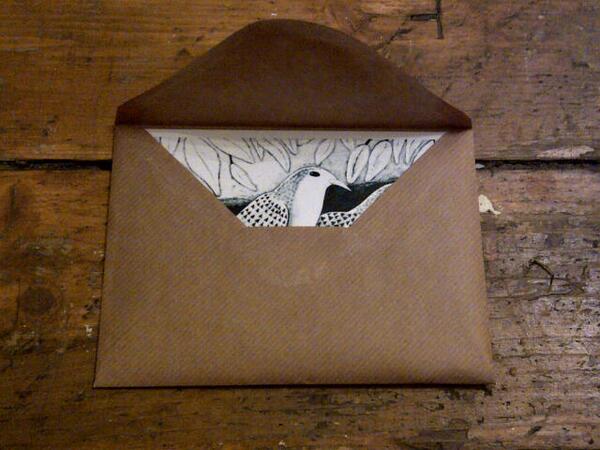
Tessa Nicholson's response to January's challenge with this a letter to her friend Sarah Butler
Tessa Nicholson’s response to January’s challenge – a letter to her friend Sarah Butler

Others said that they were already in regular correspondence, including Jill Dawson and Kathryn Heyman, the authors of last week’s wonderful guest post.

It seems that, for some of this blog’s readers at least, letter writing is not such a lost art after all. As author and journalist Erina Reddan pointed out in a comment on the site, ‘Letters pull you down and into a place that conversation does not take you’.

On Saturday, we’ll be saying goodbye to Katherine Mansfield and Virginia Woolf and letting you know about the next pair of famous writing pals.

Sarah Moore was the first to mention Maya Angelou when she left a response to our first post of the year, which mentioned the author’s friendship with Jessica Mitford.

But this was followed by separate suggestions on Twitter from the writers Wendy Vaizey and Salena Godden. They cited Angelou too, but it was another one of her friendships that they thought we should consider.

And so, after much deliberation, we’ve decided to go with that duo next: Maya Angelou and Toni Morrison. If you return here on 1 February, you’ll find lots more information about that relationship and also details of the month’s activity. And if you have any thoughts you’d like to share about this pair, do please get in touch. As always, we’d love to hear from you.

Don’t forget, if you want to make sure you don’t miss out on any Something Rhymed updates, you can sign up to follow us via email using the tab on the right of the screen.

Until Saturday then…
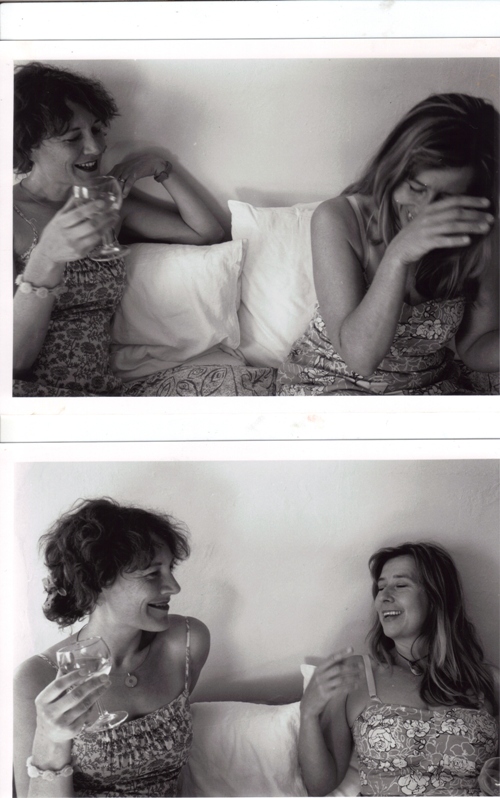
Jill Dawson and Kathryn Heyman: competition and correspondence

When Kathryn Heyman read our profile of the rivalrous friendship between Kathryn Mansfield and Virginia Woolf, she told us about the role of envy in her long-distance friendship with fellow novelist, Jill Dawson. So we decided this week to feature a guest blog from them.

Jill Dawson and Kathryn Heyman

You either want to kill your competitors or become their friends. We chose friendship. But perhaps it’s slightly disingenuous to present it that way: when we feel that competitive spirit, it’s partly because we are attracted to the very qualities which we have – or aspire to have – ourselves.

Like Woolf, who wanted to be a better writer because she believed Mansfield had set a high standard, when one of us is successful it spurs the other on. We have allowed ourselves to be truthful about the role envy plays in our friendship because envy, after all, is a way of discovering what it is that we want.

Because we are in the same field, there are inevitably times of difficulty, of one achieving something the other wants. Award shortlists, film deals, new book deals, invitations to international events: we are, in some ways, competitors, at least if we chose to believe that there is not enough to go around. Both of us would say that we would prefer to be the one winning the Booker Prize in a given year, for instance – but if the other won it the same year, that would be a pretty neat next best thing.

We live on opposite sides of the world now, which causes us some pain. But we talk to each other every week. Our conversations are about writing, gossip, lipstick, what to wear to events, children, husbands, our works-in-progress. We’ve been alongside each other for each of our novels – thirteen between us – and know the stages of writing. ‘I thought it was going so well,’ one of us will say, ‘but now it all seems so flat. I can’t hold it together, it’s going to collapse.’ ‘Yes,’ the other will say. ‘You always say that at precisely this stage, just before you discover something wonderful; remember the last book? And the one before that?’

We write to each other regularly too. Like Woolf and Mansfield, we discuss our novels-in-progress, money matters, the books we are reading, our mutual friends. At one point, the notion of the ideal reader cropped up in our correspondence, the person who we really write for, the one who is capable of understanding the depth and intelligence of our work. And we realised then that we’ve found in each other our ideal reader – the one writer in the world for whom we would value ourselves as a reader as much as a writer. We are extraordinarily blessed that the competitor we most fervently admire is also the friend who we adore.

Kathryn Heyman’s fifth novel, Floodline, was published by Allen and Unwin in 2013.

Jill Dawson’s eighth novel, The Tell-tale Heart, will be published by Sceptre in 2014.

This post is adapted from a longer article by Kathryn Heyman, originally published in Vogue in 2008.

Remember: 

We’d love to hear about the letters you’ve exchanged, or perhaps you would like to share some reflections on the role of envy in your friendship.

We’re still on the look out for famous female writer pals, so do keep them coming too.

Letter Writing in Modern Times

Emily's letter envelope
Addressed envelope all ready to go, with the origami windmill

When the letter from Emma Claire arrived last week, I brewed myself a pot of tea and sat down in an armchair to read it again.

I’d already sneaked a look at its contents on-line, when Emma Claire posted images of its eight pages here, but a postal delivery of this kind is such a rarity these days that I wanted to make more of an occasion of it, away from my computer screen.

What struck me as I sat there, the paper bending and rustling between my fingers, was how rewarding it can be to give your full attention to a letter. Time seems to slow as you focus only on your friend’s voice in your head. It’s a different sort of experience from opening an email on a busy day, when you find yourself painfully aware, even as you read, of the dozens of other messages building up in your inbox.

Prior to hearing from Emma Claire, I had already started jotting ideas in my notebook about things I wanted to discuss with her. These included:

  • Memories of our time in Japan, and how it kick-started our writing
  • Some things I admire about her prose style
  • Recurrent themes I’ve noticed in her work
  • Her influence on me as a writer
  • The Persephone Book of Short Stories, which I planned to recommend

Not all of these things made it into my reply. Influenced by the issues Emma Claire raised in her own letter, I found that I wanted to discuss some of them in more detail instead.

I ended up talking about the many ways in which I value her friendship, about memory itself, the similarities and differences in how each of our minds had preserved important recollections, and how I hoped we would correspond like this again. I also told Emma Claire about an earlier letter she once wrote to me, which I read again a few days ago, and the images of the past it immediately brought back.

I was inspired by the beauty of the stationery Emma Claire sourced, but was unable to find anything I liked as much myself. And so I took some plain sheets and decorated them with strips of coloured origami paper – something that seemed apt, considering how our time in Japan featured heavily in both of our letters

From one of the leftover scraps, I made a simple miniature windmill and added it to the envelope. If you are interested in having a go at this origami yourself, instructions can be found here.

As Emma Claire did in her last post, I’ve included pictures of the pages I wrote, which you can click and zoom in on below.

Emily's letter 1 Emily's letter 2Emily's letter 3Emily's letter 4

Emily's letter 5Emily's letter 6Emily's letter 7

Don’t forget

We’d love for you to join us in this activity by writing a letter of your own to a friend. Please use the ‘Leave a Reply’ facility below to let us know about the kinds of things you wrote in your letters.

Click here to find out about this month’s challenge in more detail.

The Lost Art of Letter Writing

Letter to Emily

Emily and I are lucky to live nearby these days – a luxury that, until recently, we hadn’t re-experienced since we first became friends back in 2001.

As we now get to see each other regularly, I tried to include in my letter some things that we might not discuss in person because of embarrassment, fear, or simply the deviations of conversation.

In a loose way, I was also influenced by the kinds of things Woolf wrote about in her letter to Mansfield: reflections on writing, reading, gender, friends.

Here are the ideas I jotted down to include in my letter to Emily:

  • Recommend The Faraway Nearby by Rebecca Solnitt
  • Are there no societal rules for friendship?
  • Is friendship between women still somehow considered subversive?
  • Unexpectedly autobiographical roots to certain aspects of our novels
  • The themes we keep circling around
  • Getting lost

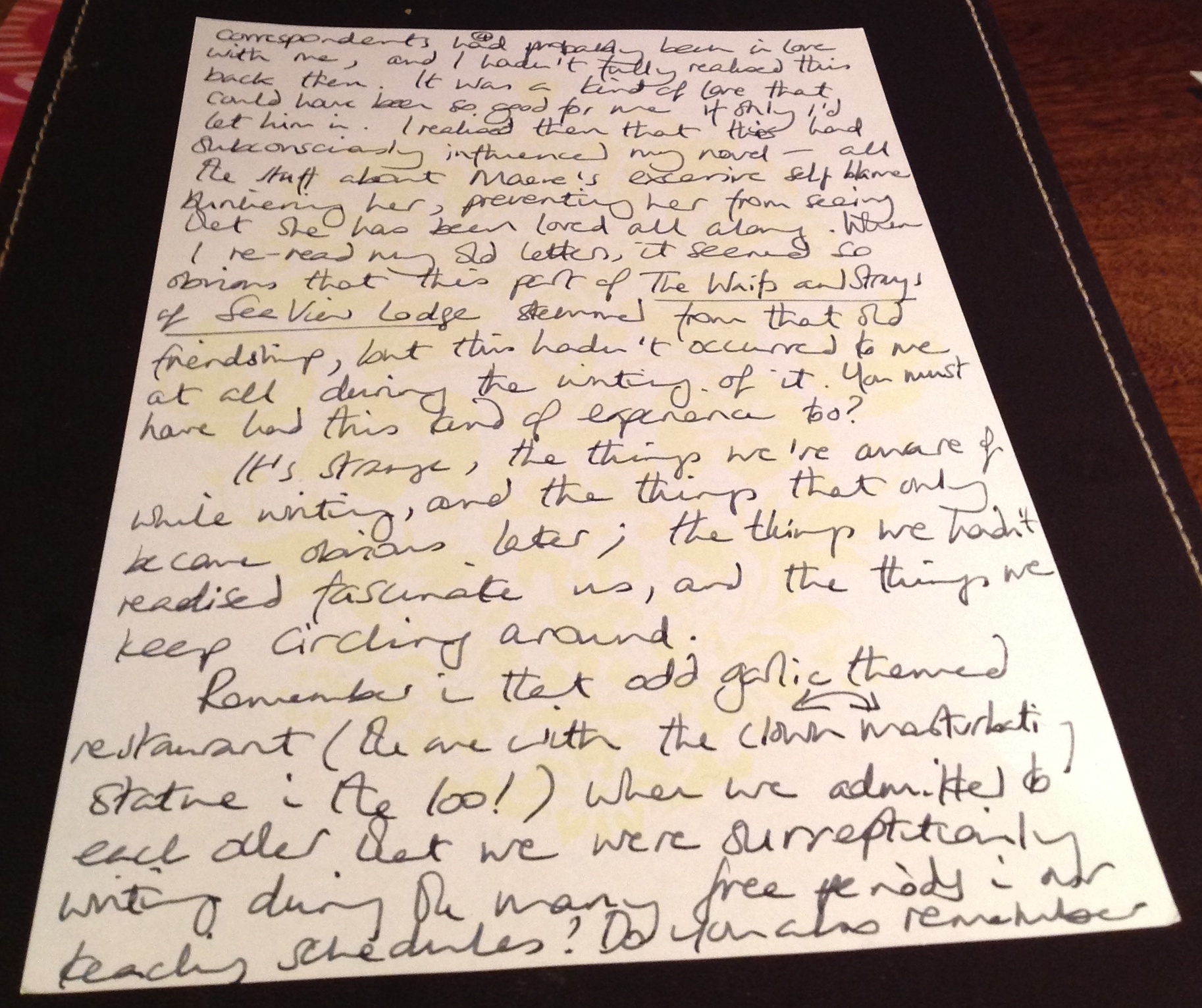
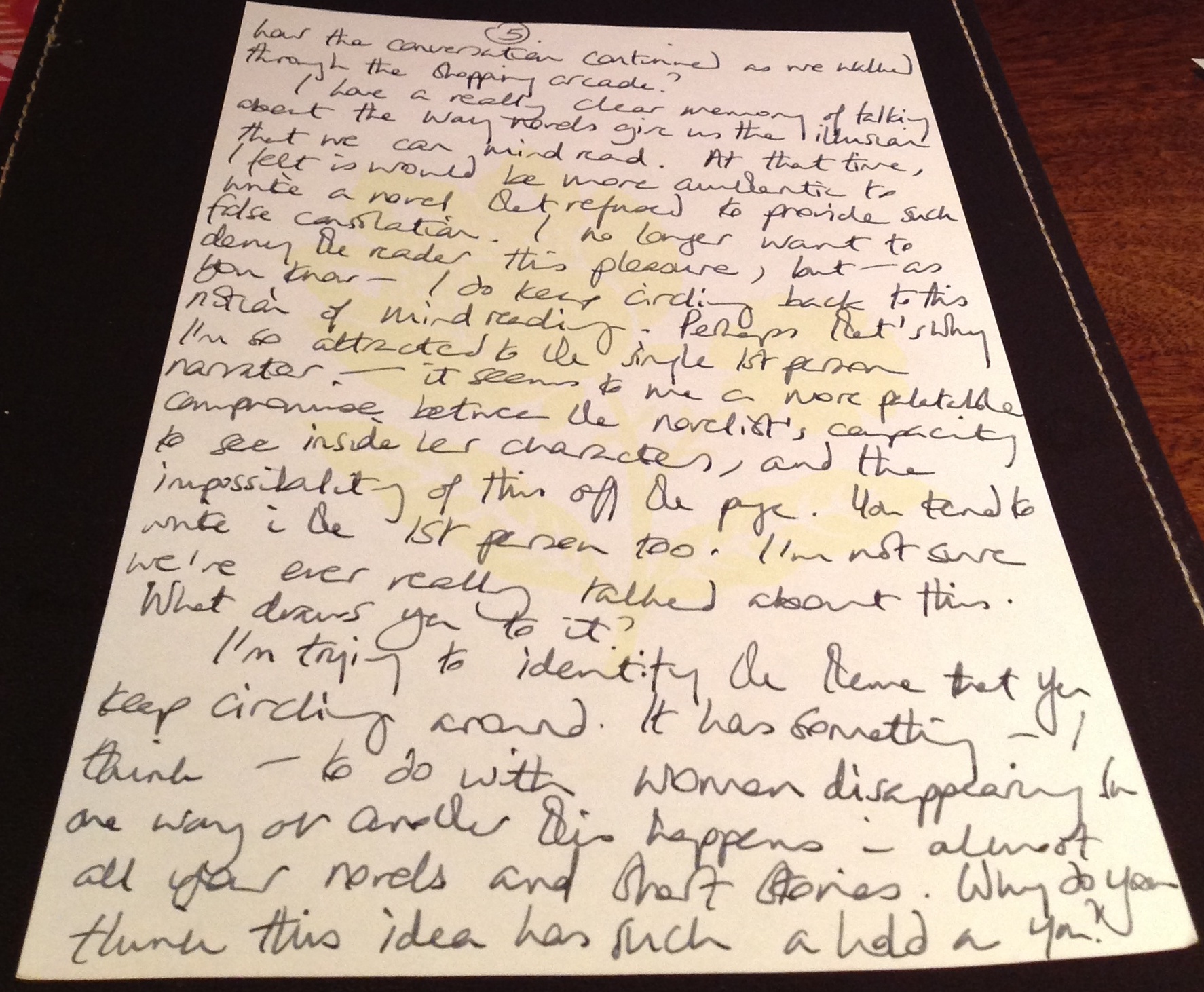
I’ve included pictures of the letter itself so you can click and zoom to see how I ended up exploring these ideas.

There was something comforting about using the fountain pen that Emily bought for me a few years back – the half-forgotten rub of the nib against paper, paper I bought in San Francisco when I visited one of our mutual friends.

The letter itself became a kind of meditation on the lost art of letter writing: the way in which the pen can explore ideas too difficult for the tongue; the eye can receive ideas too difficult for the ear.

Getting lost has itself become a lost art now that so many of us have satellite navigation systems in our cars and GPS on our phones. Through writing to Emily, I realised just how much I valued my many experiences of getting lost with her – most recently in Notting Hill on the way back from Book Slam; but also last year in Bayswater on the way to Porchester Spa; and once when we were stranded at a remote station in Cumbria with no idea of our hostel’s address.

In this letter, I reminisced about the times we first got lost together in rural Japan – joyful occasions when we began to realise just how much we shared – and, as I wrote, it occurred to me that the experience felt surprisingly like being found.

Page 1Page 2Page 3Page 4Page 5Page 6Page 7Page 8

Over to you:

Please use the ‘Leave a Reply’ facility below to let us know about the kinds of things you wrote in your letters. We can’t wait to hear.

Click here if you’d like to be reminded of this month’s challenge.